
Photo via Suitcase and Heels
***
There is an enormous gap between the desires of the American left. The difference of the left side of the spectrum is predominantly of neoliberal centrists and social democrats. Neoliberals often have progressive social rights views, but conservative economic beliefs. Social democrats have progressive social and economic beliefs. But what do the majority of leftists care about more, transportation or green spaces?
Who doesn’t like a nice garden? The project Queensway offers a design plan for a linear park, eerily similar to Manhattan’s High Line, that does not include transit use. Queensway has had longstanding backing from multiple New York politicians like former Governor Cuomo and former Mayor Adams, with the intention of beginning construction this year. Cuomo has acquired corporate backing, and Adams secured a $112 million federal fund through the One Big Beautiful Bill Act, obtaining backing from the Trump Administration.
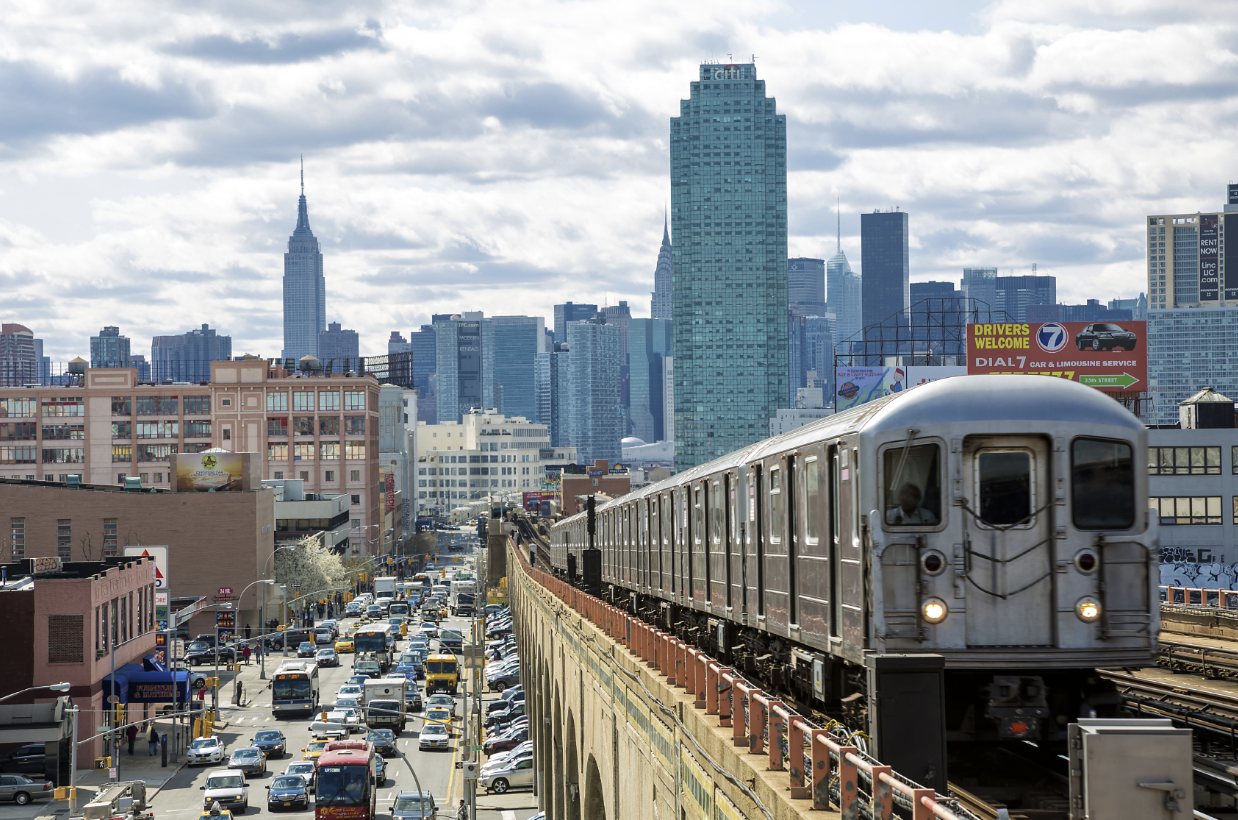
On the other hand, wouldn’t it be more efficient to have a park and accessible transit? This is what QueensLink proposes. By restoring an old rail service, existing subway lines can be extended to connect Central and South Queens together and Manhattan as well as providing neighboring park space and bike infrastructure. This restorative project would service 47,000 subway users, limit congestion on the A train, and provide interborough transit where transit does not exist. A large part of the Queenslink plan is also including the infrastructure to make safe bike lanes possible in areas where they do not exist, and include bike racks at stations. The research shows that the project will be environmentally sound by causing no impact on buildings and foundations and creating less pollution with an electric rail. The implementation of the QueensLink project “isn’t just a faster way to get around, but also a symbol of an interconnected city, which makes it worth fighting for.”
QueensLink projects a 6-8 year long timeline for construction, but they cannot begin making physical efforts until they receive more formative supporters and funding. QueensLink was able to obtain a $500,000 grant from the DOT Reconnecting Communities Initiative for research and development, but the project is ultimately waiting on the mayoral office and the MTA as construction would be their responsibility.
Unfortunately, any progress relies on the economics behind the cause. Travis Terry, the strategist of Friends of the Queensway Nonprofit was also the president of the Capalino lobbying firm closely allied to Uber. So, would the city of New York like to prioritize the finances of the wealthy elite, or take the risk to induce decades of potential economic growth? QueensLink would cut down an hour-long commute to 20 minutes, and provide connections to thousands of small businesses and Midtown’s hub for corporate business. The MTA did a study on the QueensLink proposal determining a $8.1 million price tag for the renovation, but the study disregards environmental aspects and transit equity.
The importance of transit equity addresses the argument for community need. Central and South Queens rely on bus transportation. This begs the question, how do we determine which neighborhoods deserve the privilege of accessible transit?
The lack of transit availability in the other boroughs besides Manhattan is an example of infrastructural classism. Wealthy Queens residents are discouraged from using Queenslink because it would connect low-income riders to wealthier neighborhoods, whereas Queensway would serve as a large border between the neighborhoods. The politicians and organizers of Queensway disregard local polling and continue their obsession with modeling Queens’ neighborhoods after Manhattan’s ultrawealthy ones. Following this, residents of the higher-income neighborhoods, such as Forest Park, continue to not support QueensLink. Valerie Sesso, teacher at Metropolitan Expeditionary Learning School, said, “I think about the air, what kind of fuel the train would use,” but as mentioned earlier, subway trains run on electricity. She also said, “It’s three and a half miles. That’s not that much of a distance, if you ask me.” In this 3.5-mile radius, tens of thousands would be provided with efficient transportation.
To provide evidence, polling conducted by Senator Joe Addabbo found that 75% of Central and Southern Queens communities want a rail link to address the transportation desert in the area, and prefer QueensLink over Queensway. Also, while Forest Hills is an extremely affluent neighborhood, this community is the most supportive of restoration efforts.
The residents of Queens have spoken in favor of QueensLink, yet the efforts for Queensway remain fortuitous. With the recent inauguration of Zohran Mamdani as NYC Mayor, classist neoliberalism seems to be inefficient under this new administration. By prioritizing infrastructure and community development, it would be in Mamdani’s best interest to support a restorative transit effort. It is up to Mamdani to decide whether transit development in working-class neighborhoods is valuable to him, with the decision over Queensway or QueensLink serving as a formative case.
***
This article was edited by Lena Martorana.
 Esme Carson
  Anne Eslick-Persyn
  Stan Refermat