
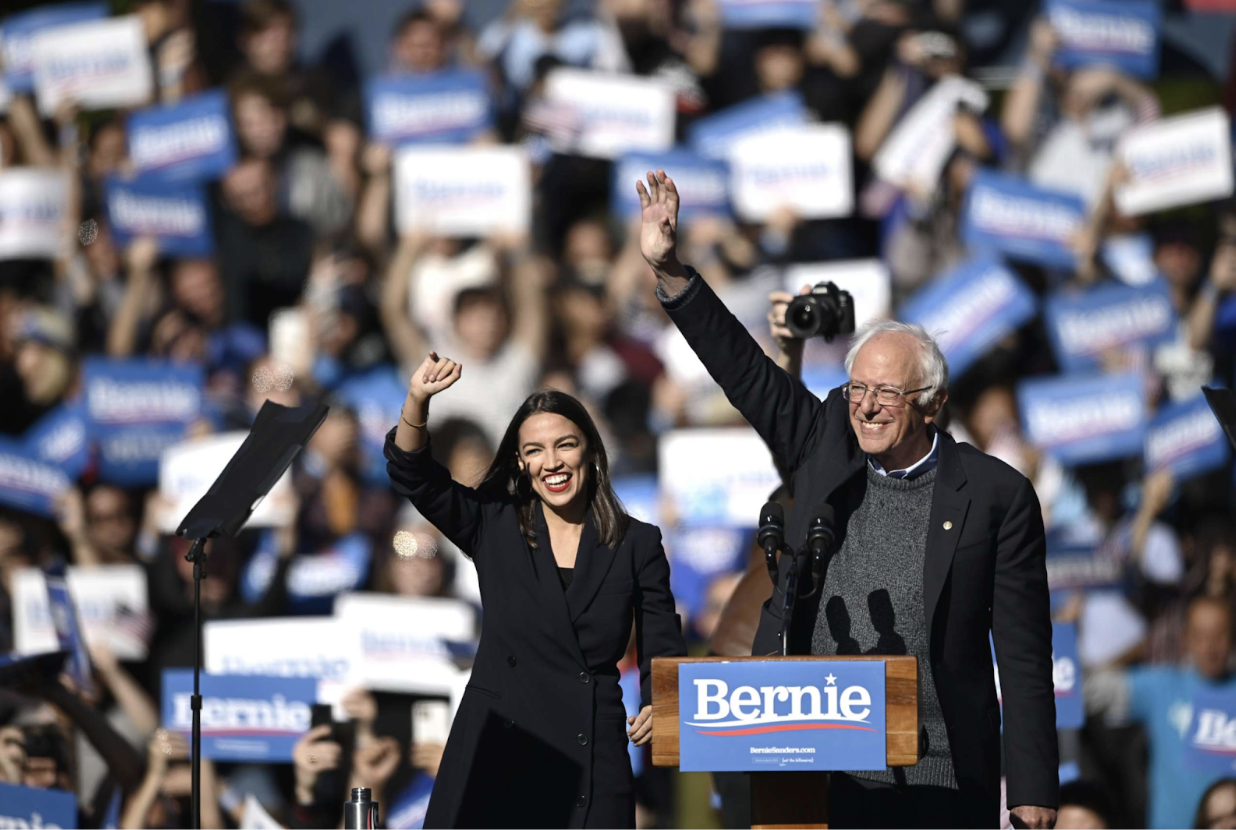
Photo via Good Morning America
***
Progressivism has been at the forefront of American politics for the entire 21st century. From President Obama’s healthcare reform, Bernie Sanders’s 2016 Presidential Campaign, to Zohran Mamdani’s recent meteoric rise to New York Mayor.
These repeated attempts to employ progressivism have yielded mixed results, yet Americans remain optimistic about the prospect of progressive policies. Recent polling indicates that approximately 60-65% of Americans support policies such as “Medicare for All,” and there has been a significant increase in support for “Abolish ICE,” a phrase with ambiguous and contested meanings. Nonetheless, support for this idea continues to grow.
As does support for progressive candidates. Self-described progressive Abdul El-Sayeed is in the midst of a fierce primary race in Michigan, locked in a 24% tie with more moderate-leaning state senator Mallory McMorrow.
The Michigan primary is one of the Democratic races that will determine whether the party moves toward a Bernie Sanders-style progressivism or a more moderate direction, à la Bill Clinton in the 2028 Presidential Election.
Maine’s primary is yet another example of the progressive vs. moderate infighting that has come to define Democrats in Trump’s second administration. Graham Platner, flanked by Bernie Sanders and Elizabeth Sanders, has gone full-court press in their attempt to oust 5-term GOP Senator Susan Collins.
While Minority Leader Chuck Schumer has tapped Maine Governor Janet Mills to run, underscoring the hesitancy among senior Democratic leadership to fully embrace progressive candidates. Yet, just as there is excitement about progressivism, there is concern. Supreme Court Justice Clarence Thomas recently gave a talk at the University of Texas at Austin, where he contended “[Progressivism] holds that our rights and our dignities come not from God, but from government,” he said. “It requires of the people a subservience and weakness incompatible with a constitution premised on the transcendent origin of our rights.”
The argument against progressivism is not new. In Thomas Sowell’s book, Intellectuals and Race, Sowell asserts that the driving force behind progressive reform movements often favors sweeping social policies without fully reckoning with their unintended consequences.
He argues that these policies frequently rest on abstract theories rather than lived experience, leading to outcomes that can exacerbate the very inequalities they aim to resolve.
Sowell is particularly critical of the belief that government intervention can reliably engineer social equity, pointing instead to historical examples where such efforts have produced dependency, bureaucratic inefficiency, and social fragmentation.
In this view, progressivism is not merely a policy agenda but a recurring pattern of overconfidence in centralized solutions, one that continues to generate both hope and controversy in American political life.
This tension helps explain why progressivism continues to endure despite its uneven track record. It is both an ideological framework and a moral appeal, one that promises fairness, opportunity, and systemic reform in a country often defined by stark inequalities.
For many voters, especially younger generations, progressivism represents not just a set of policies but a response to perceived failures of existing institutions, from healthcare to housing to climate policy.
Nevertheless, morality does not win elections.
Democrats must understand that the 2028 election is not about ideological purity, but about political viability. The party’s recent history offers a clear lesson: candidates who inspire the base but fail to expand beyond it struggle in general elections.
While figures like Bernie Sanders have demonstrated the power of grassroots enthusiasm, the broader electorate remains more ideologically mixed, particularly in key swing states that decide presidential outcomes.
This presents a strategic dilemma. Lean too far into progressive orthodoxy, and Democrats risk alienating moderates and independents who are wary of rapid structural change. Lean too far toward centrism, and they risk suppressing the very energy that has revitalized the party’s younger and more diverse base.
The challenge, then, is not choosing one faction over the other, but synthesizing both into a coherent, electable vision.
The stakes are especially high given the political context of Donald Trump’s second administration. His presidency has both galvanized progressive activism and sharpened partisan divisions, creating an environment where ideological contrast is stark, but so too is electoral risk.
If Democrats misread the moment, a favorable political climate could quickly become a strategic misstep. A “blue wave” in 2026 is not a guarantee of durable power; it is a test of discipline. Nominating candidates who prioritize ideological purity over broad appeal risks handing competitive races back to Republicans, even in an environment tilted against them. The lesson of recent elections is not that progressive energy is unimportant, but that it is insufficient on its own.
Electoral success in the United States still depends on coalition-building across ideological lines, particularly in swing states where elections are won or lost. To double down on a purely progressive slate would be to confuse momentum with mandate.
If Democrats fail to calibrate their approach, they may find that enthusiasm cannot compensate for alienation. The result would not be a progressive breakthrough, but a preventable defeat at a moment when victory should have been within reach.
***
This article was edited by Abigail D’Angelo.
 Luke Helmholz
  Gavin O'Sullivan
  Madelyn Marcisz