
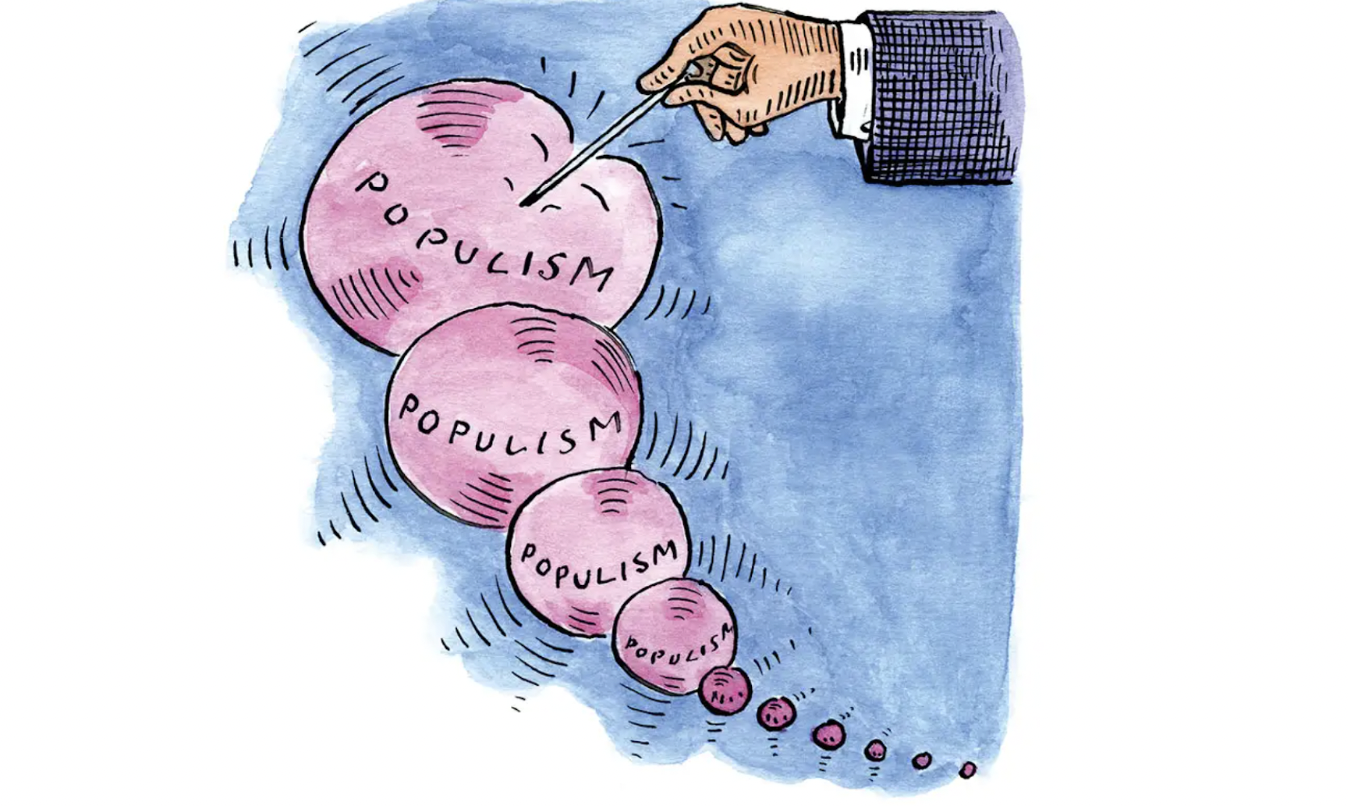
Photo via New Scientist
***
Zohran Mamdani, a self-proclaimed democratic socialist, rode a grassroots, small-donor insurgency and secured New York City’s top job as mayor—a win celebrated among left-wing Americans. The populist mayor will now face challenges that have humbled many before him: fighting the fiscal and political realities of one of the world’s most globally integrated cities, while managing his constituents’ expectations.
Labeling Mamdani “populist” is not merely a pejorative shorthand. Political theory defines populism as an ideology that divides society into “the people” versus a corrupt elite; academics warn that populist movements—whether right or left— share an anti-pluralist tendency to claim sole representation of either. Yet, it is important to acknowledge that left-wing (inclusionary) populism operates very differently from the right-wing (exclusionary) counterpart. The former is usually more willing to work within democratic institutions.
This framework explains Mamdani’s inclusionary approach: he translated widespread economic grievances into emotionally resonant demands (rent freezes, higher taxes on the wealthy, public groceries, free transportation). Mamdani cast his campaign as a fight between working-class people and billionaires.
Yet history offers cautionary lessons, especially when populist momentum meets incredibly complex economics and institutional constraints. Consider contemporary Europe. Greece’s radical left-wing populist coalition SYRIZA championed a national victory in the government with anti-austerity rhetoric. Once in government, however, it confronted major budget constraints, international creditors, and the need for technocratic adjustments. Scholarship on SYRIZA stresses the limitations of how inclusionary rhetoric often falters against institutional realities. Not for a lack of passion, but because democracy, in and of itself, resists revolution and favors negotiation—and brokering with the very market-democracy populists critique is where idealism goes to either die or mature.
The left, then, must jettison the worst temptations of populist maximalism—the impulse to treat higher institutions as mere obstacles to the popular will. This impulse surfaced when Greece’s SYRIZA realized that winning mass support doesn’t guarantee the elimination of existing political structures. Ultimately, this shows that even fervent populist movements must concede to institutional limits and pluralism, or risk undermining the very people they aim to empower. So for anyone tempted to sensationalize Mamdani’s sweeping municipal democratic socialization, this arc is instructive.
Mamdani’s insurgent rhetoric may have won votes, but now governing requires meticulous, pragmatic action. His campaign policies—entailing massive economic and ideological changes to NYC—constitute the reworkings of entrenched economic behaviors, an undertaking so formidable as to border on the impractical (but not at all impossible). Mamdani’s efforts to transform NYC’s entrenched systems follow a historical pattern: like FDR with the New Deal or Gandhi with the Salt March, organized popular movements have proved successful in changing the status quo over time.
Nonetheless, people must treat populist energy as a democratic alarm bell that points to real failures: treat populist simplification as a rhetorical tool, rather than a governing manual. If Mamdani’s mayoralty succeeds, it will be because progressive aims were matched by technocratic discipline, cross-party bargains, and a public willingness from his constituents to accept a new reality. Albeit, this reality is already distrusted by working-class NYC residents. And if it fails, the lesson won’t be that the city rejected economic justice—it will be that populist hope without institutional prudence is inhibited by real politics.
Celebrate the mobilization, but study the history and reality. Mamdani’s goals are defensible and widely popular yet incredibly complex in nature for all the aforementioned reasons. Observers across the ideological spectrum have noted both the mandate his victory confers and the arduous obstacles ahead. And for all the enthusiasm his campaign generated, the average constituent may not understand just how difficult and politically fraught it will be for Mamdani to meet promises with concrete solutions.
***
This article was edited by Annika Trippel and Dysen Morrell.
 Caroline Smith
  Saad Sandhu
  Campbell Brown