
Photo via CBC
***
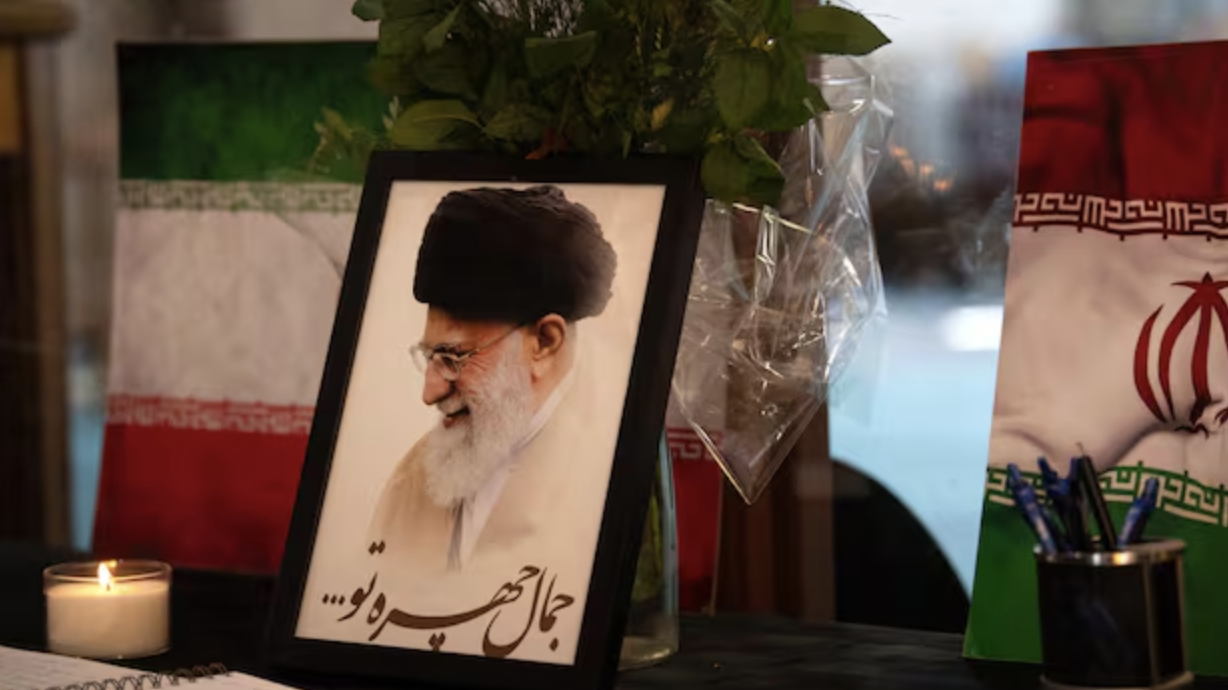
On February 28, 2026, Supreme Leader Ayatollah Ali Khamenei was slain in a joint American/Israeli airstrike on his residential compound in Tehran. He was 86. On March 8, 2026, the Iranian Assembly of Experts selected Hajjat al-Islam Mojtaba Khamenei, the second son of the slain leader, as the new Supreme Leader.
The speed of his succession is notable. The strike that killed Ali Khamenei marked the culminating act of Operation Epic Fury, a campaign justified by Washington as a targeted response to “imminent threats” from the Iranian regime, but also understood by analysts to be an attempt to spur regime change within the Islamic Republic through the removal of senior leadership. Recent developments have suggested this has not been successful. Instead of fragmenting Iranian political factions, Ali’s death has consolidated power among the most hardline, entrenched institutions while delegitimizing reform parties. Mojtaba’s selection is the clearest indication of this outcome.
Succession Favors Securitization
Despite nominally operating as a theocracy, the political ascendency of the Islamic Revolutionary Guard Corps (IRGC) has transformed the Islamic Republic into a bureaucratic security state. In such a system, succession is not primarily determined by clerical prestige or formality—as evidenced by Mojtaba’s categorical unqualification for the position of Supreme Leader due to his lack of official Ayatollah status—but rather by the capacity to manage competing elite powerbases sufficient to preserve order, maintain continuity, and ensure regime survival during crisis. The position of Supreme Leader remains the pinnacle of the Iranian power structure, but its authority is inseparable from the coercive institutions that sustain it. Consequently, Ali Khamenei’s death did not guarantee liberal fragmentation. The political landscape was already angled towards the security establishment, whose wartime powers permitted it to exercise power of arbitration during transitional periods.
This institutional configuration grounds an understanding of Mojtaba’s emergence as the preferred successor despite his clerical deficiencies. For years, Mojtaba has garnered influence not necessarily as a public figure, but rather as a middleman between the office of the Supreme Leader, the IRGC, and the broader political establishment. In a time marked by rapidly evolving circumstances, Mojtaba’s selection offers the regime institutional continuity amid crisis. His selection, therefore, is not merely a matter of nepotism but of the logical conclusion of succession philosophy that prioritizes security over theocratic legitimacy.
Martyrdom Narrows Space for Dissent
If the expected result of Ali Khamenei’s assassination was a reinvigoration of internal dissent, then the early results have been limited. Although there were many initial public celebrations of the second Supreme Leader’s passing, there have not yet emerged notable signs of widespread anti-government activity among the populace. Rather, hardliners have staged demonstrations of allegiance to Mojtaba, while formerly dissident power blocs have aligned with state interests. Ali’s martyrdom has not merely paved the way for a clear successor; it has given the regime a unified narrative through which broad government intervention can be justified. Furthermore, Mojtaba’s rapid ascent has delegitimized remaining dissidents. Once the internal power conflict was linked to the Supreme Leader’s death, dissent risked appearing as disloyalty to the nation at large. Those who could speak in terms of survival and revenge, namely the IRGC, could assert political authority. Elevating Mojtaba not only transferred authority to a deeply hardline actor but also narrowed the legitimate political field.
Expect a Prolonged Conflict
Not only has the Islamic Republic survived decapitation, but it has also recovered in a form less conducive to de-escalation than the United States and Israel likely anticipated. Mojtaba’s selection indicates that hardliners are both firmly internally empowered and prepared to engage in prolonged conflict, regardless of the rhetoric espoused by President Trump, promising a quick conclusion to the war. Leadership grounded in martyrdom, securitization, and power consolidation is unlikely to prioritize compromise, as legitimacy is established through perseverance and ideological consistency. The killing of Ayatollah Ali Khamenei seems to have backfired. Rather than disorganizing the Islamic Republic into sectarian conflict, it has narrowed the political order around the faction most willing to prolong the war beyond the horizon imagined by its architects.
***
This article was edited by Sidney Levitt and Mila Cabanlit.
 Abby Coxe
  Campbell Brown
  Holmes Wormald