
Photo via Eddie Knox/Oxford Films
***
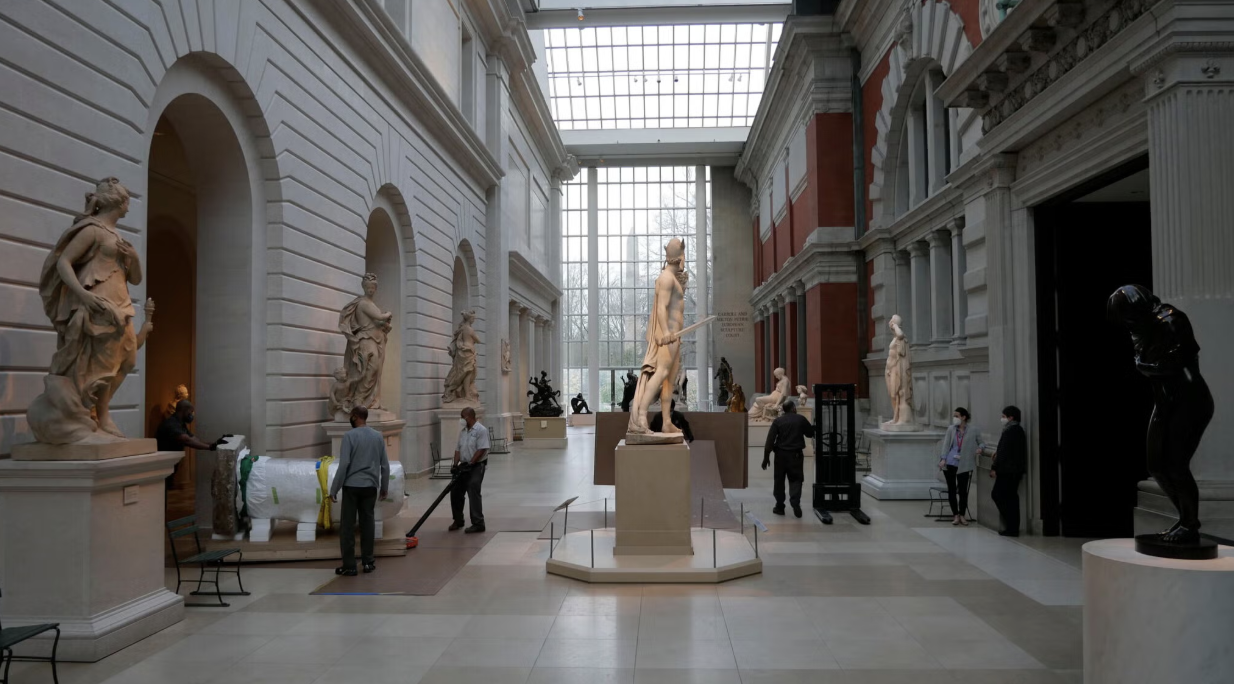
At The Metropolitan Museum of Art, an impressive collection comes at a cost. In an ongoing collaboration with the Manhattan District Attorney’s office, the Met has released over 120 artifacts to the Antiquities Trafficking Unit, valued at about $95 million.
Since 2017, the Manhattan DA, led by Alvin L. Briggs, has pioneered an initiative to track international trafficking rings as part of a broader effort to bring art pieces back to their rightful owners. This process, commonly known as restitution, is integral to modern art institutions’ responsibility to correct their reputation for unethical art acquisition methods.
Throughout history, several museums, widely revered as pillars of cultural taste and status, engaged in immoral practices to achieve the “best” art collection. While most museums are guilty of this, the Met has an especially grim track record. In general, in cases of ethical art collection, pieces are acquired with awareness of their impact on the environment and human rights, and with respect for the cultural heritage they represent. Collectors achieve this primarily by prioritizing provenance, or tracing the ancestry of an art piece, to verify it was fairly acquired.
With the Met, its very conception was rooted in bypassing ethical art acquisition to one-up its competitors. Established in 1870, the Met was founded with the intention of building an American art institution that could rival that of Europe, specifically the Louvre.
Throughout the 20th century, the museum operated under a “shark” mentality to achieve cultural status, with directors like Thomas Hoving taking pride in piracy tactics to acquire art. The executive even boasted of his practices in his 1994 memoir, admitting that his connections to “smugglers and fixers” were “longer than anyone else’s in the field.”
Before Hoving’s tenure, the Met also acquired a majority of its pieces from Robert E. Hecht, an antiquities dealer who was once put on trial for alleged smuggling and the illegal exportation of art. Despite Hecht’s estrangement from the art world, the Met still has several of his pieces on display, alongside those of dozens of other unethical art dealers. Beyond the legal issues, the cultural damage inflicted on the communities these pieces originate from is paramount.
The unethical acquisition of art entails a loss of history and identity across nations, ethnicities, and diasporas, leaving entire social groups devoid of their own narratives. Fine art belongs to the broader category of cultural property, where visual storytelling carries a unique meaning and chronology of a community’s past. To deny a group of their own heritage is to deny their humanity, reducing the cultural significance of their lineage to a series of trafficking practices.
The power dynamics at play are also inseparable from this issue, as the communities most commonly targeted in antiquities trafficking are historically disenfranchised. Between 90-95% of Sub-Saharan Africa’s cultural artifacts are located outside the continent, with many taken during colonialism, trafficked, and distributed during post-colonialism. Today, these artifacts are housed in Western museums, detached from their original nations.
Defining the legal obligation nations have to return these artifacts is difficult, as international legislation, specifically the 1970 UNESCO Convention, only applies to artwork trafficked after 1970. This distinguishes modern trafficking from colonial looting, which, despite arguably involving a larger volume of pieces circulating in illegal markets, is addressed on a case-by-case basis by individual governing bodies.
Still, institutions continue to carry out the necessary seizures to begin addressing history’s wrongs. Recently, the Met announced the return of several Hellenic artifacts to Greece, including a gold pendant, a Middle Helladic terracotta jug, and a Roman marble head. A press release from the Manhattan DA’s office also revealed that this is the eighth restitution to Greece, totaling about $51.5 million in stolen artwork. While restoring a nation’s stolen heritage takes time, the beginning strides made towards restitution, on behalf of both institutions and governing bodies, are just the first step in the long but necessary journey towards cultural justice.
***
This article was edited by Sofia Alvarez and Kaitlyn Horn.
 Christian Dziura
  Javeer Khan
  Amelia Felice