
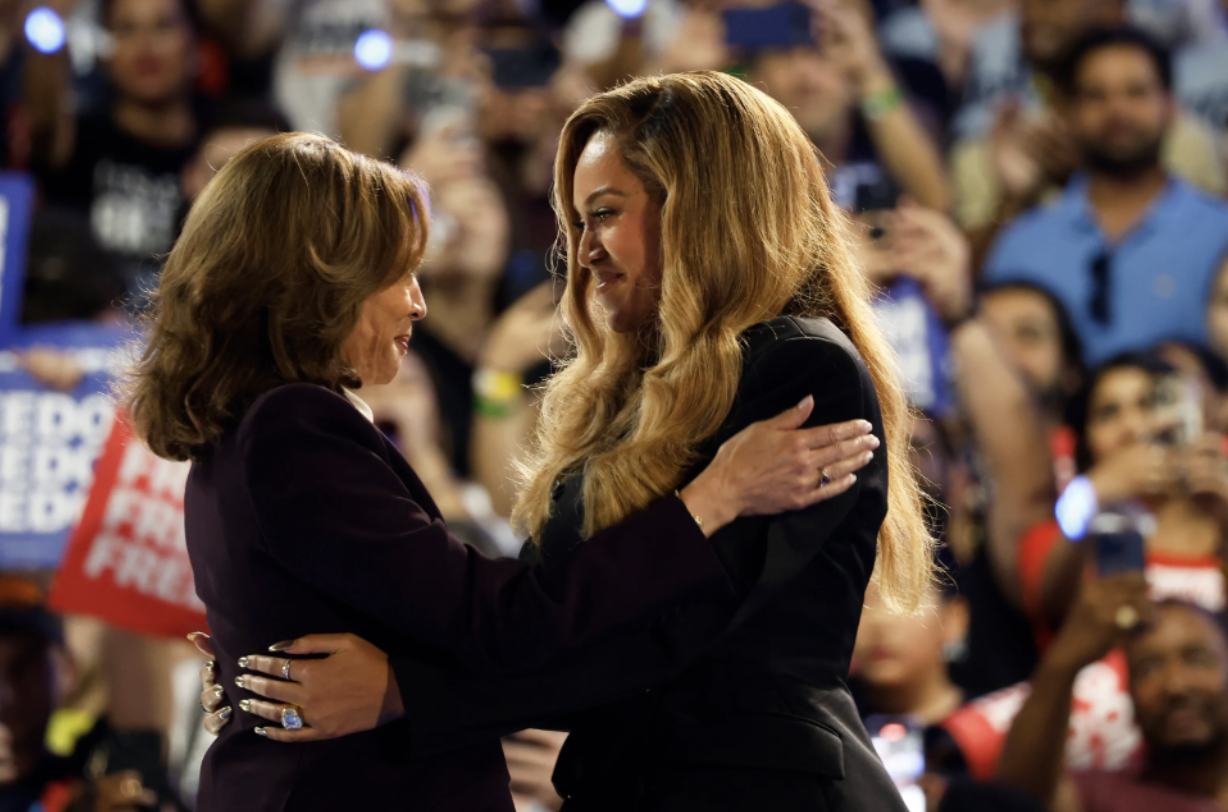
Image via KTLA5
***
Any American adult with access to social media has likely opened their phone to a major political development being communicated through a tweet or a TikTok at some point. The app they would have opened would contain a stream of information directly tailored to their worldview and, more importantly, their biases. The way Americans consume news is shifting from strictly reviewed, factual publications to influencers’ contrived takes on social media. Politicians are becoming celebrities. Current events are increasingly digested and interpreted through celebrity drama itself. In September of 2026, the fallout and controversy between singers Macklemore and Ed Sheeran over their tour is shaping public discourse surrounding the Israeli government’s ongoing siege of Palestine. Social media users are currently rallying behind Macklemore, who was removed from Sheeran’s tour after outspoken comments supporting Palestine. Many are demanding that Sheeran be more explicitly political, and he is currently facing backlash for being too neutral. The question of the extent and role celebrities ought to have in politics is only growing more poignant with time. Those in the entertainment industry are becoming political actors; the statements people like Macklemore release have a real, tangible effect on the public. Crossing entertainment with politics is creating a concerning pattern of preoccupation and distraction. The traditional political power struggle has been transfigured into a war for momentary attention. When politics becomes driven by spectacle rather than duty and values, political information and entertainment are blended in a dangerous way.
One change wrought by social media is that presidents and others in prominent government positions are taking on a celebrity role. Beginning with Obama’s social media presence on Twitter (now “X”), the way the president engages with the public has rapidly changed. A politician’s strategic decisions on how and when to appear in order to shape public opinion have been intensified by the rise of social media. This technique of utilizing the public’s perception of what transpires inside the government has always been an important aspect of domestic politics. The current President of the United States, Donald Trump, is well known for his heavy use of the social media platform X, which gives the public almost constant access to him. By exploiting this to his advantage, Trump has assumed the role of a celebrity or influencer by building parasocial relationships with his audience when relaying events occurring within the White House. Beyond strictly presidential information, however, the president has also used the account to express personal grievances, which creates a sense of intimacy with his followers while also intimidating the subjects of his displeasure.
In the present day, the president has innumerable outlets and influence to regularly harness public opinion to their own political ends. Because communicating with the public via social media accounts is far less constrained than official speeches or press conferences, modern presidents have tapped into a novel source of influence through apps like Twitter (X), Instagram, and Facebook. Social media is an entirely new form of political currency, and currently, Trump has been extremely effective in his use of it.
Conversely, social media is also pushing political identities onto celebrities, giving them a disproportionate effect on public opinion. This is best demonstrated through celebrity endorsements of politicians. While these endorsements have transformative power, such as Beyonce’s endorsement of Kamala Harris (pictured above), they call into question the critical engagement of contemporary voters. The Fair Elections Center describes this phenomenon as an “eco chamber effect.” The impact of these endorsements demonstrates that the public has increasingly become comfortable with offloading the responsibility of understanding their political orientation onto their favorite celebrities. Doing so shows a concerning lack of individual initiative. TikTok is used by 63% of American adults under 30, and 37% of the entire adult population, according to the Pew Research Center. In addition to this, half of the adult population in America use Instagram regularly.
There has also been a parallel generational shift away from news sites. The percentage of adults who say they closely follow the news dropped from 51 to 36 percent between 2016 and 2025. This drop in readership coincides with the increased use of social media, and the way the general populace receives their news has shifted drastically toward algorithmic consumption, whereas it used to come from independent sources. These trends are all conducive to the increased influence of popular figures. Social media followings confer perceived authority on celebrities, even when they lack expertise and understanding of political issues. Regardless of the overall positive or negative effects of celebrity politicization, social media is here to stay as a primary conduit for communication between prominent political figures, their celebrity allies, and the populations they wish to mobilize.
Social media will be a long-lasting form of intermediacy between the government and people for one primary reason: it is profitable. Its functions have been taking over those of other media; it is now used as a primary advertiser, socializer, and informer. It takes a lot of individual effort to look beyond social media sites for additional information when everything the consumer is looking for is available in one place. This poses a threat to the exchange of information, and especially political information. Unlike traditional journalistic or newspaper publication standards, fact-checking is not required in a social media post. It is an incredibly effective tool for mass mobilization and a quick spreader of political information that contributes to an informed public opinion; however, what social media gains in ease of distribution, it loses in integrity and enduring structure.
***
This article was edited by Julianna Wottawa and Ferdinand Rivera Ortega.
 Christian Dziura
  Javeer Khan
  Amelia Felice