
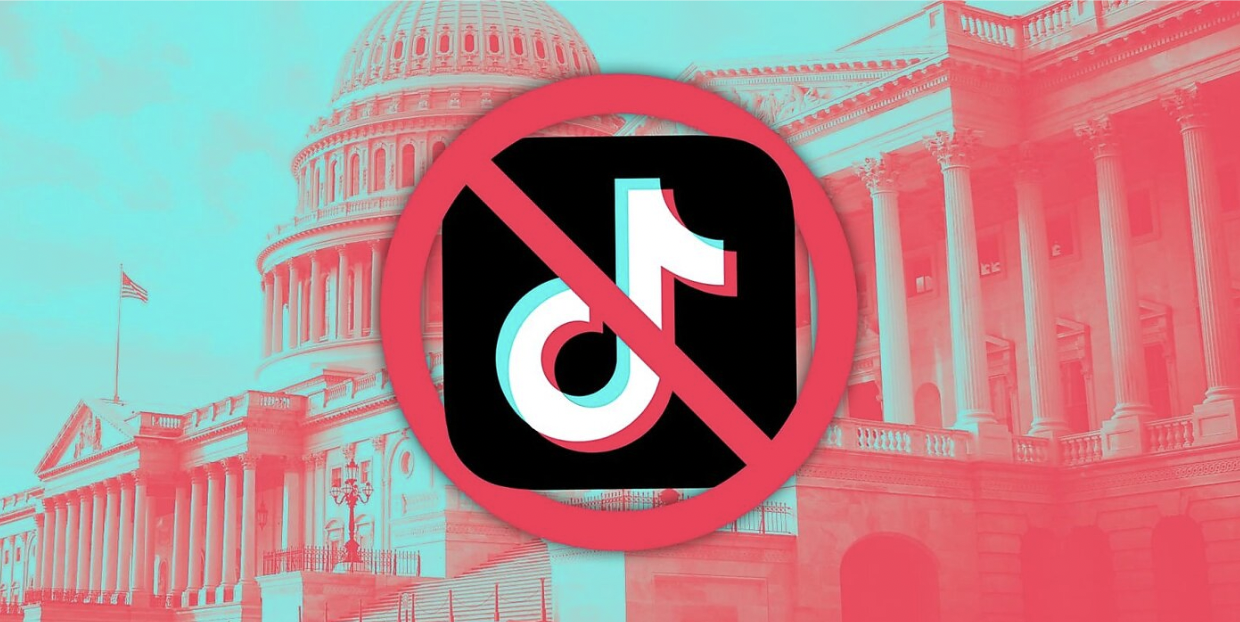
Image via Cato Institute
***
TikTok, or what original users might refer to as Musical.ly 2.0, has taken the globe by storm, amassing over 1.59 billion global users at the start of 2025 and currently maintaining 1.84 billion monthly active users. The app, known for its short-form content, viral trends (like dances and challenges), and a strongly curated personalized feed, is especially popular amongst teens and young adults; it’s a place where one can get their news, showcase their talents, and find their niche, whether that be fitness, BookTok, educational mini-lessons, or “brain-rot” content. With the potential to blow up as an influencer (and, for some, a pipeline to celebrity status), TikTok has become a platform where content creation has supplied some users with full-time jobs, while others use it as a side hustle to make extra cash through features like going live or securing brand deals.
Despite TikTok’s growing popularity (as it is projected to reach approximately 1.9 billion global users by 2029) and its widespread use among teens, there has been ongoing federal action aimed at banning the app in the United States. Toward the end of his first term, President Donald Trump issued an executive order under the International Emergency Economic Powers Act (IEEPA)—a federal law that authorizes the president to regulate certain economic transactions in the event of national emergencies. Issued on August 6, 2020, Executive Order 13942 was set to take effect 45 days later and targeted “the spread in the United States of mobile applications developed and owned by companies in [China]” due to national security, foreign policy, and economic threats. The order specifically focused on TikTok, arguing that the app collects extensive user data, including “location data and browsing and search histories,” to which the Chinese government could potentially gain access. According to the administration, this data could be used to compile personal files for blackmail or engage in corporate espionage.
Upon his transition into office, President Biden revoked Executive Order 13942 and replaced it with a broader executive order in 2021. This new order mandated that the government review national security threats posed by foreign-owned technology and software applications. This shift signaled ongoing concerns about the risks TikTok and similar platforms pose to U.S. national security. After a series of federal initiatives, temporary bans, and legislative efforts, Biden signed a bipartisan bill—H.R.7521 – Protecting Americans from Foreign Adversary Controlled Applications Act (PAFACAA)—in April 2024. The law required TikTok’s Chinese parent company, ByteDance, to divest its U.S. operations by January 19, 2025, or face a nationwide ban. In the face of constitutional and legal challenges, the Supreme Court of the United States ultimately upheld the statute.
Left in limbo, it was up to the incoming administration to determine whether to implement Biden’s bipartisan divestiture law. The TikTok ban briefly went into effect on January 18, 2025, the night before President Trump’s inauguration. However, once sworn in, the Trump Administration restored the app’s service nationwide. The administration was able to do so because Section 2(a)(2)(B) of H.R.7521 permits the President to delay enforcement of the ban on foreign adversary-controlled apps “beginning on the date that is 180 days after the date of the relevant determination of the President” if active steps are being taken to divest TikTok from ByteDance. In other words, TikTok would be able to continue operating if the President certified to Congress that binding divestiture agreements were in effect, thereby postponing the ban’s enforcement date.
Since then, the Trump Administration has extended the divestment deadline numerous times, prolonging the app’s lifeline for a fourth time as of September 2025. The latest Framework Agreement between the United States and China provides that “TikTok’s United States application will be operated by a newly established joint venture based in the United States, [which] will be majority-owned and controlled by United States persons.” Under the agreement, “ByteDance Ltd. and its affiliates” will retain “less than 20 percent” ownership, ensuring that the entity “will no longer be controlled by any foreign adversary.” The joint venture will have its own board of directors and will be “subject to rules that appropriately protect Americans’ data and our national security,” including oversight by U.S. security officials who will monitor the platform’s algorithms and software independent of ByteDance.
In short, TikTok won’t be banned (for now). The app is expected to operate under majority U.S. ownership and oversight, allowing Americans to continue accessing the app. Nevertheless, serious and unresolved questions remain as to whether the Trump Administration’s agreement fully complies with PAFACAA and whether the data of U.S. users is adequately protected.
TikTok has emerged as a critical platform for American political, social, cultural, and economic engagement, and critics warn that banning the app would produce detrimental consequences. Aside from suffering the loss of TikTok’s user self-expression, a digital global intersection of culture, and a network for political activism and socialization, removal of the platform could generate substantial economic harm. U.S. economic experts predict that domestic businesses that rely on TikTok for advertising and demographic exposure may suffer financial losses, and heightened tensions between the United States and China could adversely affect foreign investment and broader trade relations.
It’s clear TikTok is loved by many Americans and plays such a critical role in the U.S. economy, yet the government continues to threaten banning the app. While this has been framed as a national security issue, is that what’s really at risk? Instead, it seems the U.S. government is using this rhetoric not just for its own protectionist motives, but, more alarmingly, as a way to gain restrictive control over Americans’ digital space through limiting their expression and reducing foreign influence.
Protectionism is an economic policy where a government restricts international trade in order to defend domestic industries from foreign competition. In the scope of this article, one would consider data protectionism, referring to “the American and Chinese practices [that] use the global inflow of online data as a tool for global economic leverage.” In other words, data protectionism restricts the free flow of a nation’s digital data within its own borders,in this case the United States, and in turn, this forces companies to store data locally instead of globally,in this case China). However, if the United States government was just concerned with protectionist motives, then through the new American-led ownership and oversight, there should no longer be a discussion as to whether or not to ban the app, yet there still is. Thus, one can be led to believe that the United States is NOT just looking to economically advance domestic industries, but to also gain control of political narratives in the United States.
There is reason to question the Trump Administration’s motives, first because the documents outlining the deal that kept TikTok in effect have not been fully disclosed to the public. The law that mandated TikTok’s divestiture did “not require the release of any information about his determination or the transaction itself.” In other words, the president does not have to publicly prove that the TikTok sale qualifies as a proper divestiture, which means that both Congress and the American public are not able to verify whether or not the deal actually complies “with the very law that required the divestment.” In essence, we would have to assume that the president is faithfully enforcing the law, and based on Trump’s track record, people have valid reason to be doubtful.
Although Congress does have the power to exercise checks-and-balances on the president, the legislature has not insisted on full transparency regarding the deal, which raises concerns about whether the agreements of the deal are legal and actually protective of Americans’ civil liberties, specifically their digital freedom.
In particular, substantial concerns remain regarding how the agreement will address “the heart” of TikTok: its algorithm. Reports say the new U.S. owners will “retrain” the algorithm using “American user data” and that U.S. security officials will closely monitor it. But here’s the issue: PAFACAA demands “a qualified divestiture to have no cooperation with respect to the operation of a content recommendation algorithm,” which means upon the sale of TikTok, there should be NO cooperation with ByteDance when it comes running the recommendation algorithm. So if the algorithm is then truly separated, why would it need ongoing monitoring by U.S. security officials? And what exactly does “monitoring” mean?
This raises concerns about government influence over digital speech because algorithm oversight equals potential influence over what gets amplified or de-prioritized on users’ feeds. In a politically polarizing climate online platforms matter more than ever. Especially when some users are claiming TikTok to be “censoring and limiting their content, including posts and messages about Jeffrey Epstein and the shooting deaths of U.S. citizens by federal agents in Minneapolis.” Is Tiktok really a threat to national security, or a threat to the nation its truths are exposing?
***
This article was edited by Peter Leyba and Madison Boyd.
 Glenmarie Rios Rodriguez
  Sarah Olivia Sullivan
  Luke Helmholz