
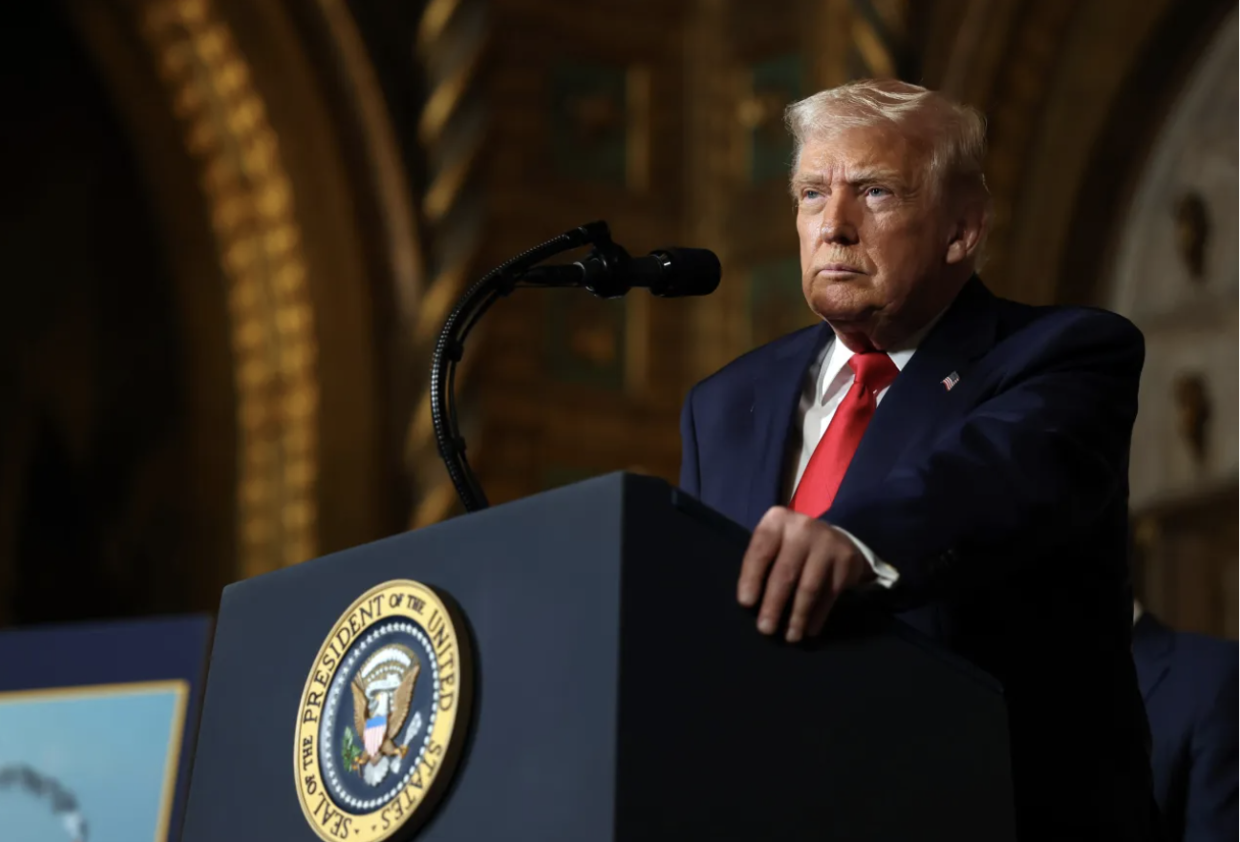
Photo via Fortune.com
***
Language and the art of rhetoric are commonly used and powerful political tools. This being the case, it is alarming to see the conventions of traditional political debate be degraded by the insults and personal attacks we have become accustomed to seeing on our screens every day.
It is no secret that our president has egregiously misused the English language to issue thinly veiled threats to the personhood of many people in this country. One example of this is his use of the word “illegal alien” to refer to undocumented immigrants. This word was first codified into the legislative fabric of our country in 1924, with the creation of the border patrol. While the origins of the word were originally viewed as neutral, “by the ‘90s, “alien” was no longer seen as a neutral term, and it had become code for bigotry.”
Trump’s heavy use of the word has weaponized our country’s history of xenophobia while running on a staunchly anti-immigration campaign and does not shy away from using the moniker and other racial slurs to appeal to nativism, defined by Britannica as prioritizing “native” people over immigrants, a political ideology rooted in xenophobia and racism. Although the use of “illegal alien” may seem largely unobtrusive, aggressive and dehumanizing language creates pervasive harm to immigrant communities. The president’s use of this term among others has a rippling effect on the people that work in his administration, to the news cycle, and into our daily vocabularies. With each verbal assault, we are subconsciously adjusting what we as a society will tolerate.
Hatred begins at the top. When powerful people use inflammatory language to debase “…political opponents, ethnic, racial, and religious groups,—the consequences transcend by far the hate speech of the bully next door and on social media platforms.” When political leaders recklessly use hate speech to prove political points, they normalize and circulate the use of toxic rhetoric that brings physical and mental stress to at-risk communities.
President Trump has even gone so far as to repeatedly refer to undocumented immigrants as “animals” a crude characterization that appeals to the pre-existing divides over immigration existent in America. His persuasion lies in the idea of “us versus them”. By villainizing the other, he drives division into the heart of his campaign. This use of language can be classified as an “enthymeme,” which Poster defines as a function of speech that analyzes its own discursive practices. Trump creates a story, whether grounded in truth or not, that his base identifies with. It is rooted in extremes. All Democrats are unpatriotic, all immigrants are criminals. These statements rely on the regular use of dehumanizing terms. By degrading a group’s human qualities over time, he strengthens his own base and their convictions to believe this narrative.
There is a deeply unsettling truth that underlies the success of Donald Trump’s aggressive vocabulary. In order for enthymemes to be effective, large numbers of people must invest and believe in them.
Political violence has been on the rise since the 2010s, as has violent speech. These national trends also coincide with Donald Trump’s first term. According to a study done at UCLA, violent vocabulary often motivates individuals with aggressive vocabularies to commit acts of physical violence.
A component of this is the constant combatant use of dehumanizing words, which psychologically enables the brain to be less inhibited towards acts of violent nature. Trump’s vocabulary has also been echoed in recent months by members of his administration. For example, Scott Wagner heinously attacked immigrants and refugees by equating their presence in the U.S. with “hundreds of rabid, messy, mean raccoons.”
The social ramifications of this rise in hate speech, is inevitably its normalization. If violent speech appears on our television screens, it will permeate into our daily interactions, and in an increasing number of cases, our classrooms. A school teacher sees Swastikas graffitied into school property for the first time ever in her 15-year long teaching career. The bullying and belittling that occurs on a national scale inflicts itself into our larger culture in the clearest ways through our most impressionable demographic, children.
Language has an essential functional purpose in modern society. However, beyond this it has the power to influence, contort, and even disfigure reality. Dehumanization rhetoric takes hold of our politics and our children alike. It is a breeding ground for the extinguishing of individual thought, but perhaps even more important, it chips away at compassion, empathy, and basic human decency. If a constructed argument lies on the basis of denying another human being their worth, it is no basis at all. In order to uphold truth we must be able to determine it for ourselves. This means being cognizant of when we become the unsuspecting perpetrators of hateful speech.
***
This article was edited by Abigail D’Angelo
 Sarah Olivia Sullivan
  Luke Helmholz
  Gavin O'Sullivan