
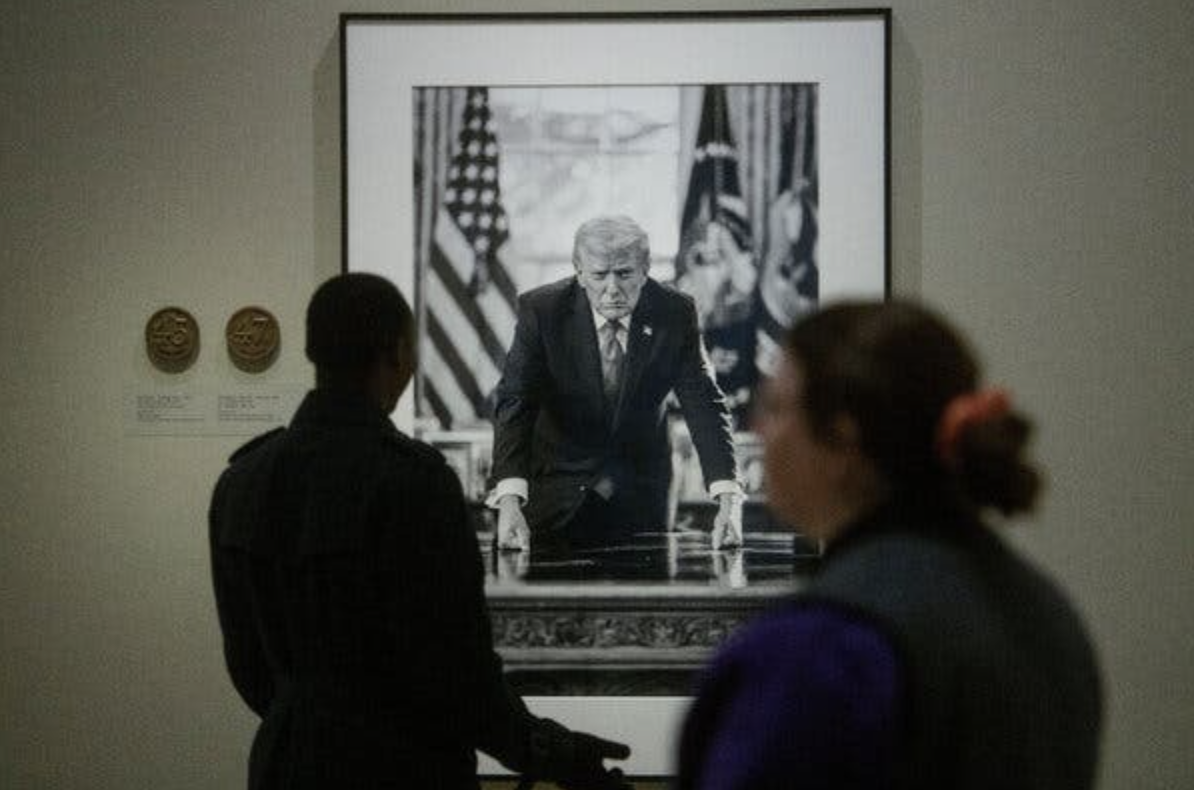
Photo via Daniel Torok
***
How is it that in an America dominated by a swift transition into conservatism that urges a relentless All-American national pride, the simple act of examining our nation’s “all-American” history is branded as “disparaging” against our nation?
Among the barrage of Executive Orders introduced by President Trump is Executive Order 14253, superciliously titled “Restoring truth and sanity to American history.” It establishes the administration’s definition of an accurate framing of American history. The administration describes the country’s past as a “remarkable” legacy of “advancing liberty, individual rights, and human happiness,” arguing that recent historical interpretations (that they attribute to left-leaning stakeholders) have instead portrayed America as “inherently racist, sexist, oppressive, or otherwise irredeemably flawed.” American history, in Trump’s framing, is subject to two competing narratives, one that celebrates national achievement and one that reduces the country to its failures and shortcomings.
That becomes especially important when Trump’s administration pivots from describing their vision of a true and correct American history to candidly directing how Americans should encounter it. The order instructs the Department of the Interior to review monuments, memorials, and other historical properties for material that “inappropriately disparage[s]” Americans and to ensure that these sites instead focus on “the greatness of the achievements and progress of the American people.” At the Smithsonian, the administration similarly called for a review of exhibits, arguing that museums should become places that inspire “pride in the hearts of all Americans.” The language used in the order acknowledges that history is more than a record; it is a tool that shapes how citizens understand their country, including its political systems. Trump’s concern is therefore not simply that certain historical interpretations are inaccurate. It’s those particular interpretations, in his administration’s words, that divide, cause shame, and hinder the progress of American society. In my view, the continued exploration of interpretations that center on topics like critical race theory and queer studies interferes with decisions that further his agenda. The question that follows is whether this current campaign to protect national pride actually succeeds in narrowing the ways Americans can examine the past.
The order reflects a widespread, growing criticism of DEI and the humanities, conflating the standard practices of a critical, niche approach to encountering American history with an attack on the sanctity of America by simply challenging the narrative. The Trump administration accuses institutions of perpetrating a “concerted and widespread effort to rewrite our Nation’s history,” claiming that this adversarial movement is driven by ideology rather than truth. This dramatic conclusion lacks any real reasoning, as acknowledging exclusion or other forms of inequality does not inherently require erasing existing narratives or American progress. Likewise, emphasizing national achievements does not require ignoring the people who were excluded from those achievements. History becomes less useful when only one side is treated as the sole legitimate story that can exist, and the demand for an exclusively “uplifting” history diminishes complexity. Trump’s order ultimately asks historical and educational institutions to do more than preserve and present evidence; it also demands that they cultivate a highly partisan emotional relationship between Americans and their history.
This dynamic is hardly unique to the present political moment. During the mid-twentieth-century peak of McCarthyism, widespread apprehension among both political leaders and the public about class analysis and Marxist frameworks severely constrained how scholars approached fundamental national milestones, including the narrative of the American Revolution. A historiographical timeline designed by Revolutionary War historian Michael D. Hattem vividly illustrates how national narratives evolve over time, highlighting the valuable insights gained when history is not restricted to a single viewpoint. For example, the timeline shows a shift from what was described as the progressive interpretation spanning 1909 to 1945, which framed the Revolution’s conflict and resolution from the frame of class struggles, to the Consensus School era of scholarship, spanning 1945 to 1965, which entered the Cold War, where discussions of class conflict were not platformed. Instead, unity and the redefinition of American identity were the focal points of the period. Rather than being discarded by subsequent generations, evolving cultural values and social priorities must be protected and examined to enrich our understanding of the nation’s collective path. Because historiography follows a non-linear trajectory, shifting neither exclusively toward conservatism nor progressivism, it demonstrates that intellectual progress does not develop as the Trump administration frames it. Therefore, the premise that “woke” historical analysis is inherently regressive lacks merit, and erasing key historical perspectives risks the nation retreating into polarized echo chambers and limiting future generations’ capacity for critical thought by restricting their access to broader knowledge, thus hindering the progress the administration claimed it was fighting to pursue.
***
This article was edited by Kaitlyn Horn.
 Christian Dziura
  Javeer Khan
  Amelia Felice