
Photo via Salar Salim/AP
***
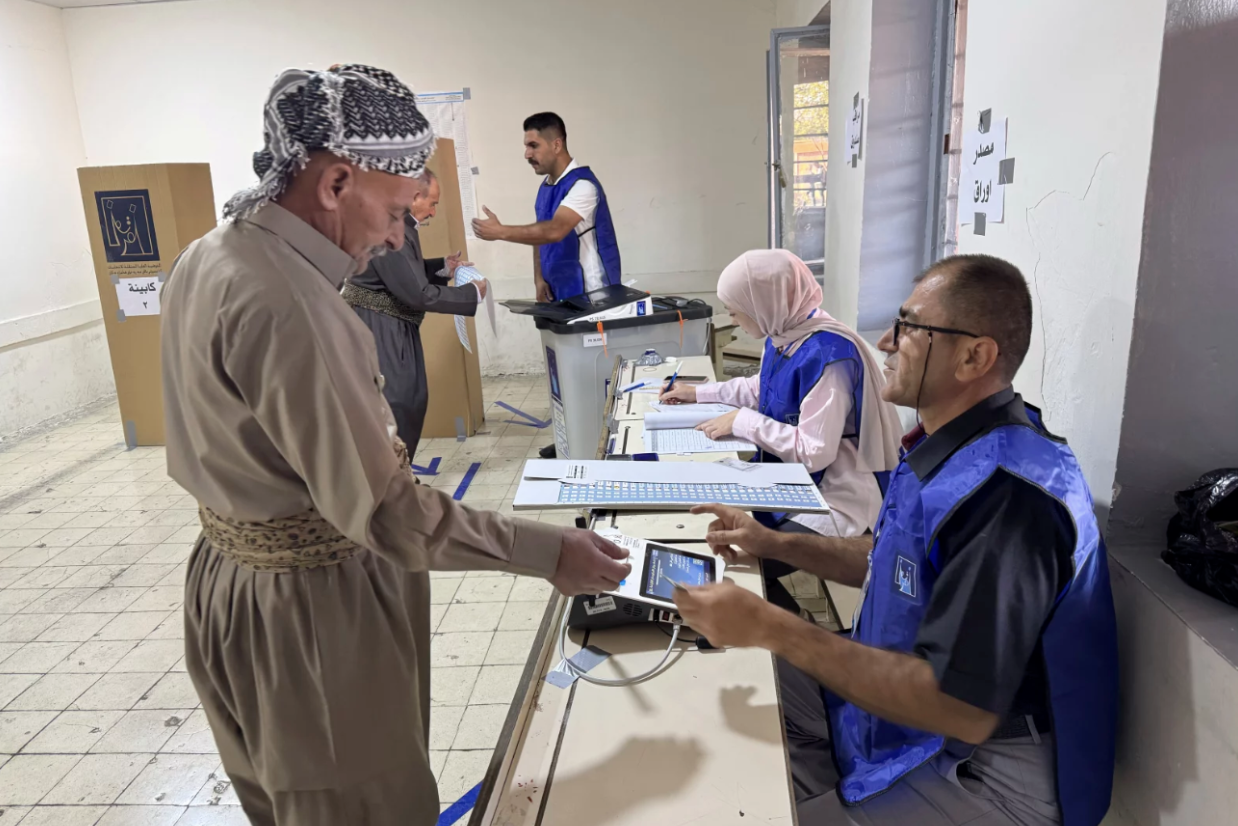
On December 29, 2025, Iraq’s newly elected parliament held its first session, beginning its presidential electoral process. Three months later, a new president has yet to be elected, stalling normalization efforts in a nation still recovering from the Islamic State and sectarian violence. The Iraqi parliament has sought to advance the voting effort by organizing dedicated presidential-election sessions. These proceedings, however, have been continually postponed, preventing the chamber from beginning government formation. Sessions scheduled for January 24 and February 1 were both delayed amid coalition gridlock. In the meantime, the current caretaker government will continue to hold power, led by Prime Minister Mohammed Shia’ al-Sudani.
Unlike other parliamentary systems, Iraq’s presidential vote is not ceremonial: it is the procedural hinge that triggers the transfer of power between governments. Until parliament elects a president, there will be no constitutionally legitimate means to designate a new prime minister and, subsequently, form a new cabinet.
A Delicate Balance
Iraq’s post-Saddam political order operates through a fragile, informal power-sharing agreement between the three main political blocs: Sunni Arabs, Shia Arabs, and Kurds. In practice, the power balance is represented through a division of the country’s top offices: the prime minister is usually Shiite, the parliament speaker Sunni, and the president Kurdish. Although unofficial, this structure has become essential to Iraq’s operational framework. Parliament elects the president by a two-thirds majority, necessitating cooperation among blocs, preventing majoritarian strong-arming. Political mutualism is built into the nation’s electoral process; any group that fails to assemble a broad coalition cannot close the vote. This system is designed to incentivize any elected government to disseminate appointments, budget priorities, and veto power across groups.
In practice, this power-sharing agreement places unusual weight on the presidency, because it is the one office that formally requires a supermajority and informally represents Kurdish participation in the state. When alliances collapse, the presidential vote becomes less of a routine procedure than a veto function. In the current cycle, the veto power is vested in the Kurdish camp.
Kurdistan Divided
The most immediate cause of the parliamentary stall is that the Kurdish political parties have yet to unify sufficiently to deliver a single nominee to the ballot. Two parties dominate the Kurdish regime’s politics: the Kurdistan Democratic Party ( KDP) and the Patriotic Union of Kurdistan (PUK). Their rivalry has transformed a traditionally discreet parliamentary procedure into an intense political bargaining cycle.
On a surface level, the split has taken the form of a candidate dispute. Against convention, the KDP circumvented the PUK and nominated foreign minister Faud Hussein as their candidate, under the understanding that any Kurdish nominee would require approval from parliamentary Sunni and Shia blocs to succeed. The PUK has disputed the KDP’s unilateral decision, highlighted that the presidency is a key marker of the ethno-religious political balance, and pushed for its preferred path.
These debates have emphasized the transactional nature of the presidency. Sources claim that Faud Hussein had floated a trade of four major ministerial positions to the PUK in exchange for their support. Reported consensus around PUK candidate Nizer Amedi have failed to materialize, and the Parliament remains in a standstill.
Breaking Deadlock
The deadlock can plausibly break in two ways. The most straightforward pathway is a Kurdish consensus that produces a single, broadly supported nominee. Presenting this candidate would validate future presidential sessions and likely secure a quorum for a vote. Alternatively, Baghdad may step in; if Kurdish blocs remain in a standstill, Sunni and Shia forces may broker a compromise by signaling support for a specific Kurdish candidate. In doing so, these blocs are getting greater concessions from Kurdish forces.
For the foreseeable future, the presence of the reasonably stable caretaker government may disincentivize quick progress until the stakes are raised. The weights of leverage must change for parliamentary elections to proceed fruitfully.
***
This article was edited by Sidney Levitt and Mila Cabanlit.
 Abby Coxe
  Campbell Brown
  Holmes Wormald