
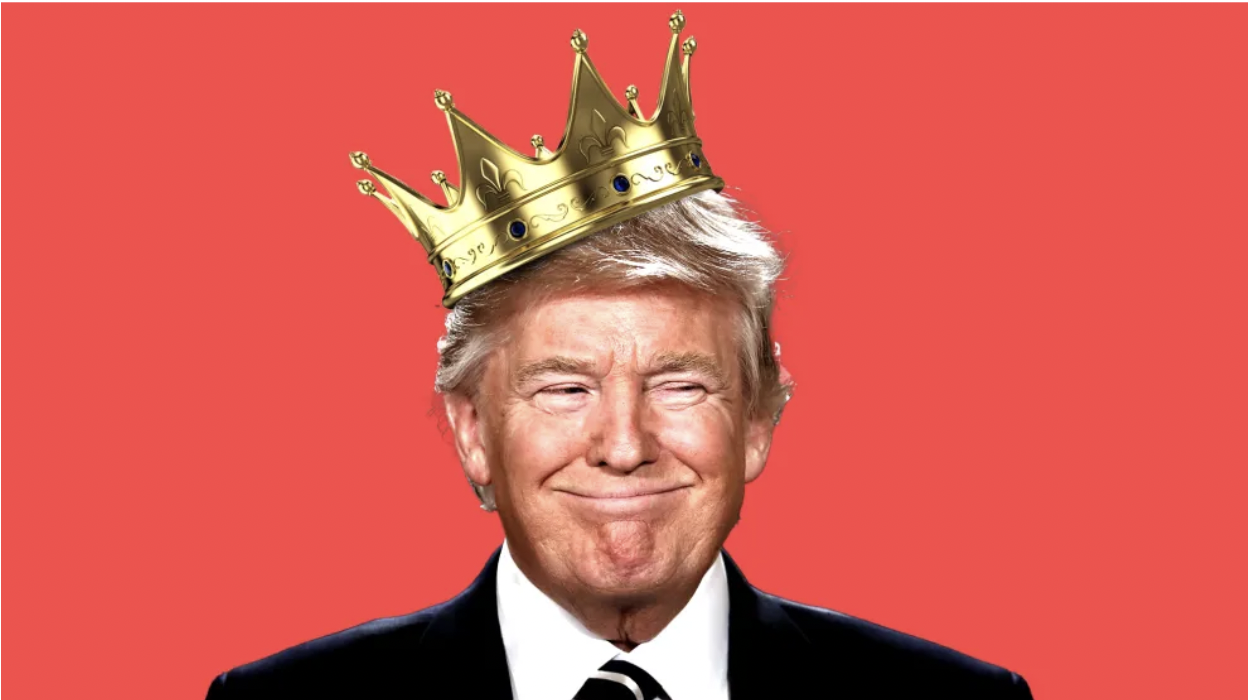
Image via MotherJones
***
On October 18, over seven million Americans gathered in cities across the United States to participate in the anti-Trump “NO KINGS” protests. Due to President Donald J. Trump’s continuous expansion of presidential power, protestors assembled in New York City, Boston, Los Angeles, and beyond to remind Americans that the United States was created in rejection of absolute monarchy. As written in the description of the “NO KINGS” movement, “this country does not belong to kings, dictators, or tyrants. It belongs to We The People.”
In response to the protests, Trump and his Republican allies attempted to delegitimize any and all opposition as inaccurate, unpatriotic, or a threat to national identity. Republicans accused the protestors of being linked with Antifa, an anti-fascist movement with no centralized organization that the Trump administration has designated a domestic terrorist group. They also described the gatherings as “hate America rallies,” claiming that protestors are not true Americans.
Protestors often pointed to several examples of Trump diminishing democratic norms: protecting the Epstein files, authorizing inhumane actions of Immigration & Customs Enforcement, and the use of executive orders to dismantle the federal government. Yet, in the weeks after the protests, it has become increasingly apparent that Trump’s interpretation of absolute power extends beyond federal policy efforts. While Trump continuously makes significant federal decisions without considering their constitutionality or consulting Congress, he also makes visual and symbolic choices that purposely present him as a lavish king rather than a democratically elected president.
From the demolition of the White House’s East Wing for a 300-million-dollar golden ballroom to the selling of 2028 “Make America Great Again” merchandise, Trump is crafting a presidential term defined by personal grandeur and a rejection of constitutional law. These actions demonstrate not only an expansion of presidential power but an attempt to leave behind a presidential legacy that mirrors monarchy, precisely what the “No Kings” protestors criticize. Additionally, Trump strives to be “president for life,” by running for a third term as president, regardless of the 22nd Amendment’s clear statement that “no person shall be elected to the office of the President more than twice.” Currently, this recurring joke has seemingly become a visible and intentional message.
In an open advertisement of this possibility, the Trump Store has begun selling a “Trump 2028” high crown hat. Disregarding the illegality of a third presidential campaign, the product description tells loyal Trump supporters to “rewrite the rules,” buy the hat, and spread the message. Bringing this imagery into the White House, Trump has intentionally displayed “Trump 2028” hats and others exclaiming “4 More Years” on a bookcase just outside the Oval Office. In August, Trump even proudly held up his red “4 More Years” hat for Ukrainian President Volodymyr Zelensky and French President Emmanuel Macron to see, showcasing his disregard for democratic norms to other world leaders.
On social media, Trump amplified the symbolism even further, posting and reposting videos on X of campaign lawn signs for 2024, 2028, 2032, and beyond. In reaction to the “No Kings” protests, the president mocked protestors by sharing the campaign sign video, in addition to fake videos depicting him as a king and dumping a stream of feces on the demonstrators.
Reinforcing the possibility of the 2028 Presidential campaign, Stephen K. Bannon, the brief White House chief strategist in Trump’s first term, definitively claimed that Trump will get a third term. During an interview with the Economist, Bannon explicitly stated that “Trump is going to be president in ‘28” and there is “a plan” to circumvent the 22nd Amendment. “There’s many different alternatives,” Bannon insisted.
To maintain his presidency, one possibility floated by supporters is that Trump could run as vice president alongside another Republican and return to the office after the elected president steps aside. Yet, this strategy is also unconstitutional, as the 12th Amendment stipulates that no person constitutionally ineligible for the presidency shall be eligible for the vice presidency. Trump himself dismissed this approach, saying, “[the American People] wouldn’t like that. It’s too cute. It wouldn’t be right.”
Trump’s attempts to establish his legacy are not only rhetorical, as he is additionally reshaping the physical structures that serve as symbols for the presidency. On October 23, the White House’s East Wing was reduced to rubble to make room for a 90,000-square-foot gilded ballroom for large-scale events. The cost: 300 million dollars.
Originally built in 1902, during Theodore Roosevelt’s presidency, the East Wing served as a modest public entryway, the site of offices for the first lady, and the home of the White House calligraphers. The previous structure signified that the presidency is rooted in public service, not the spectacle and grandeur of a monarchy.
Despite originally making promises that his plans “won’t interfere with the current building,” Trump dismissed the historic structure as “a very small building” and took a wrecking ball to the “People’s House.” In doing so, Trump by-passed the review process that White House renovations usually go through and took a “demolish first, ask questions later” approach. In support of Trump, White House press secretary Karoline Leavitt said the demolition of the East Wing is necessary for a “strong and stable” ballroom.
During the last large-scale renovation 83 years ago, President Harry S. Truman consulted Congress for funding and legislative oversight. Opposite to President Truman, Trump has bypassed legislative review entirely, relying instead on technology corporations like Apple, Microsoft, and Meta to fund the 300 million dollar project. The reasoning for the ballroom: so large state dinners will no longer take place under large tents on the South Lawn.
The future American-version of the Palace of Versailles will likely include the imperial aesthetic of gold accents and opulent decor, ultimately culminating into a visual depiction of monarchical spectacle. Unlike President George Washington’s refusal to support proposals for a presidential palace, Trump is purposely introducing a royal aesthetic into the “People’s House” that can be showcased for decades after his presidency. The message is clear: Trump’s presidency is less about enacting policies that benefit the everyday American and more about fulfilling his narcissistic need for a lasting legacy.
The “No Kings” protests made one principle clear: the United States operates as a democracy, not a monarchy. Yet, in the weeks since, Trump has continued to transform the presidency into a personal spectacle that leaves a symbolic imprint that outlasts legal or institutional limits.
***
This article was edited by Jorja Mulvihill and Griffen Strauss.
 Glenmarie Rios Rodriguez
  Sarah Olivia Sullivan
  Luke Helmholz