
Photo via The Intercept
***
Article I of the Constitution states that Congress has the sole power to declare war. But for decades, presidents have ordered military action without congressional approval, despite the Constitution commanding otherwise.
In 1973, Congress passed the War Powers Act in order to reassert its power to declare war. The resolution requires the president to alert Congress within 48 hours of military action and outlaws the armed forces from being deployed for more than 60 days without congressional approval.
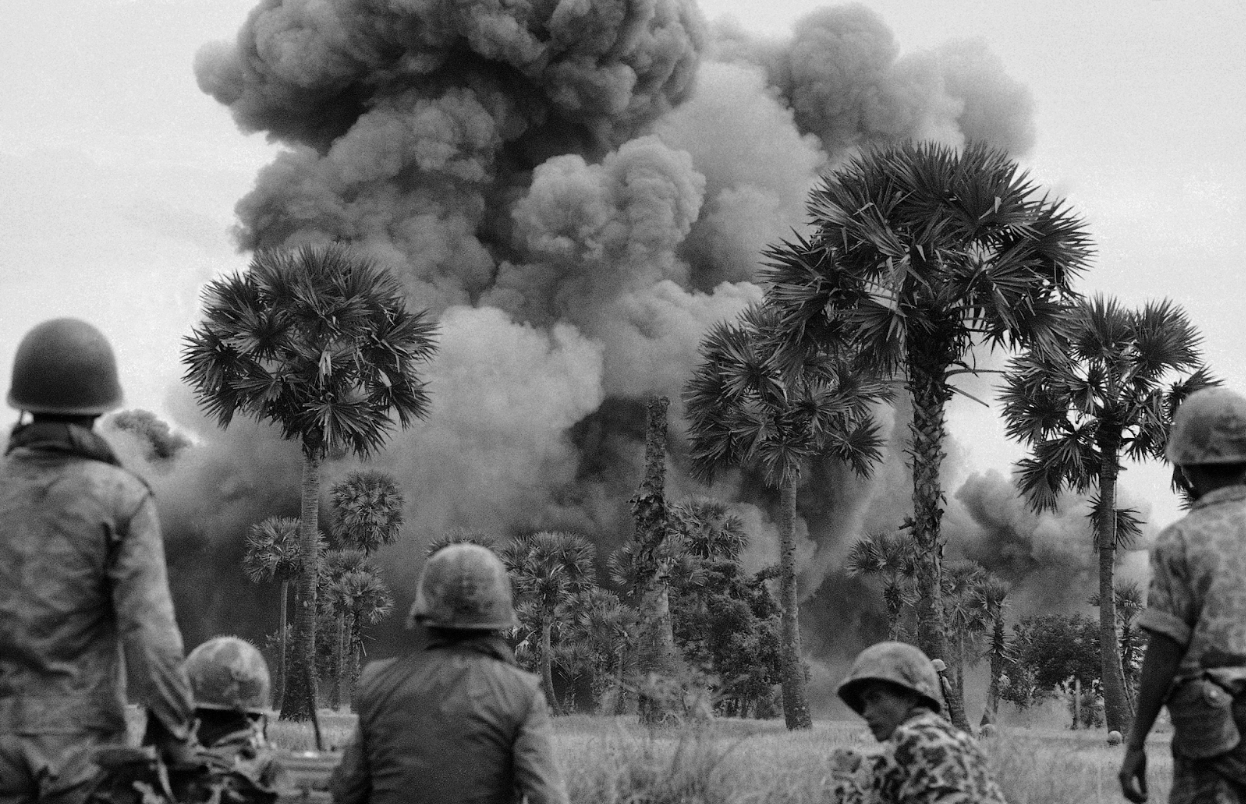
Congress has not declared a war since World War II, yet the United States has been involved in many wars since then without an official declaration of war, such as in Korea, Vietnam, Cambodia, Iraq, Afghanistan, and now Iran. Prior to the Korean War, presidents had always asked for congressional approval for international military action. However, when President Truman deployed troops to Korea in 1950 for a “police action,” it marked a turning point in presidential power; it was the first time a president sent troops without congressional approval. Presidents began to engage in wars without congressional approval and asserted their power independent of Congress.
This expansion of presidential power conflicts with the Founding Fathers’ vision for the division of power in the United States government. Fearing the rule of another tyrannical monarch, the Founding Fathers specifically designed the Articles of Confederation to establish a limited central government without a strong executive. The Articles were described as a “league of friendship” between the states, ensuring that each state had an equal number of representatives and power in order to prevent a single person or group of people from consolidating power and exerting absolute authority. Evidently, modern presidents’ exertion of absolute control over military action conflicts with the Founding Fathers’ design of a limited central government. Various presidents have called the War Powers Resolution unconstitutional, claiming it infringes upon their power as Commander in Chief. This claim has yet to be officially corroborated, though, as the War Powers Resolution has never been brought to the Supreme Court.
Though the Founding Fathers wanted more checks on presidential powers, the War Powers Resolution is insufficient at limiting the president’s ability to exercise unilateral control over United States military action. The U.S. is a representative democracy, meaning that both senators and members of Congress represent the will of the American people. One of the most crucial parts of a representative democracy is that these officials are elected by the people to carry out the people’s will, not their own. When the executive branch operates with unilateral control of the government, the people are excluded from the government’s decision-making, infringing upon the definition of a representative democracy. Thus, more legislation is needed to ensure that congressional approval precedes the deployment of armed forces in order to maintain the balance of power between Congress and the executive branch that the Founding Fathers intended. With international conflict on the rise and the decrease in importance and leadership of the U.N., Congress needs to check presidential power. This ensures that presidents are held accountable and are acting in the interests of the American people rather than in their own interests. Presidents need to act for the American people, not for themselves or their own agenda.
***
This article was edited by Annika Trippel and Sophie Reilly.
 Sarah Olivia Sullivan
  Luke Helmholz
  Gavin O'Sullivan