
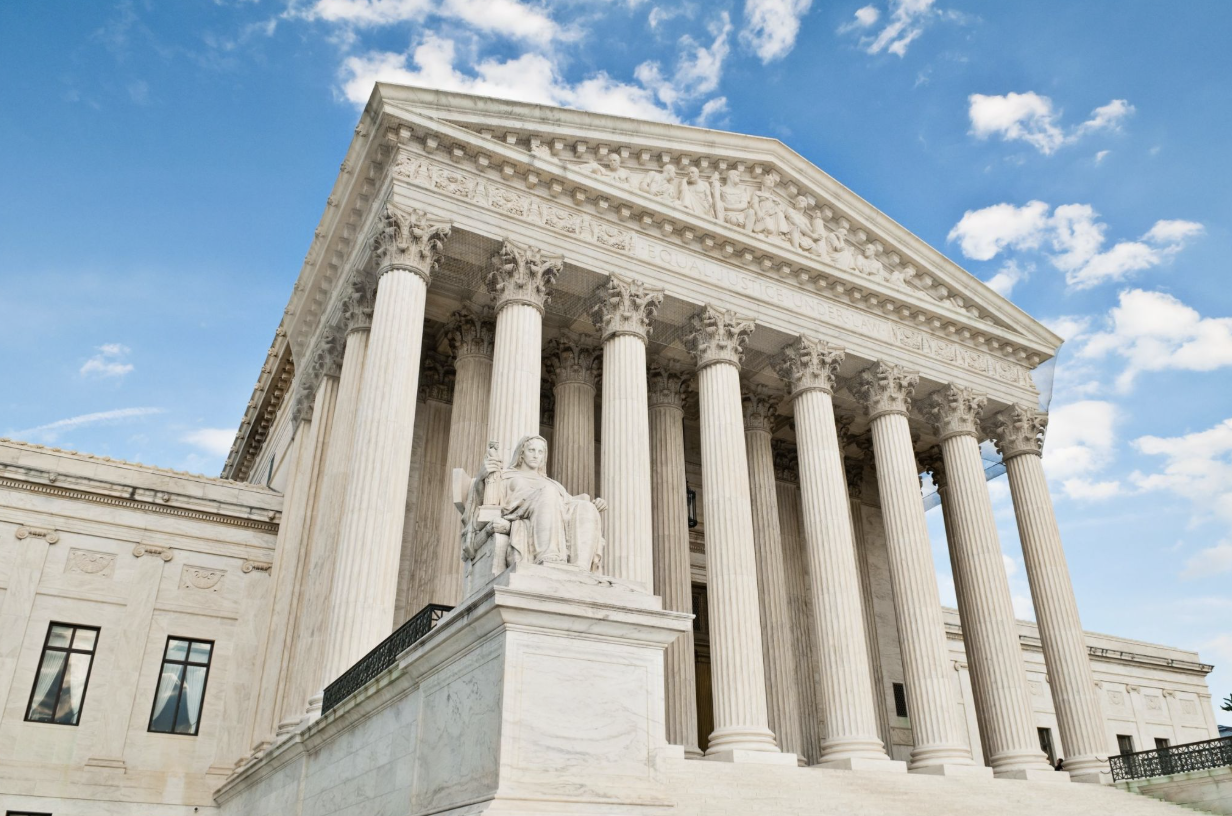
Photo via Virginia Court Case Finder
***
The boundary between constitutional rights and public safety is once again before the Supreme Court, where the interpretation of the Second Amendment could determine the future of assault weapons restrictions in the United States. On December 2, 2026, the Supreme Court will hear Grant v. Higgins and Viramontes v. Cook County, two cases challenging the constitutionality of restrictions on AR-15-platform and similar semiautomatic rifles in Connecticut and Illinois. Although these decisions directly concern these two states — Connecticut and Illinois — the rulings will also be major indicators of the future of federal gun control legislation, raising questions about how much authority state governments retain to regulate firearms in the interest of public safety. The Second Amendment protects an individual’s right to keep and bear arms, but that protection should not be interpreted as an absolute right to possess every category of firearm. The Supreme Court should uphold Connecticut and Cook County’s assault weapons restrictions and recognize that constitutional protections and the ability to address serious public safety risks do not have to be contradictory.
Background
Connecticut enacted An Act Concerning Gun Violence Prevention and Children’s Safety on April 3, 2013, after the event of the Sandy Hook Tragedy, where a gunman shot and murdered twenty first graders and six educators on December 14, 2012. This law expanded on the state’s already existing restrictions on assault weapons, limiting the sale, transfer, and ownership of firearms classified as assault weapons, including AR-15 and AK-style firearms. On September 29, 2022, Eddie Grant Jr., a retired state correction officer and long-time pistol permit holder, alongside the Second Amendment Foundation, Connecticut Citizens Defense League, and two other individuals, filed suit against the then Commissioner of the Connecticut Department of Emergency Services and Public Protection (DESPP), James Rovella, in hopes of legally owning and purchasing modern semiautomatic rifles like the AR-15. When Rovella retired in late 2023, Ronnell Higgins took over his position and name as defendant.
Cook County, Illinois, enacted its own assault weapons restrictions in 2006 and later revised the ordinance in 2013. Cook County’s assault weapons ordinance, similarly to Connecticut, bans the sale, purchase, delivery, and manufacture of over 100 specific semiautomatic and automatic firearms (AR and AK models), large capacity magazines, and .50 caliber rifles, under certain rules and exceptions. Viramontes v. Cook County began with Cutberto Viramontes, a Cook County resident who wished to purchase an AR-15-style weapon for self-defense, and Christopher Khaya, another Cook County resident who wanted to purchase an IMI Galil, a type of semiautomatic firearm. Since the ban barred these two citizens from purchasing or owning these weapons, they joined the Firearms Policy Coalition and the Second Amendment Foundation to petition Cook County, arguing that the ban violates their Second and Fourteenth Amendment rights.
Precedent Cases & The Court’s Decisions
Since these cases are consolidated, meaning they are being heard by the Supreme Court together, the cases raise a central constitutional question: how far can state and local governments go in regulating firearms to keep the public safe while regulating the constitutional right to bear arms?
The Court’s interpretation of the Second Amendment, in particular, has developed through a series of landmark cases that are now crucial to the debate over assault weapons restrictions. In District of Columbia v. Heller (2008), Dick Heller challenged D.C.’s restrictions on handgun possession in the home. The Supreme Court held that the District’s handgun ban violated the Second Amendment. He sued the District of Columbia on the premise that the Code, which prohibited the carrying of an unregistered firearm and the registration of handguns, violated his Second Amendment right to keep a firearm in his home without a license. The Supreme Court, with a 5-4 decision, determined that the ban was unconstitutional. Two years later, McDonald v. Chicago (2010) held that states do not have unlimited authority to regulate and ban weapons under the Due Process Clause of the Fourteenth Amendment, the Second Amendment, and the precedent of D.C. v. Heller. The Court’s decision in McDonald v. Chicago established that state and local governments, like the federal government, must respect the Second Amendment.
However, the Court’s recognition of an individual’s right to bear arms did not mean that every firearm regulation was automatically unconstitutional. In New York State Rifle & Pistol Association v. Bruen (2022), the Court established a new standard for determining whether the firearm regulations violate the Second Amendment. It held that when the Second Amendment’s text covers an individual’s conduct, the government must demonstrate that its firearm regulation is consistent with the nation’s historical tradition of firearm regulation. Under Bruen, the government must show that a firearm restriction is consistent with the nation’s historical tradition of regulation.
Second Amendment in Context
The plaintiffs’ argument that these restrictions are unconstitutional relies heavily on the “common use” doctrine established in District of Columbia v. Heller. “Common use” claims that common use or ownership should place a firearm under the strongest protection of the Second Amendment; however, common ownership alone should not limit the Court’s questioning of Constitutional interpretations. The Second Amendment was written to protect an individual’s right to bear arms, not to prevent governments from responding to developments in firearm technology and increased – and justified – concerns for public safety. In fact, Heller itself recognized that the Second Amendment right is not unlimited. In the majority opinion, Justice Antonin Scalia acknowledged that “like most rights, the Second Amendment right is not unlimited. It is not a right to keep and carry any weapon whatsoever in any manner whatsoever and for whatever purpose.”
This same principle exists in other constitutional amendments. The First Amendment protects freedom of speech, but, like other constitutional rights, it has observed limits. If someone were to shout “Fire!” in a movie theatre when there is no such fire, there can be legal consequences for causing an unnecessary panic and potential harm to those in the theatre. Therefore, constitutional rights can have boundaries without becoming entirely meaningless. The Second Amendment should be interpreted from a similar viewpoint, recognizing that the right to bear arms is not all-encompassing and does not mean that every firearm must be equally protected from regulation.
The distinction between protecting constitutional rights and protecting public safety is especially important when considering assault weapons restrictions. These laws do not eliminate the Second Amendment or prohibit Americans from owning firearms altogether. Instead, they regulate a particularly dangerous and relatively new category of firearms under specific statutory definitions. The constitutional question, therefore, is not whether Americans have the right to own firearms, but whether that right also holds the potential for completely reasonable restrictions. Treating the Second Amendment as an absolute guarantee against any firearm restriction would go beyond what was established in Heller, McDonald, and Bruen. McDonald v. Chicago held that the Second Amendment applies to the states through the Fourteenth Amendment, thereby extending it to state and local governments. Whether or not the firearms covered by these bans fall outside the Second Amendment is contested.
Now, the public safety concerns behind these restrictions are no longer hypothetical. Assault weapons and large capacity magazines are undeniably dangerous. Mass shootings with assault weapons are nearly twice as deadly, with an average of 5.2 deaths and 7.6 injuries, while mass shootings not involving assault weapons or high-capacity magazines average 2.9 deaths and 3.2 injuries. Eight out of the ten deadliest mass shootings were executed with an AR or AK variant, and all of the ten deadliest shootings used a semiautomatic weapon. An assault weapon is statistically more deadly than any other legalized firearm. They are murder tools. It is as simple as that.
The Supreme Court’s decision should not rely on the assumption that recognizing a Second Amendment right requires courts to invalidate every modern firearm restriction. Connecticut and Cook County adopted these laws in response to public safety concerns as expressed in McDonald v. Chicago and the other cases previously explained. If the Court rules that these restrictions are unconstitutional, it will permanently stain the gun violence prevention movement and narrow the ability of state and local governments from being able to respond to similar concerns through legislation. Upholding the laws would not settle every debate regarding gun regulation; it is an incredibly nuanced topic with both the Amendments and laws having several different interpretations, but it would preserve the ability of governments to defend these policies in court under the Constitution’s established framework and modern contextualization.
Why Care?
Grant v. Higgins and Viramontes v. Cook County are about more than the constitutionality of assault weapons restrictions. They also concern themselves with how the Constitution’s protections should apply to modern concerns and how much authority governments retain to address public safety risks. The Second Amendment is a fundamental right, but its protection should not be treated as an automatic rejection of every kind of firearm regulation. The Court should uphold Connecticut’s and Cook County’s bans, recognizing that protecting constitutional rights and protecting the citizens the Constitution is intended to protect need not be mutually exclusive. A constitutional right can still remain meaningful without being unlimited, and the Court should leave room for carefully designed restrictions that seek to prevent further harm to all United States Citizens.
***
This article was edited by Ferdinand Rivera Ortega and Julianna Wottawa.
 Dominic Razzano
  Daniel Ukandu
  Campbell Brown