
Photo via Strauss Center
***
Former Secretary of Defense Donald Rumsfeld, less than a month before the 2003 U.S. invasion of Iraq, insisted in an interview with Al Jazeera that “We don’t take our forces and go around the world and try to take…other people’s resources, their oil. That’s just not what the United States does. We never have, and we never will. That’s not how democracies behave.” On the contrary, American control of Iraqi oil dominates discussions of why the United States went to war in the first place. Far beyond its material value, oil has been supposed as the idée fixe of American foreign policy. The recent military actions of President Trump and the rest of his administration give evidence to the claim that American hegemony in the Middle East is not as simple as smash-and-grab colonialism. While key figures in the Bush administration advocated for the War on Terror as a quasi-evangelical mission to spread democracy, Trump has perverted the underlying logic, such that the U.S. has the latitude to strike wherever it perceives a shortage of democracy, but lacks the vocation for nation-building.
The key arguments surrounding Bush-era involvement in Iraq and Afghanistan centered around the 20th-century political economy of oil, beginning with Saudi oil exploration in the 1930s and continuing through the formation of the Organization of the Petroleum Exporting Countries (OPEC) in 1960 and the 1973 oil embargo. As production shifted away from the United States, a new economic arrangement became necessary to ensure American consumers’ access to oil and, more importantly, to advance American hegemony in the Cold War. This arrangement has been called the “petrodollar.” Many millions of U.S. dollars spent on oil from the OPEC nations were returned to the American economy through deals with so-called petro-regimes: purchases of U.S. securities, real estate investments, and infrastructure developments awarded to U.S. contractors. In place of the gold standard, the dollar was now tied to oil, and every fluctuation in the oil market reverberated throughout the American economic sphere.
Because the dollar had been established as the global reserve currency and had become increasingly correlated to the value of oil, the diplomatic and economic relations between the United States and oil-producing countries became central to the maintenance of U.S. hegemony. In 1973, the OPEC nations objected to U.S. support of Israel in the Arab-Israeli War and issued an embargo against the United States. While it failed to create a lasting disruption in American foreign policy, it exposed a vulnerability in the predominance of the United States’ economy. Controlling the flow of oil through the petrodollar paradigm became many times more important once the strength of the debased currency was threatened.
This defined American foreign policy regarding the Middle East for the coming decades and still does to this day. In 1979, in the heat of the Cold War, the Carter administration issued a new doctrine—much like the Truman and Monroe Doctrines—wherein it laid claim to the Persian Gulf in its entirety, “An attempt by any outside force to gain control of the Persian Gulf region will be regarded as an assault on the vital interests of the United States of America, and such an assault will be repelled by any means necessary, including military force.”
Here, American interests lay as much in controlling the trade of Persian Gulf oil, if not more, as they did in curtailing Soviet and Chinese encroachment. According to Chapter One of Andrew Price-Smith’s “Oil, Illiberalism, and War,” President Eisenhower concerned himself with the internal politics of an oil-producing nation like Iran but “almost solely [with] some scheme or plan that will permit that oil to keep flowing westward.” Through the 1980s and 1990s, the United States involved itself in regional conflicts in the Gulf, first between Iran and Iraq, then between Iraq and Kuwait. In the words of President Nixon, “the entire military machine of the West runs on oil…Never has the future of the Persian Gulf been so vital…Never have the nations of the Persian Gulf been so vulnerable to an aggressive power that seeks to impose its will on the world.”
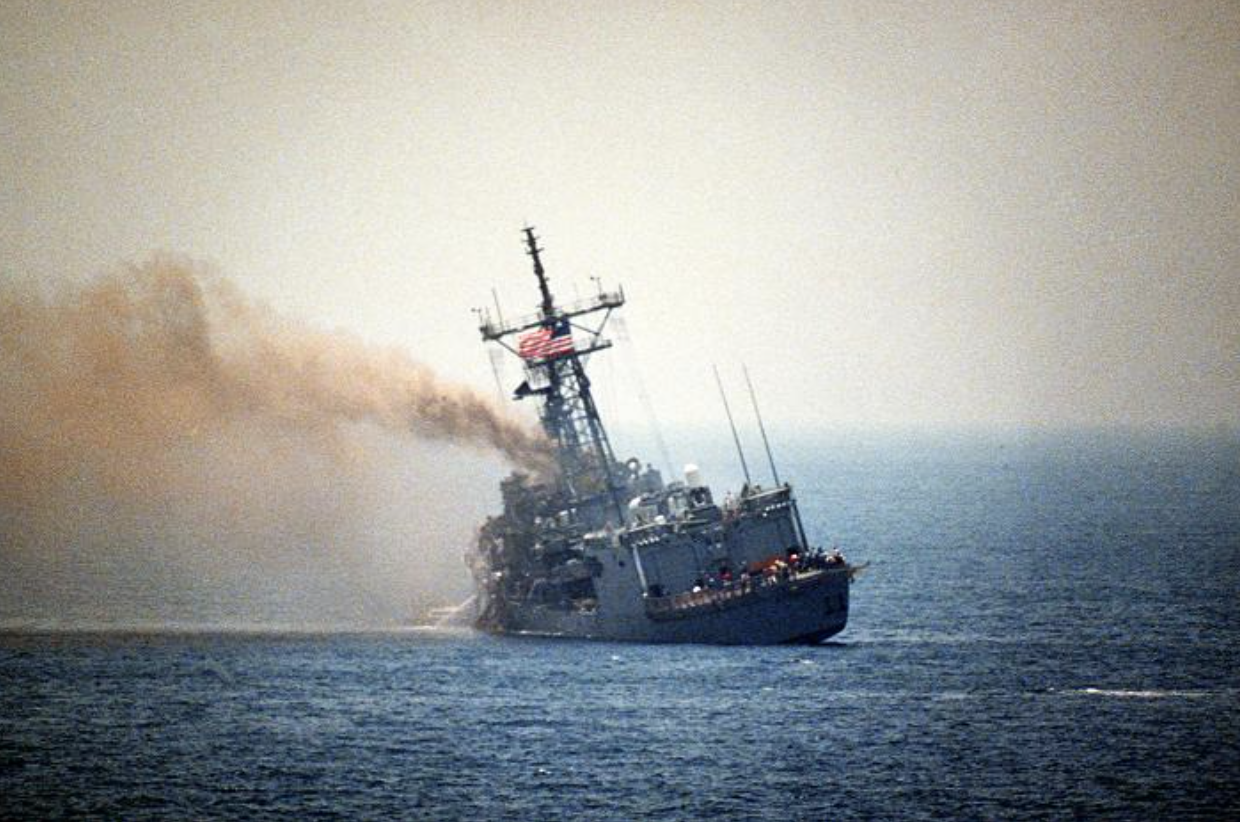
In the case of the Iraq-Iran conflict, the Reagan administration provided supplies, weapons, and dual-use technology to Iraq—led at the time by Saddam Hussein—putatively as a means to quarantine the Islamic Revolution. However, the mechanisms of U.S. engagement lay bare the real motive: oil. As part of this collaboration, the United States commenced Operations Prime Chance and Earnest Will, naval and aerial efforts to protect flagged Kuwaiti tankers from attacks by Iranian vessels. These operations mark direct military action against Iran and the first Iranian casualties in a conflict that has now festered for over four decades. American involvement, outside of its Iraqi proxies, served to maintain the flow of oil through the Strait of Hormuz, which makes it clear how little this conflict has moved.
In fact, many of the same patterns and principles were at stake in the Iraq War and the Global War on Terror (GWOT) in general. Yet again, American power was under threat by an amorphous global enemy, first communism, now terrorism, and military expansion was necessary as an act of overextended self-defense. President Bush—and others in his administration—went as far as to claim that the War on Terror was, in fact, a holy war blessed and supported by God: “I am driven with a mission from God. God would tell me, ‘George, go and fight these terrorists in Afghanistan…go and end the tyranny in Iraq.’ and I did.”
Now, without even the fiction of strategic tact or moral rectitude, the Trump administration has hurled itself headlong into the same conflict. An act of pre-emptive self-defense against Iran, an oil-rich nation hostile to American interests in the Gulf. Here, history repeats itself past tragedy and past farce.
Trump has differentiated himself quite intentionally from the administrations of Bush and Reagan, true-blue neoconservatives. In fact, he called the efforts of the Global War on Terror a “beauty” of a mistake and stated plainly, “We should have never been in Iraq.” During his first presidential term, he negotiated with the Taliban on a plan for the withdrawal of American forces from Afghanistan in order to end the so-called forever war that began officially with Bush’s invasion.
The conditions, decided upon in 2019 without the oversight of the Afghan government, were a ceasefire on the part of the Taliban, the release of about 5,000 Taliban fighters from prison, and the total departure of the U.S. military by May 1, 2021—notably after the end of Trump’s first term. President Biden pushed this deadline back until September, but it changed little. By the end of August, the Taliban had overwhelmed the flimsy defense of the Afghan military and overthrown the government; American forces and Afghan citizens were forced to retreat hastily and under constant, unchecked threat of attack by Taliban forces—suicide bombers especially. While the mess fell in Biden’s lap, it really marks another failure of Trump as the executor of the American neoconservative will.
Trump’s extralegal capture of Venezuelan President Nicolás Maduro, for example. Where previous acts of regime change operated by neoconservative principles—that is, the evangelization of democracy and capitalist freedoms —the unilateral imprisonment of a foreign head of state operates by one principle: power. In framing his arrest solely as an act of international criminal justice, Trump is reasserting American jurisdiction in the Western hemisphere. This hearkens back to the doctrines of Carter, Nixon, and Monroe—delineating a colonial sphere of influence; it loses none of the paternalism and all of the accountability. Moreover, Trump made no attempt at concealing or running cover for his real aim of controlling Venezuelan oil.
The clumsily-titled Operation Epic Fury resumed hostilities against the Islamic Republic of Iran, killing Ayatollah Ali Khamenei and purportedly crippling the Iranian nuclear program at once. This operation comprised three unforced errors at once: the tragic killing of 156 civilians at Shajareh Tayyebeh Elementary School, the lack of anticipation for the economic damage of Iran’s closure of the aforementioned Strait of Hormuz, and the failure to come up with an exit strategy.
The United States, again failing in its self-imposed providence over oil traded out of the Gulf, has put its economy—the lynchpin of the global economy—at risk unnecessarily.
***
This article was edited by Emma Cate Martin and Eamonn Tucker.
 Luke Helmholz
  Sidney Levitt
  Ayden Suber