
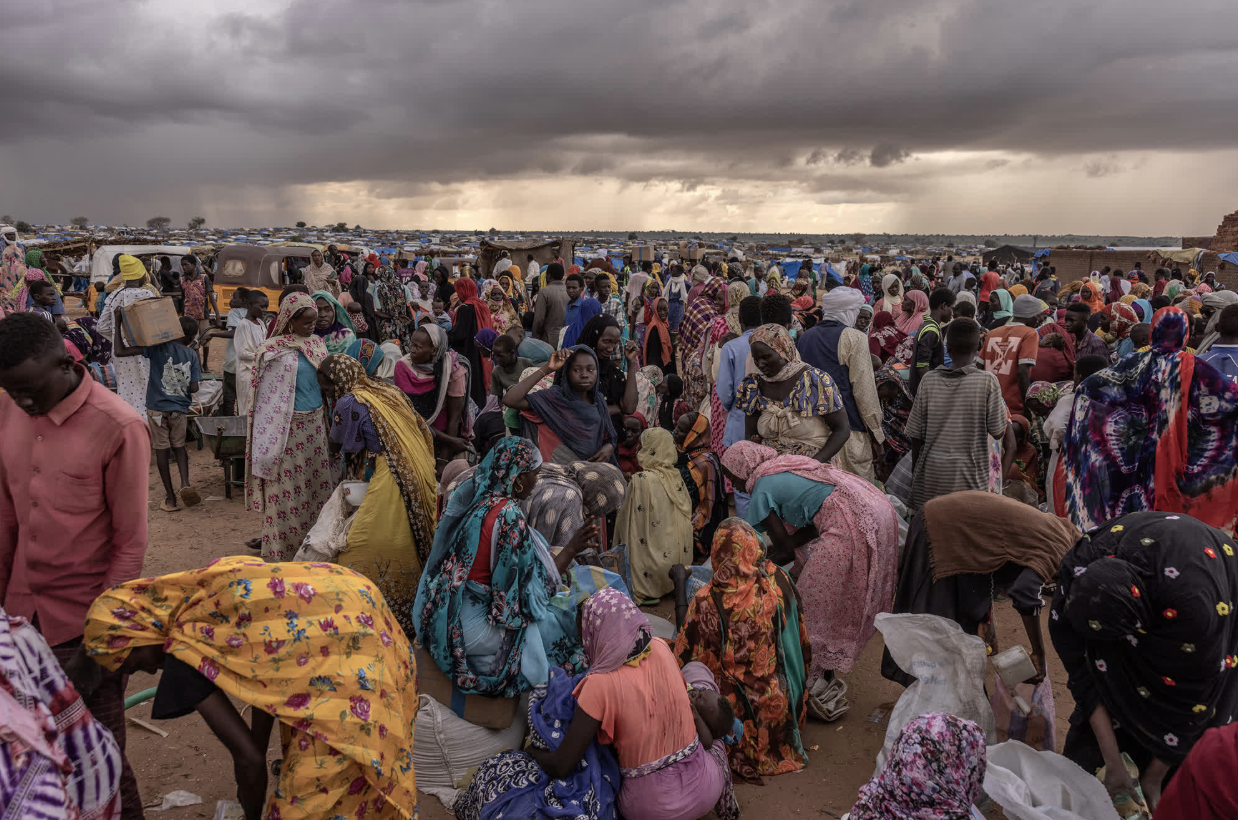
Image via CNN
***
In 2026, the United Nations estimated that 87 million people worldwide need humanitarian assistance to survive. That is the highest number ever recorded. To meet that need, the UN’s Global Humanitarian Overview asked for roughly $23 billion this year to address the most urgent, life-threatening cases, as part of a larger $33 billion appeal to respond to global humanitarian needs overall. As of September 23, 2026, total tracked humanitarian funding stands at about $21.8 billion, according to the UN’s Financial Tracking Service, still short of even that smaller, more urgent request.
For context, the world spent $2.7 trillion on defense spending last year alone. The entire humanitarian appeal amounts to just over 1% of that number. By the UN’s own calculations, the appeal could be fully funded if the world’s wealthiest 10 percent of earners each gave just 20 cents a day.
This is not a story about the world running out of money; it is a story about where that money goes instead, and who gets left behind when it does not show up.
Humanitarian aid operates through a system of annual appeals coordinated by the United Nations, funded almost entirely by voluntary pledges from a small number of wealthy governments. There is no binding requirement that any country contribute a set amount, and no guarantee that a pledge made in January of that year will actually be paid out by December.
This structure makes humanitarian funding fragile. For years, it worked well enough, as the gap between what was needed and what showed up remained manageable. That, however, is no longer true.
A recent policy analysis from the S. Rajaratnam School of International Studies describes the current transactional state of aid: humanitarian aid has long been treated as the “low-hanging fruit” of international cooperation, and is increasingly becoming an arena of power politics. Rather than a system that allocates aid based on need, the analysis argues that aid is shifting toward one based on bilateral relationships between donor and recipient states. In other words, whether a crisis gets funded increasingly depends less on its severity and more on who a country’s allies are.
That shift became especially apparent starting in 2025, when several of the largest historical donors cut their aid budgets nearly simultaneously. The United States dismantled the United States Agency for International Development (USAID), once the world’s largest humanitarian donor, and its foreign aid spending is projected to fall by more than half between 2023 and 2026. The United Kingdom cut its aid budget from 0.5 percent of its national income down to 0.3 percent. France, Germany, and Switzerland also made cuts.
According to research from the Center for Global Development, how much aid a country is projected to lose often has less to do with how severe its crisis is and more to do with which donor happens to be funding it in the first place. Yemen, for example, is projected to lose 19 percent of its aid between 2023 and 2026, while neighboring Somalia is projected to lose nearly 39 percent. That is not a humanitarian calculation, but a political one which aligns directly with the “transactional diplomacy” argument above.
It is worth asking where the money went instead. In the same years that aid budgets shrank, defense spending rose. NATO reports that European members and Canada increased core defense spending by nearly 20 percent in 2025 alone. Part of a new agreement to raise total defense-related spending to 5 percent of GDP by 2035.
The United Kingdom’s aid cut was no coincidence, sitting alongside that trend. The government said directly that it was cutting aid specifically to fund higher defense spending. When a government has to choose between the two, it appears to be choosing defense.
What that choice looks like on the ground is visible right now in Sudan, currently the largest displacement crisis in the world. Roughly 33.7 million people, which is about two-thirds of the country’s population, need humanitarian assistance. 14 million people have been displaced since the civil war began in 2023. More than 70 percent of the country’s hospitals have been destroyed, and a cholera outbreak has infected over 120,000 people.
U.S. funding for the International Rescue Committee’s Sudan response ended in July 2026, and its temporary bridge funding has now run out. As a result, the organization has been forced to close services across the country. At least 473,700 people have lost access to lifesaving care, including through the closure of 36 health facilities and 29 nutrition centers. This is not an abstract funding gap; it is people losing support they depend on.
The issue here is that the U.S. government does not see it this way. When asked about the human cost of the USAID cuts, the State Department has said that the U.S. still spends more on humanitarian aid than any other country in the world, and that other nations need to contribute more rather than relying on the U.S. to carry all the weight.
That argument is not baseless. The U.S. has historically given more than any other country. However, it does not answer what happens to the 87 million people in need while donor countries argue over who is supposed to pay for what. The need does not pause while that argument plays out.
USAID itself is worth reflecting on, since its dissolution is part of why this conversation is happening at all. The agency was created in the 1960s to run most of the country’s foreign assistance programs, everything from disaster relief to disease prevention in developing countries. A 2026 study published in The Lancet credited its programs with preventing an estimated 91 million deaths, including 30 million deaths of children under 5. In 2025, the Trump administration dissolved the agency entirely, folding its remaining functions into the State Department.
If aid funding continues to follow this pattern, the consequences will not stay contained to any one country. Public health researchers have already warned that global child mortality could rise this year for the first time this century, reversing two decades of progress in a single funding cycle. A humanitarian system built on voluntary, year-to-year pledges was never designed to absorb a shock like this, and little in the current trend suggests the shock is temporary.
None of this requires believing that donor countries have a moral obligation to give endlessly, or that defense spending itself is the villain. It only requires noticing that the two are being weighed against each other, in real budgets, right now, and that humanitarian aid keeps losing.
Ultimately, this comes down to a question of priorities, not resources. The world has the money. It is not close, whether measured against defense budgets or the wealth held by the highest earners on the planet. What is missing is the political will to treat helping the most vulnerable as a fixed obligation rather than a line item that gets cut whenever something else feels more urgent. Until that changes, the gap between who needs help and who receives it will not be about a shortage of money in the world, but will be about where the people who hold that money decide to direct it.
***
This article was edited by Elaina Gibson and Cameron Ma.
 Luke Helmholz
  Sidney Levitt
  Ayden Suber