
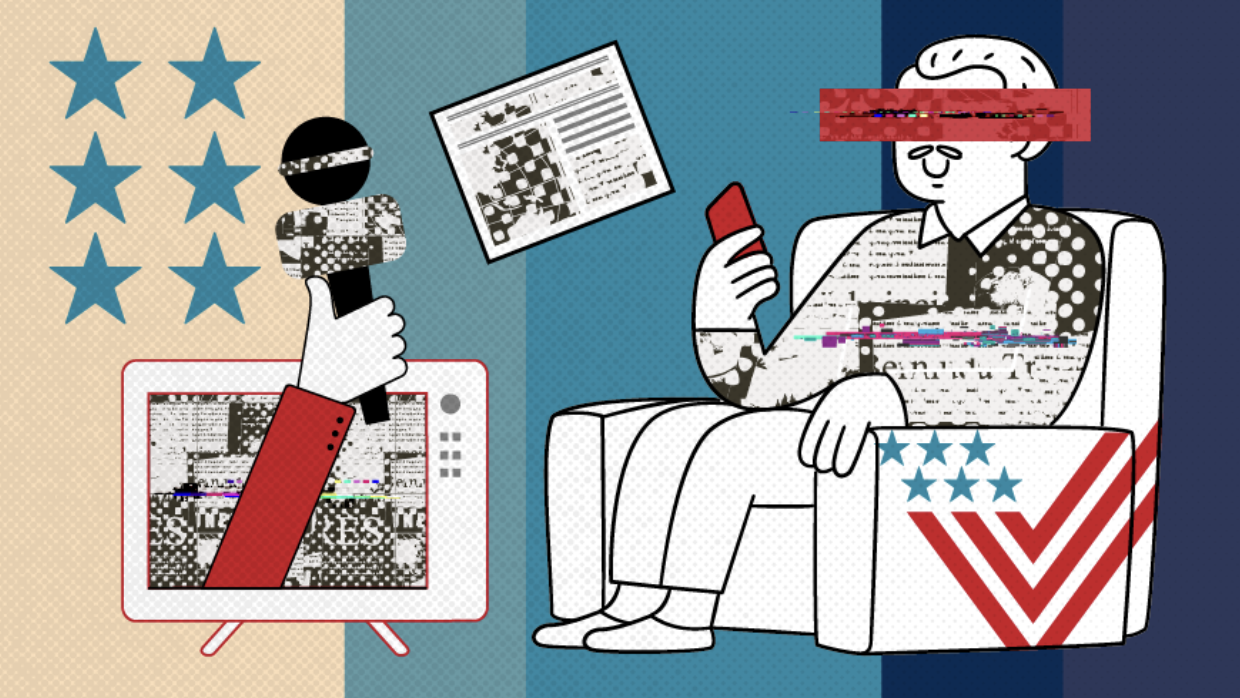
Image via University of Washington
***
I must admit that I am guilty of consuming the media. Through my doomscrolling, I know that I am feeding the beast that is the media every single day. Therefore, I can’t deny that the media most definitely has me in its grasp. In fact, I feel strongly that the media has everyone in a chokehold. Whether it is altering your perception on a topic or brainwashing you, the media is in control of just about every facet of life. At the moment, one of the media’s means of extending its influence is through podcasts. What first began as a manner to discuss RSS (Really Simple Syndication) has morphed into a powerful tool in the political media world. Since their creation in 2004 by Dave Winer and Adam Curry, podcasts have grown to become a widespread type of entertainment and news source. The word “podcast” is simply a mix of the words “pod”, short for “iPod”, and “cast”, the suffix of the word “broadcast.” Given that there is such an infiltration of politics in podcasts, how is the media infiltrated in politics?
Personally, I love political podcasts. I have been introduced to different politicians and even learned about several policies through this media style. In fact, podcasts are my preferred news source. What I enjoy most about podcasts is that sometimes it is difficult to read or watch the news; the thought of being “face-to-face” with distressing headlines makes me uneasy. On the other hand, when I listen to podcasts, I love the fact that they can play in the background as I go on walks, do homework, or do chores. I find them to be a more palatable and digestible way to get my daily fill of current affairs.
It’s clear that podcasts are not going anywhere. It seems that just about everyone has one. From washed-up celebrities to current A-listers, politicians, doctors, professors, and maybe even your old classmate from high school, everyone has a podcast. With this trend in the world of podcasts, there is a rise in politics blending into them. While true “political podcasts” hosted by actual politicians and or people with a background in political science are not a new phenomenon, there is a surge of podcasters without political backgrounds sharing their takes on affairs, which at times spews misinformation. The lines between politics and the media are currently so blurred. It is evident that the power of current affairs lies in the interweb.
Left-Leaning Media
In a study conducted by the Pew Research Center, the results showed that more Democrats (54%) regularly listen to podcasts than Republicans. In the world of liberal media, some of the biggest names in podcasts include “Pod Save America” and “I’ve Had It.” According to their website, Pod Save America “is a no-b******t conversation about politics hosted by former Obama aides Jon Favreau, Jon Lovett, Dan Pfeiffer, and Tommy Vietor.” On the show, they have interviewed figures such as former President Barack Obama, CNN anchor Jake Tapper, and Twitch streamer Hasan Piker.
“I’ve Had It” and its political show “IHIP News” is hosted by two women named Jennifer Welch and Angie ‘Pumps’ Sullivan. They have garnered attention for their profanity and clever use of nicknames for certain politicians. As opposed to other liberal media forms, Welch and Sullivan have a unique perspective given that they are “blue dots in red states.” On IHIP News, they have featured guests such as former CNN anchor Don Lemon, New York City Mayor Zohran Mamdani, and the former right-wing commentator Ashley St. Clair, who has a child with Tesla founder Elon Musk. While Welch and Sullivan have gained attention in liberal media, they have also been a hot topic on Fox News. Ted Cruz, Senator of Texas, recently tweeted, “God save us from liberal white women” in response to Welch condemning him.
A style of media that has almost become synonymous with podcasting is streaming. In the world of politics, a figure that has made headlines in both right-wing and left-wing media outlets is Twitch streamer and podcaster Hasan Piker. Piker, a member of the Democratic Socialists of America, has been a fixture in debates and media outlets in recent years. Last year, during the New York City mayoral election, Independent nominee Andrew Cuomo condemned Mamdani for collaborating with Piker in a YouTube video. This instance catapulted the streamer into mainstream media, further showing the power of streaming and podcasting. It is also worth noting that this past August, Piker was mentioned on Fox News more than 300 times. He has furthered his influence by campaigning for various politicians, such as Abdul El-Sayed, Michigan’s Democratic nominee for the Senate.
Right-Leaning Media
Despite 46% of Republicans listening to podcasts in the last year, the top listened to podcast in the United States according to Spotify is the Joe Rogan Experience. Rogan got his start in the UFC and MMA world before becoming a stand-up comedian and podcast host. The Joe Rogan Experience is arguably one of the most influential podcasts in the world. With his plethora of guests, ranging from controversial figures like Tesla founder Elon Musk and InfoWars founder Alex Jones to the astrophysicist Neil deGrasse Tyson and Texas Senate Democratic nominee James Talarico. In addition to making headlines for platforming a wide variety of guests, Rogan has had his fair share of controversies. In 2021, after testing positive for COVID-19, he took the veterinary drug ivermectin in addition to spewing vaccine misinformation.
Rogan is also closely associated with the infamous manosphere. This side of the media has been a hot topic this year, with figures such as Clavicular and the Tate brothers being fixtures in mainstream media. Additionally, the release of Louis Theroux’s Netflix documentary, “Louis Theroux: Inside the Manosphere,” has caused an influx of interest in this subculture. The Manosphere is intertwined with right-wing politics, such as in the case of controversial figure Nick Fuentes. He has made a plethora of contentious comments, such as saying, “I’m just like Hitler.” Despite the hate speech he has spread, Fuentes has collaborated with politicians such as Arizona Senator Wendy Rogers and Arizona Representative Paul Gosar. Laura Loomer is another fixture in right-wing media who has had influence in the world of politics. She is the host of Loomer Unleashed, a streaming show on the platform Rumble. has even been accused of being responsible for decisions made by the White House, given her close relationship with President Donald Trump. Loomer recently posted a racist and derogatory remark about Angie Nixon, Florida’s Democratic Nominee for Senate, on her X account. It is worth noting that the topic of the comment was brought up when Nixon was interviewed in a recent IHIP News episode. The influence of the media is extremely apparent, as there are many instances of crossover between party lines. We are seeing trends of political influencers having true power amongst politicians.
Wrapped Up
With the media, such as podcasts, having such a crucial role in the way we learn about politics and current affairs, it is interesting to note how each party utilizes them. In the Pew study, the results concluded that 88% of Democrats and 87% of Republicans “expect that [news from podcasts] to be largely accurate.” Whether you are a lover of podcasts, streaming, or traditional news outlets, there is no doubt that political influencers and podcasters are here to stay. Given the power of podcasters and influencers, it will be interesting to see how influential the media will be in the upcoming elections. If podcasts have the power to essentially wipe out radio shows, do they have the power to replace all traditional news outlets as well?
***
This article was edited by Ella Cohen and Jack Gonzalez.
 Luke Helmholz
  Sidney Levitt
  Ayden Suber