
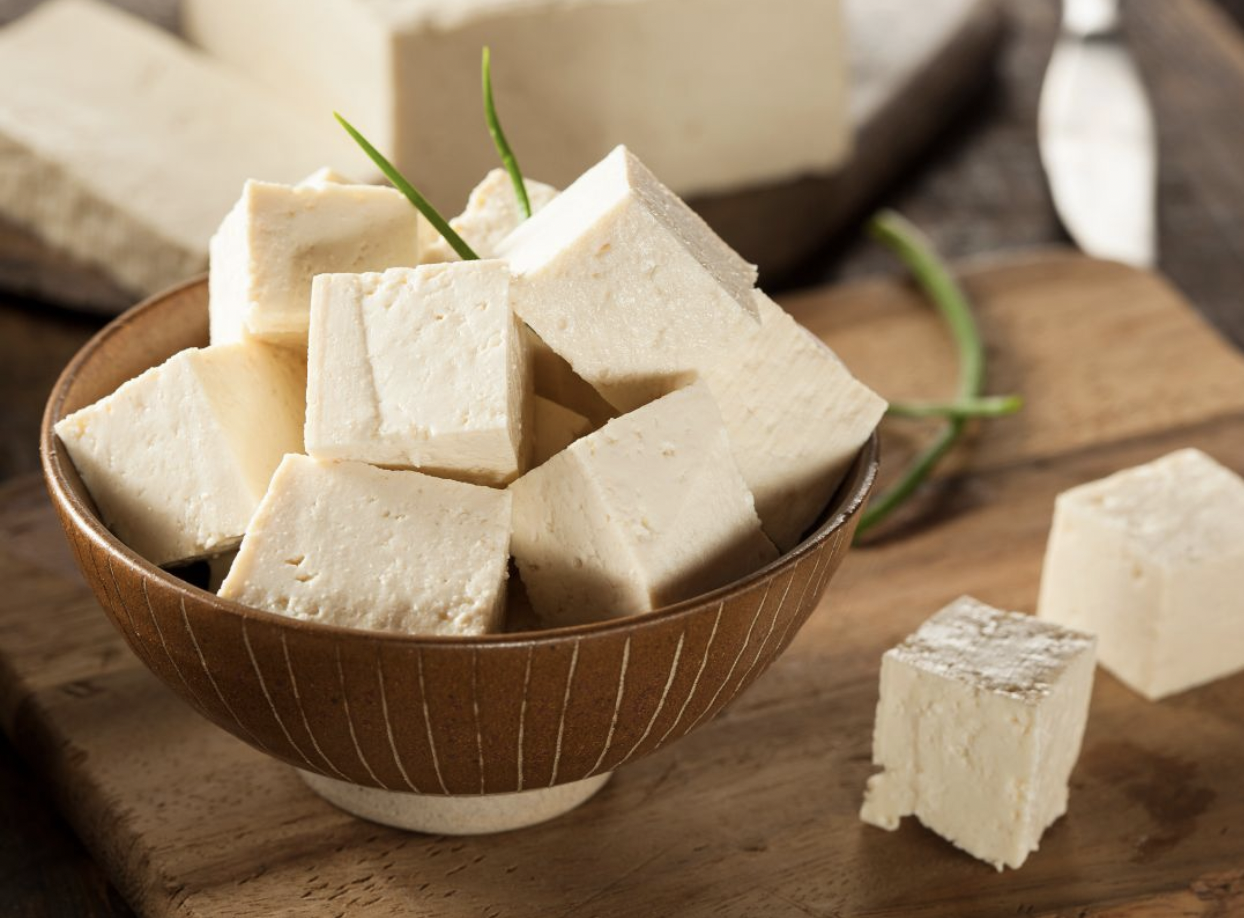
Photo via La Drogheria Veg
***
“What is it about soy that turns men into such spineless wimps?”
Far-right commentator Paul Joseph Watson asked in a video he uploaded online, warning his audience of impressionable boys that phytoestrogens in soy incite men’s genitals to shrink, cause men to grow breasts, develop higher voices, and even become less-assertive. He claims this dietary trend is creating “an army of soy boys,” a term that would soon become as common as “cuckservative” and “snowflake” in alt-right spaces. It is important to note here that soy does not actually contain estrogen, nor is there any significant scientific evidence that tofu chemically feminizes men.
In 2018, at a political rally in Texas, Senator Ted Cruz warned voters that liberals wanted to turn Texas into California: “right down to tofu and silicon and dyed hair.” The crowd laughed at the “joke,” knowing that tofu functioned as a symbol of feminized, coastal hippie liberalism—soft, while Texans wanted to remain hard; plant-based, while real Americans grilled meat.
When conservatives sneer at tofu, they rarely, if ever, are talking about nutritional facts. Tofu has become a shorthand for everything that is supposedly wrong with America today in the eyes of conservatives: environmentalism, empathy, femininity, and social change that threatens traditionalism and deviates from male-centered dominance. What matters in examples like these is that food has become a cultural proxy for anxieties over masculine power being threatened.
But why would a bean curd threaten masculinity?
The answer requires a deep understanding of historical contexts, as the idea that “real men eat meat” is so culturally ingrained in our society that it often goes unquestioned.
Western gender traditions explicitly equate meat-eating with manliness within “hegemonic masculinity.” Hegemonic masculinity refers to the culturally exalted form of masculinity that justifies inequality and dominance by naturalizing a particular version of manhood—one defined by “dominance, rationality, violence, and sexual prowess.” The act of consuming meat implies conquest over another body, making meat-eating a daily ritual of dominance.
This should come as no surprise to most Americans. We’ve all seen advertisements, like those from Carl’s Jr., that sexualize meat and pair it with half-naked women’s bodies, implying that both are consumable objects for male pleasure.
Many ecofeminist scholars argue that patriarchal systems function to degrade women, animals, and nature simultaneously. Empirically, this connection makes sense. Men consume more meat than women, are less likely to be vegetarian, and are more resistant to the idea of reducing meat intake.
If meat signals dominance, then plant-based food must signal something else.
Studies found that men who don’t eat meat are often seen as “weak” and less masculine by both men and women. Vegan men frequently report having their masculinity questioned and facing social exclusion from other men. Psychologists believe that, due to the fact that men are the high-status social group and therefore particularly motivated to protect the status quo, they are more likely to engage in and strictly defend stereotypically masculine behaviors and degrade non-traditional men. For some men, relinquishing meat feels like relinquishing power.
Meat’s masculine value extends to basic perception—in one study, identical dishes labeled as “plant-based” were rated as less masculine than when labeled as regular meat. Mass media frames vegetable consumption the same way: emasculating. One Hummer advertisement featured a man so worried about having just bought tofu that he purchased a Hummer to, essentially, restore his manhood.
This association between vegetarianism and weakness holds deep-rooted, racialized colonial origins. British colonizers in India used Hindu men’s vegetarian diets in order to further depict them as feminine, weak, and in need of patriarchal control, thus rationalizing their domination over them. Even today, Indian men are still portrayed in the media as physically weak, unmanly, awkward, unable to seduce women, or altogether asexual.
At the same time, this gendering based on food consumption intersects directly with race and empire, as Western societies have long categorized traditional white men as fully “human” while casting women (specifically, women of color) and colonized people aside as animalized, primitive in behavior, and closer to nature. Such a hierarchy further justified the dominance, sexism, and colonial rule of meat-eating Western men.
Because women and other marginalized groups have been naturalized, meat carries an additional layer of cultural meaning. It mimics male supremacy by staging a bodily domination of a feminized, natural world, effectively cognitively linking sexism to speciesism. Research shows that men justify meat consumption more directly and unapologetically than women, often invoking human superiority over animals.
As Western patriarchy sustains itself by dehumanizing those it seeks to subordinate, rendering them symbolically passive and therefore supposedly fit to dominate, many ecofeminists argue that eating meat cannot be a neutral dietary choice. It is inherently one of the many mundane rituals through which patriarchal power is expressed and reinforced, daily, and functions as a daily affirmation of male strength, control, and covert violence.
Thus, modern mockery of tofu or the unnecessary celebration of carnivorous diets is not merely about taste, but is embedded in a long history of sexist and racialized patterns in which meat-eating became a way to assert power over women, people of color, and the natural world alike.
So, when conservatives mock tofu as a “California” food, they unconsciously draw on decades of white supremacist and misogynistic extremist cultural and socio-political coding. The panic around soy is not really about estrogen—it’s about defending a hierarchy.
Evidently, tofu is not the enemy. Dismantling the stigma around plant-based diets requires more than nutritional data. It requires reimagining masculinity itself. Society must decouple strength from violence, dominance from identity, and meat-eating from status.
***
This article was edited by Siera Calderon and Siya Patel.
 Giovanni Esposito
  Emma Trauner-Coady
  Lauren Gracia