
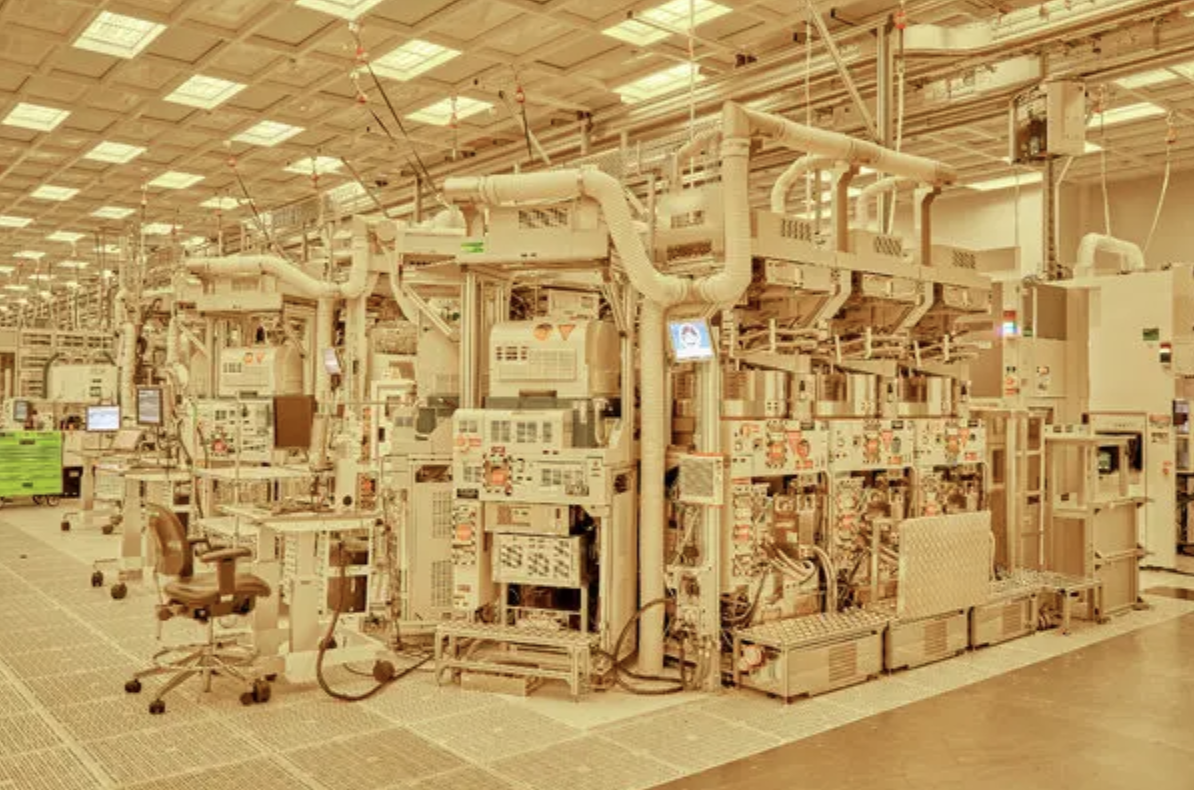
Photo via New York Times
***
Roughly $116 trillion rests in the hands of one island, the size of Maryland. The world depends on Taiwan for the chips powering AI, defense systems, and everyday tech. Silicon Valley has favored short-term profits for too long, and market competition has undermined the United States’ national security and economic durability by refusing to meaningfully diversify the semiconductor supply chain, even after repeated warnings from government officials.
Taiwan, a small island off the southeast coast of China, produces about 90% of the world’s most advanced semiconductors, which are a global economic dependency. Any blockade or conflict could crash economies and cripple technology sectors. A confidential 2022 report said loss of Taiwanese chips could shrink U.S. GDP by 11%, which would be the equivalent of wiping out the UK’s entire economy, and over double the impact of the 2008 recession. In this sense, these chips are not luxury goods; they power weapons systems, satellites, and AI infrastructure, which humans and corporations seem to rely on more and more every day. So supply fragility is not exclusively economic, but strategic.
With all of this taken into account, why hasn’t real change happened yet? Washington has been pushing for action, but Silicon Valley keeps responding: not yet. National security officials have privately warned top tech CEOs, like Apple, Nvidia, and AMD, that China could attempt to take or blockade Taiwan as early as 2027, posing catastrophic risks. And yes, 2027 feels far away, but we’re only getting more dependent on tech, especially AI, so the risk just keeps growing. Former President Joe Biden’s national security advisor called semiconductor dependency “one of America’s greatest vulnerabilities.” Although Apple CEO Tim Cook reportedly told officials that he sleeps “with one eye open,” many companies hesitated to shift procurement, noting cost and competitive strategy over security, despite classified warnings. Industry executives have said domestic chip production can cost around 25% more than Taiwanese production due to labor, materials, and training, and current U.S. chip factories are still behind Taiwan’s most advanced technology. The ongoing standoff between risk and profit is a policy failure wrapped in a corporate strategy. Silicon Valley has the information it needs, but continues to bet on stability (and budgeting) over resilience.
Policy efforts have struggled to change behavior; the CHIPS and Science Act of 2022 gave billions in incentives and tax credits. A bipartisan US law whose goal was to boost domestic semiconductor manufacturing and lessen dependence on foreign supply chains, the CHIPS Act helped attract private investment and new U.S. facilities. However, implementation has been slowed by high production costs, workforce shortages, and delays in construction and funding deployment. Therefore, it has yet to significantly shift the balance of global chip production. A Taiwanese company, TSMC, pledged significant investments in U.S. fabs (Arizona plants), yet even these still require tech packaging back in Taiwan. The Trump administration used tariffs and threats to push relocation, reflecting bipartisan concern about supply chain risk. The United States has also launched supply-chain cooperation initiatives like Pax Silica with partner countries to reduce “coercive dependencies” across tech supply chains, including semiconductors and AI hardware.
Public policy makers have repeatedly signaled the national risk, but corporations calculate risk differently, often through profit margins, quarterly performance, and market standing. Companies initially ignored warnings and hesitated to commit to the expensive U.S. purchases despite being briefed on invasion scenarios. Investment commitments frequently hinge on government incentives or pressure rather than voluntary risk mitigation. This reveals a structural issue in the United States’ political economy, which is that when private firms control production of strategic goods, national security becomes hostage to corporate cost-benefit calculations.
Some may argue that reshoring alone will not fix the problem without worldwide cooperation and diversified allies, since no single country can replicate Taiwan’s technological edge quickly. While yes, diversification and alliances are vital, the core political problem remains that the industry leadership has been slow to act without aggressive policy levers or existential dangers.
With this evidence taken into account, the worldwide chip dependency on Taiwan was not a mystery; governments warned the industry, yet profits continued to take priority. If it takes a crisis to finally force action, no one can say they were not warned. The dynamic where private incentives override collective security is not limited to semiconductors. It echoes in climate policy, infrastructure, and technology regulation. This is a systemic challenge, not an isolated case.
***
This article was edited by Abigail D’Angelo.
 Cooper Toland
  Lara Ejzak
  Jonathan Kho