
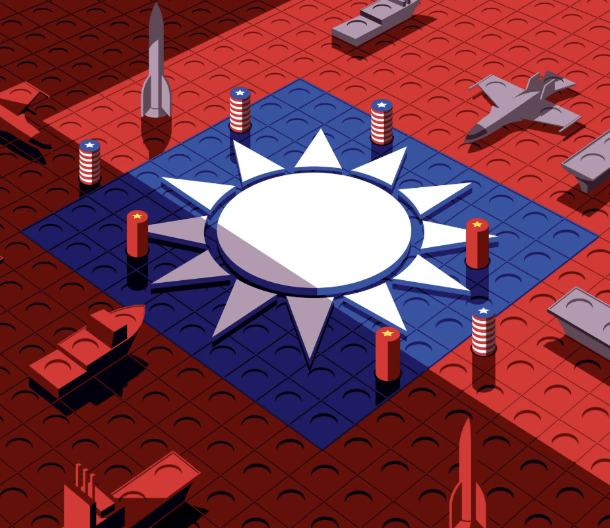
Image via The New Yorker
***
China may not need to blockade Taiwan if it can persuade the world’s commercial system to do it first
The battle for Taiwan may not begin with a missile strike, an amphibious landing, or a Chinese warship crossing the Strait. It may begin with a tanker captain changing course.
Imagine the order arriving before dawn. Chinese authorities announce that vessels bound for Taiwan must submit to inspection at a mainland port. Beijing insists that it is enforcing domestic law, not imposing a blockade. No declaration of war follows. No American president has yet ordered a response. Yet within hours, insurers recalculate risk, banks reconsider letters of credit, shipping firms suspend routes, and suppliers begin looking for safer markets.
The vulnerability this exposes is not merely physical isolation. It is the speed with which private actors can isolate themselves, long before any government decides what has actually happened.
That is the danger of a Chinese maritime quarantine. RAND researchers have examined precisely such a scenario, in which a quarantine is designed not to cut Taiwan off completely, but to give Beijing control over which ships, cargoes, aircraft, and people could reach the island. The objective would be to convert commercial fear into political leverage faster than democracies can agree on how to respond.
The attraction for Beijing is ambiguity. A quarantine could impose costs without immediately accepting the political and military consequences of a formal blockade, forcing Taiwan, Washington, and private companies to decide whether maintaining normal commerce is worth the risk of escalation.
The Invisible Blockade
American debate on Taiwan often jumps from gray-zone coercion to invasion. A quarantine occupies the dangerous space between them.
A blockade is a conventional military instrument with far clearer implications for war. A quarantine is deliberately ambiguous, framed as customs enforcement, safety inspection, or the routine exercise of sovereignty over waters that Beijing claims to regulate. RAND analysts have argued that such a quarantine could allow Beijing to assert de facto control over Taiwan’s access to ships, cargo, aircraft, and people while avoiding the immediate political consequences of declaring a formal blockade.
The ambiguity is not diplomatic theater; it changes the behavior of private actors. An insurer need not determine whether a Chinese operation legally constitutes a blockade; it need only determine whether it can still write the policy.
A quarantine does not have to physically close Taiwan’s ports to function. It can succeed if Beijing causes the commercial system surrounding Taiwan to close itself.
By day three, the port is technically open. The Navy has not fired. No blockade exists in any clear legal sense. But the insurer has withdrawn coverage, the bank has frozen financing, and the shipowner’s board has prohibited the voyage. The isolation does not exist physically. For the tanker that never sails, the legal distinction may be beside the point.
The Clock
The strategic variable is time. More precisely, it is the mismatch between how quickly commercial actors withdraw and how quickly governments organize a response.
Three clocks are running simultaneously. Beijing’s clock: disrupt, frighten, withdraw, strain, coerce. Taiwan’s clock: absorb, adapt, conserve, mobilize, endure. Washington’s clock: detect, deliberate, decide, organize, respond. The coercive window exists when the first clock moves faster than the other two.
A shipowner does not need to believe that war has begun. An insurer need not believe that a blockade is legally in force. A bank does not need to believe that Taiwan is about to fall. Each only needs to decide that its next voyage, loan, or contract carries more risk than it is willing to accept. The strategic effect emerges from those decisions accumulating faster than governments can replace them.
Insurers, bankers, shipping executives, and suppliers do not think of themselves as combatants. Each can make an individually rational decision to avoid a risk it considers commercially unacceptable. No individual decision needs to be coordinated with Beijing for the aggregate effect to serve Beijing’s purposes. That is precisely what makes the mechanism difficult to deter: every participant can act rationally, legally, and independently while producing a strategically cumulative effect. The first battle may be fought by people who do not even consider themselves part of the war.
That outcome is not inevitable. Governments may intervene. Insurers may continue coverage. Shipowners may judge withdrawal more costly than sailing. But the uncertainty itself is strategically important. Beijing does not need every commercial actor to retreat. It needs enough of them to move faster than Taiwan and its partners can compensate.
The Window
For Taiwan, the coercive window becomes dangerous when commercial withdrawal threatens the essential functions on which national endurance depends. Taiwan’s geography makes that vulnerability especially consequential.
In 2025, imported energy accounted for 95.4 percent of the island’s total energy supply. Natural gas generated 47.7 percent of its electricity, and coal another 35.3 percent. Taiwan’s 2025 Quadrennial Defense Review also warns that Chinese naval and coast guard forces could coordinate to isolate or blockade key ports and surrounding lines of communication, disrupting strategic material transport and commercial activity.
In a 2025 CSIS wargame of a Chinese blockade, electricity production fell to 35 percent of peacetime levels at its lowest point. The exercise was not a prediction, and its scenario involved a military blockade rather than the quarantine envisioned here. But it illustrates the consequences of a prolonged interruption in merchant shipping and energy deliveries.
Stockpiles buy time, but they cannot indefinitely substitute for the financing, insurance, shipping, and logistics through which a modern economy remains connected. A maritime crisis could therefore strain multiple systems, including energy, finance, and logistics, on different timelines simultaneously. Beijing would not need every system to collapse. It would need just enough of them to become uncertain at once.
The problem, in other words, is not isolated vulnerabilities, but the synchronization of strategic threats. A quarantine weaponizes not only physical access to Taiwan, but uncertainty about whether that access will remain safe tomorrow. Chinese exercises have increasingly combined military and maritime law-enforcement pressure around Taiwan. Taiwan’s defense ministry has reported PLA aircraft and naval vessels operating around the island alongside the Chinese coast guard and other official maritime forces.
Closing It
Who insures the ship that everyone agrees should sail, but that no private insurer wants to underwrite? That is the operational question hidden inside the coercive window.
That is not a hypothetical administrative problem. In 2025, CSIS ran 26 blockade scenarios and identified merchant shipping, energy deliveries, and insurance as central resilience problems, recommending that Taiwan and the United States prepare the ships, crews, and insurance mechanisms needed to keep commerce moving.
The conventional framework for Taiwan policy focuses on deterring invasion. A quarantine creates a different problem: shortening the interval in which commercial withdrawal can outrun political response. That requires two distinct jobs that strategists tend to collapse into one.
Endure the coercion. Deny the seizure.
“Endure” means keeping Taiwan’s essential commerce and services functioning under pressure. To achieve this end, the United States and its partners should designate in advance a narrow class of Taiwan-bound essential cargoes, including fuel, food, medicine, and grid equipment. If private insurers withdraw coverage after predefined triggers are met, a standing multinational facility should provide a capped layer of war-risk coverage for those cargoes. The point would not be to replace the private insurance market, but to prevent its sudden withdrawal from becoming a strategic choke point. The facility would activate only for predesignated cargoes and under predefined conditions, limiting the government’s exposure while eliminating the need to improvise coverage after a crisis begins.
This mechanism would require governments to determine in advance who bears the risk, which cargoes qualify, and who has the authority to activate coverage. These are precisely the decisions that should not have to be negotiated after ships have already stopped sailing.
Its value would not be solely financial. It would also eliminate one of the delays on which a quarantine depends: the need to invent an emergency insurance regime after private coverage has already disappeared. Fuel reserves, hardened infrastructure, and redundant ports would buy additional time.
“Deny” means making the second move, an escalation from quarantine to seizure, too risky to execute quickly. Taiwan’s military resilience, therefore, matters not only because it can complicate an invasion but also because it can prevent a quarantine from becoming a fait accompli before outside support arrives.
Deterrence, in this framing, begins before American forces ever enter the Strait. It begins when Beijing knows that commercial coercion will not produce a rapid political result.
The Power to Wait
The captain’s decision would reveal whether Beijing’s strategy was working. If a Chinese quarantine causes insurers to retreat, suppliers to suspend contracts, and allied governments to deliberate while Taiwan’s essential systems strain, China may gain political leverage without fighting the war most Americans have been trained to expect. The United States does not need to make Taiwan impossible to isolate. It needs to make isolation too slow to become coercion, before the tanker captain runs out of reasons to sail.
***
This article was edited by Christopher Bongiorno Jr. and Georgie Javier.
 Madelyn Marcisz
  Dominic Razzano
  Daniel Ukandu