
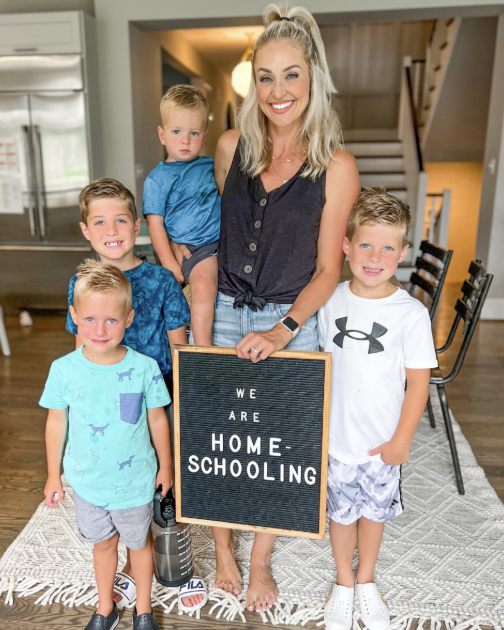
A homeschooling family announces their choice, via the instagram account @brookeraybould.
***
In the 2018-2019 academic year, approximately 2.8% of American students were homeschooled. In the 2020-2021 school year, the rate of students who were traditionally homeschooled (not enrolled in an online school or district-based distance learning program) was estimated to be 5.4%. At the time, some education professionals speculated about whether or not the pandemic would lead to any long-term growth in homeschooling rates. But, in the 2022-2023 school year, only 3.4% of American students were homeschooled, indicating that the pandemic-related boom in homeschooling had mostly leveled off.
However, in the past two years, a curious trend has emerged. In the 2024-2025 school year, 6.5% of American students were homeschooled, nearly double that of the 2022-2023 school year. Additionally, researchers suggest that the number could be closer to 7.5% once underrepresentation adjustments are made. This suggests that the increase in the number of homeschooling students could not possibly be a mere coincidence or a result of hangovers from the pandemic. Rather, the data suggest a cultural movement where more students are being homeschooled full-time than ever before. On social media, content propagates where conservative influencers are denouncing traditional public schooling in favor of homeschooling their children. One could argue that this trend is a striking and potentially even concerning development that has come out of the rising conservative movement.
According to the Pew Research Center, approximately 75% of parents who choose to homeschool their students do so in part because they want to provide them with “moral instruction,” and 53% do so because they want to provide them with “religious instruction.” While there is perhaps nothing inherently wrong with parents wanting to instill their children with their family’s values, any reasonable onlooker might wonder if the children being homeschooled for religious reasons receive exposure to any kind of diversity of belief systems. In an increasingly diverse nation, researchers suggest that kids who are unexposed to multiculturalism and diversity in childhood may have a more difficult time adapting to multicultural communities and workplaces.
There is also a major difference between the homeschooling environment of 1999 and the homeschooling environment of today. Prior to the advent of the internet and of social media, homeschooling families largely remained out of the spotlight. Other families did not frequently get exposure to homeschooling families that lived on the other side of the country, nor did they frequently encounter online videos propagating suggestions that public schools were toxic. In 2026, anyone who spends enough time on TikTok, Instagram, YouTube, or any other platform may be able to discover homeschooling content where families are sharing their daily routines, opinions, and curricula online.
One such family, known online as “The LaBrant Fam,” has recently come under fire by critics after sharing on a TikTok that the couple uses ChatGPT to create curriculum for their children, and that they only teach their kids the history they want them to learn once per week. This bleeds into another major issue of homeschooling, which is that children who are educated by their parents may not receive the same breadth of curriculum as would a child educated in a traditional school environment. Homeschool advocates describe the state of Tennessee (where the LaBrant Fam lives) as a “low regulation” state. What this means is that parents who educate their children at home are not required to have any kind of teaching qualification or to have a college degree. Rather, parents must simply hold a high school diploma or G.E.D. Parents must submit a curriculum plan to state authorities, but no particular subjects are required. Additionally, students only take standardized tests in the 5th, 7th, and 9th grades, meaning that for the majority of the years in which they are homeschooled, there will be no checks to ensure that they have met grade-level targets.
This is all opposed to the public school compliance requirements for the state of Tennessee. There, public school teachers are required to attain a Bachelor’s degree, attend an approved teacher preparation program, pass required assessments for the grade level and/or subject they will be teaching, and apply for certification with the state board of education. In public schools, students are taught by multiple teachers who each have received extensive grade-level or subject-level training in order to help them best serve the needs of their students. In contrast, children educated at home by parents who do not have the qualifications necessary to teach in public school do not have access to the variety of experiences and curriculum that they would in a traditional school setting. There is a reason why teacher qualification requirements are strict: it is a job that necessitates preparation.
But homeschooling is not the only area in which American children are being put at risk by the rising conservative movement. A mere cursory search on Instagram for the term “unvaccinated” yields a wide range of results, with many videos describing the reasons why parents are choosing not to vaccinate their young children. Some videos also feature people describing vaccines as a “hoax” or congratulating other anti-vaxxers on surviving what they deem to be a government conspiracy and psychological fear-mongering. All of this is in line with the work of the conservative MAHA movement, led by Health Secretary Robert F. Kennedy Jr. Under his direction, the CDC moved in March to reduce the number of required childhood vaccines from 18 to 11.
Other videos feature young women describing their aspirations to homestead, homeschool, and keep their children unvaccinated. This trend aligns with a broader social movement where the phrase ‘trad wife’ has entered the public lexicon. Online, young women are promoting getting married young, having children young, and following traditional, often biblically-inspired gender roles. Because of the propagation of this kind of content online, other young women may see idealized lifestyles that include homeschooling and homemaking, and make underinformed choices to take on that same role in their own lives. Certain former trad wives themselves have already spoken on the dangers of media influence in encouraging young women to follow similar paths.
This article is not meant to bash the people who are choosing to make decisions that are best for themselves and their families. However, it is meant to prescribe a certain level of caution around the conservative media currently populating social media. Choosing to homeschool, not vaccinate your children (against standard medical advice), or to get married at a young age are all important decisions that should not be made on the basis of online ideologies. Thus, media content like that outlined above can be dangerous when it is not evaluated critically. A nation fails when it fails its children, making how the next generation proceeds in the face of a confusing media environment all the more important.
***
This article was edited by Sean Cramer and Ella Keddy.
 Madelyn Marcisz
  Dominic Razzano
  Daniel Ukandu