
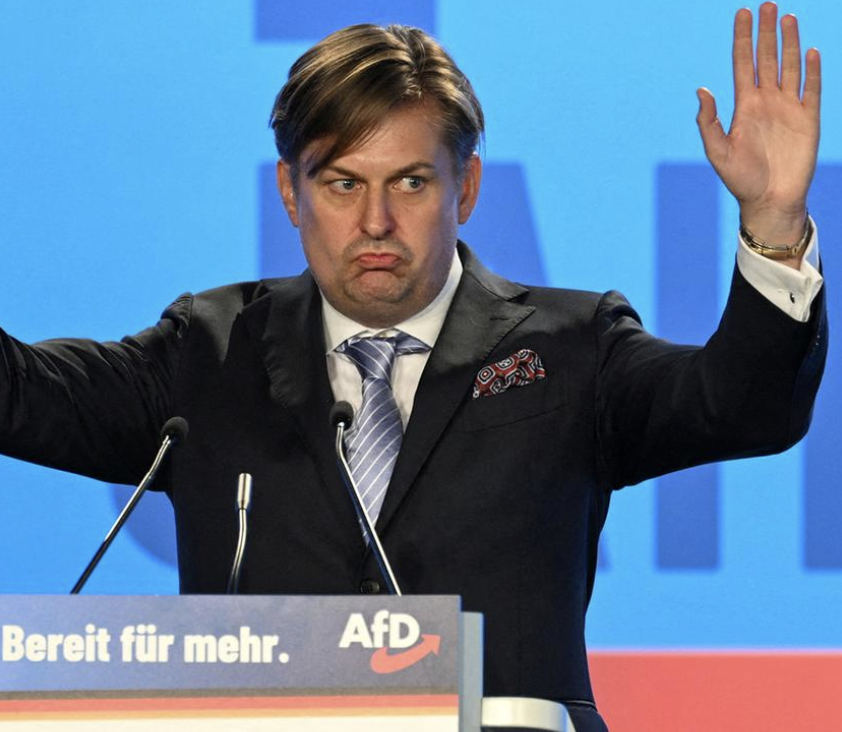
Image via tagesschau
***
In a recent election, the Alternative for Germany (AfD) gained a major parliamentary victory in the state of Saxony-Anhalt, inching it closer to being the first far-right German political party since the postwar period. The AfD won 44% of the vote, and therefore lacked an absolute majority in the state legislature. Other parties have long put a ‘firewall’ in place, under which they refuse to work with extremist parties. However, this firewall may be challenged with the AfD’s victory, possibly reigniting a cruel history of far-right tyranny in Germany.
For context, the AfD party was founded over a decade ago on German nationalist sentiments and quickly adopted anti-immigrant and anti-constitutional positions. The AfD has been described as “embodying Nazi ideals,” with the party leader for Thuringia, Björn Höcke, even using an illegal Nazi slogan at a rally. The party is a clear threat to order and democracy in Germany.
Support for the AfD has been predominantly male, with an overwhelming 50% of men voting for the party in the recent election. This is reflective of an overall pattern described by one 2025 study in which it was found that “the electoral success of far-right parties among young voters is primarily driven by the support of young men.”
This can in part be attributed to the manosphere. This term refers to online communities that create narratives about the struggles that men face, such as dating and fatherhood. It is a space concerned with the alleged threat that feminism and gender equality pose to men’s ability to be masculine. Men within the manosphere view themselves as victims of social progression and thus find refuge and belonging with other men online who understand them.
Openly misogynistic influencers who inhabit the manosphere, such as Roosh V and Andrew Tate, exploit the desire of young men to feel empowered. They profit from their insecurity, selling subscriptions and books about wooing women and being sufficiently masculine, usually by dominating women.
These men, who feel that their status in society is at stake, are being similarly targeted by politicians. A 2024 study found a link between far-right parties and vulnerable men, where parties “directly appeal to young men with a focus on questions of masculinity” in the face of patriarchal structures being challenged.
Returning to Germany, this trend is illuminated when looking at the methods of garnering support used by politician, and proud AfD member, Maximilian Krah. Krah is controversial to say the least, once claiming that serving in Nazi-Germany’s SS elite doesn’t make someone “automatically a criminal.” However, his politics are particularly illustrative of the manosphere’s correlation with far-right parties.
Krah connects with young men online through TikTok videos, acting as a mentor and guiding them through the struggles they say they face, such as getting a girlfriend. He directly reflects the sentiments that progression is a threat to manhood: he says, “‘Men are realizing that the promises of the modern left-liberal world are not doing them any good.’” In other words, he claims that the patriarchy being dismantled will harm men.
In this way, Krah hails the AfD as the party that understands young men and can thus best represent them. He plays on men’s insecurities in a world where they are decreasingly recognized as dominant and offers them hope of maintaining their status in society. Invigorated by its countercultural image, the AfD is a manospheric space through which men can band together in favor of societal regression.
The AfD, of course, is not just fighting for the pride of men, but for remigration, conscription, and pro-life legislation, while also engaging in climate change denial and islamophobia. So, whether inadvertently or not, male support for the AfD will have effects outside of the manosphere’s realm.
As a far-right wave crashes down and threatens to flood European politics, we must examine the broader cultural conditions that politicians strategically exploit to garner support for their parties. As vulnerable men are lured to the far-right with promises of social power, male-centered movements will not only perpetuate toxic patriarchal norms, but will also chip away at efforts, such as the German firewall, to prevent the not-so-distant memory of the Nazi Party from forcing its way back into power. Germany stands at a critical juncture, at risk of backsliding into an ugly history, and its fate remains unclear at the moment.
***
This article was edited by Cynthia Duchitanga.
 Thomas Tisdale
  Samuel Speiser
  Domenick Fedele