
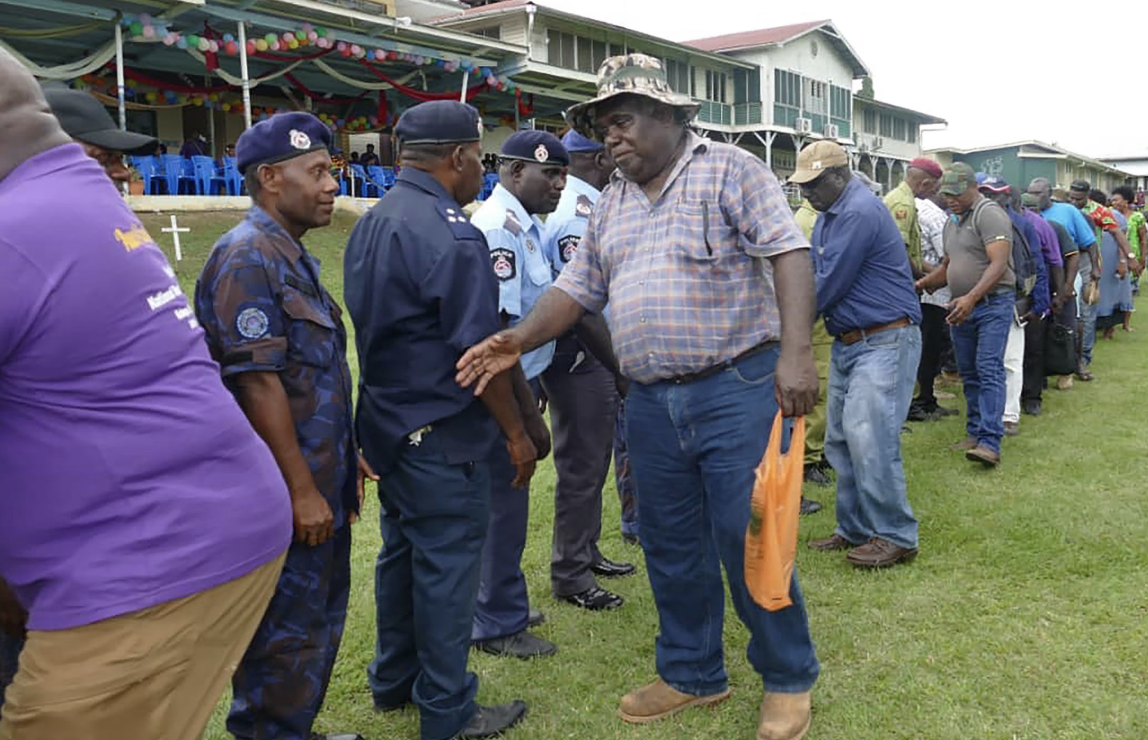
Photo via the Guardian
***
Within the next year, the world may see a new nation join its ranks. Currently an autonomous region of Papua New Guinea, Bougainville and its government aim to achieve independence in 2027, an ambitious goal for its population of 300,000 people.
In 2019, the island held a referendum with two positions – increased self-governance or complete independence. With approximately 85% of voters turning out, the independence option won with 97% of the vote. Though the regional and national governments have pledged to enter cooperation talks, the result has not been recognized by Papua New Guinea’s parliament and technically remains non-binding.
The referendum reflected continued division between the native population and the national government. Previously, these hostilities boiled over into a civil war that claimed over 15,000 lives, ending with a peace agreement in 2001 that established the region’s autonomy and laid the groundwork for the independence referendum nearly two decades later.
Decades of Division
The island’s unsuccessful attempts at independence follow a cycle of struggle for many aspiring nations. Geographically and culturally similar to the nearby nation of the Solomon Islands (of which it is the westernmost island in the archipelago), Bougainville has long been isolated from the rest of Papua New Guinea.
In the 1960s, the discovery of mineral deposits in Bougainville provided a boost to the Papuan economy. This would eventually lead to the opening of the Panguna copper mine in 1972. However, most of the mineral profits went to the federal government rather than the natives of Bougainville; the mine would eventually be closed in 1989 due to widespread opposition from local landowners. This issue was also compounded by the lack of significant political representation in the national government, which created some support for an independence movement.
Between 1989 and 1998, a series of armed conflicts would take place between the federal government and several rebel groups due to the aforementioned grievances, which displaced a large portion of the island’s population and destroyed critical infrastructure. Even today, the independence movement represents the lingering disconnect between Bougainville and Papua New Guinea.
The Hurdles of Independence
If Bougainville does achieve independence, it will face several obstacles on its ascension to the international stage.
The main roadblock would be UN recognition. Being accepted into the United Nations requires an application to be submitted to the body’s Security Council; this then must be approved by 9 of its 15 members, including all five permanent members that have had seats since the end of World War II – the United States, United Kingdom, France, Russia, and China.
If Bougainville chooses to pursue independence against the wishes of the Papua New Guinean government, it would still exist as a nation but with limited recognition as a non-UN member state. Given the Chinese government’s growing interest in Papua New Guinea as a potential strategic ally, entrance into the United Nations would be unlikely, which means that Bougainville would likely exist in a limbo alongside other partially unrecognized states that lack large-scale international recognition.
Assuming the region achieves an independence agreement with Papua New Guinea and has a successful admission into the UN, Bougainville will still face issues of national stability and unity. The most recent nation to join the United Nations, South Sudan became a nation in 2011 following an independence referendum after previous civil wars against the government in the North, largely driven by religious, ethnic, and cultural divides. However, the country soon plunged into its own civil war. The country’s path to independence shares parallels with Bougainville’s; although this does not mean that this newly independent state will face a similar situation to South Sudan, it serves as a warning that independence does not guarantee peace and, in fact, can be a cause of further conflict for a nation and its people.
Additionally, while Bougainville’s vast mineral wealth could be used to greatly benefit the native population, it could also establish a cycle of instability known as the “resource curse”, where nations often fail to fully utilize resources like oil and minerals to the benefit of their people; this is often coupled with political and economic insecurity. While this issue is not always prominent for developing countries, it can often stifle their growth and make it difficult for developing institutions and infrastructure that are critical for these countries.
Conclusion
Whether Bougainville decides to declare independence or not is still up for question. Whatever path Bougainville aims to take, we should hope that it ultimately benefits the people first. Bougainville’s independence is a challenge that requires its leadership to make long-term decisions in order to create a better future for its people.
***
This article was edited by Andrew Ang and Elise Grin.
 Thomas Tisdale
  Samuel Speiser
  Domenick Fedele