
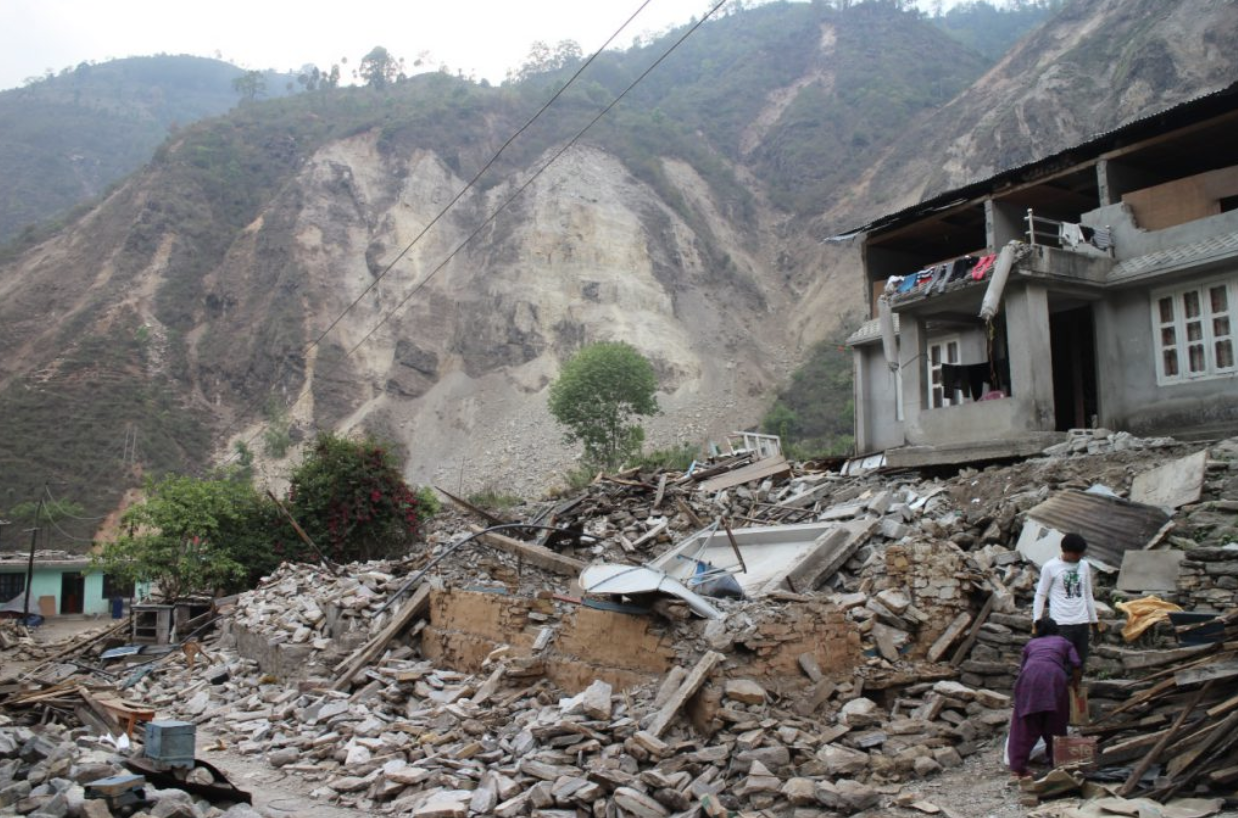
Image via Dialogue Earth
***
A month ago, Nepal was struck by deadly flash floods caused by a rock-and-ice avalanche. Roughly 1,400 people perished in the disaster, and more than 6,150 remain missing. It was a compound event caused by multiple effects of climate change. Thawing permafrost seeps into the cracks between rocks, deforestation makes it easier for rainwater to enter the soil, and a combination of thinning glaciers and rising temperatures also contributes to this event. The floods destroyed large amounts of infrastructure, bridges, and entire towns. Recovery will take years, but the floods are becoming simultaneously more persistent and destructive.
Two years ago, Hurricane Helene rampaged through the Appalachian region of the United States, dropping over eighteen inches of rain across the mountains, causing eerily similar deadly flash floods to those in Nepal. Due to oversaturated soil, the mountains became slick, creating the perfect conditions for over 2,000 landslides to occur in the area within a week. The personal damage was immense, with over 227 deaths in six different states, hundreds missing, and 4.6 million North Carolinians—40% of the population—lived in the designated disaster zone. On an infrastructure scale, 7,000 roads and bridges were damaged, some of which were completely washed away, and communication lines remain inoperative.
As in Nepal, Appalachia will experience more persistent storms and more intense flooding due to atmospheric warming. Hurricane Helene carried 10% more water with 11% stronger winds, which follows an increase over 100 years for the region. These increasing statistics are attributed to climate change; if climate change continues to worsen, devastating rainfalls in the Appalachian region will become 15-25% more likely.
Appalachia has been exploited since the Industrial Revolution. The ecosystem was reshaped by railroad expansion, coal mining, and natural gas fracking. Studies show that the historical context, combined with the extreme weather conditions, makes Appalachia the “nexus of the climate crisis.” The area’s rural economy cannot fund the recovery or precautions; it is solely reliant on the federal government’s nonexistent investments in Appalachian infrastructure. The exploitation of the land and its residents will continue to suffer if no support is given, and the current administration shows no signs of making this a priority.
Nepal is arguably another “nexus of the climate crisis,” as it ranks sixth in countries most vulnerable to climate risk. The Himalayan Mountains and glaciers are beginning to melt faster, slicking the mountains down. Dr. Friederike Otto, a climatologist of Imperial College London, co-authored a study on the disaster, stating there was “absolutely no doubt that human-induced climate change played a role here in the preconditioning of the disaster.” Nepali authorities state that Nepal is among the lowest contributors to greenhouse gas emissions, yet it is one of the most globally vulnerable places. They are calling for compensation and global efforts to cover recovery funds. Nepali Prime Minister Balendra Shah is scheduled to address the UN General Assembly on disaster and climate justice, seeking roughly $20 million from the UN Fund for Responding to Loss and Damage. This will be a historic meeting, and the UN’s response will set a precedent for how world powers respond to disasters, especially in climate-risk zones.
Climate scholars predict that climate change will cause, and is currently causing, massive waves of migration to areas with a safer environment. Where is that, though? There is seemingly a different natural disaster on each continent continuously. Where is this supposed “Garden of Eden” that is supposed to safeguard all 8 billion of us? Our safeguard is supposed to be our democratically elected government’s policies ensuring our endurance, quality of life, and prosperous future.
The Appalachian region in the United States is a climate-risk zone in one of the richest and most powerful countries in the world. If the so-called unipolar hegemon does not make efforts or funds to one of its territories, then that response will be replicated. Nepal, which experienced a disaster similar to Appalachia’s, is a country with far less funding, military power, and influence, and is on the other side of the globe. Will their government be able to gain legitimacy and help their people if Appalachia can’t? The citizens of both regions are subject to their governments’ decisions, but are ultimately vulnerable to the actions of the world at large. The future of climate-risk zones and global migration is being determined in the coming days, and if the world powers do create safe zones large enough to house all of us, then we must create our own Garden of Eden.
***
This article was edited by Ria Mukherjee and Mila Cabanlit.
 Thomas Tisdale
  Caroline Smith
  Samuel Speiser