
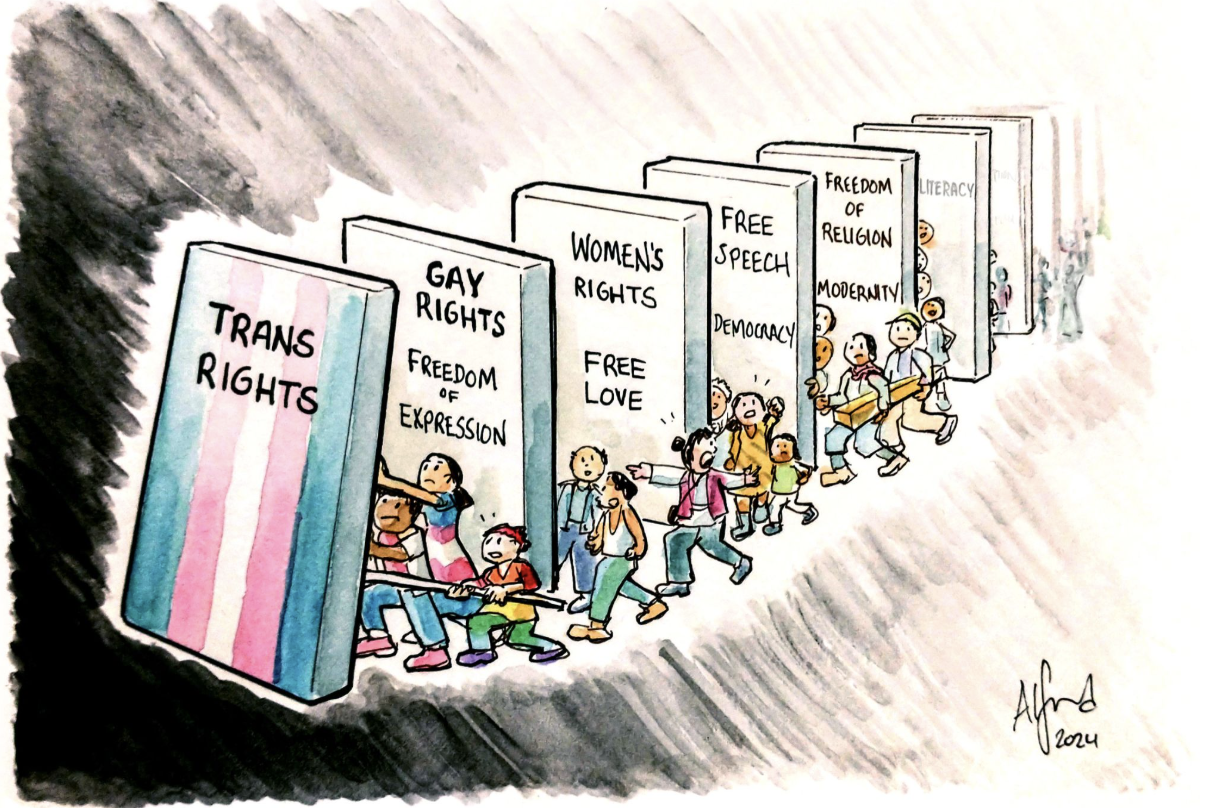
Image via Alfred Twu
***
As limited government is a core principle of conservatism, would it make sense for American conservatives to fight against legislation that allows the government to dictate individual identity? Is there really a difference when it comes to policing identity steeped in faith versus gender expression?
A shining principle of our constitutional republic is embodied in the First Amendment, which guarantees our rights to expression and self-determination. While many American conservatives adhere to an individualistic approach to politics, a possible solution to the disconnect between progressive causes and conservative ideologies is the premise that American freedom is indivisible. Principles of American conservatism, such as individual freedom and limited government, are directly compromised by the infringement on trans people’s rights. Therefore, it would follow that a conservative voter, even if their personal beliefs are based on traditional social norms or religious practice, while disagreeing with a specific choice of identity, would rally against anti-trans legislation as an attempt to limit expanding government authority.
Selective liberty and exclusionary constitutional protections weaken the very structure of American freedom, because “let’s be clear–if the government has the power to deny constitutional rights to one vulnerable group, then everyone’s rights are at risk.” This fact alone should concern conservative Americans, as former instances of group-specific laws, such as national security and counter terrorism laws targeting foreign nationals to deter international acts of terrorism, eventually expanded to touch the general populace. Without a doubt, anti-trans legislation will follow a similar pipeline, as the American legal system is an all-encompassing body; therefore, targeting a specific demographic will not prevent the ripple effects seen in previous attempts at national security. In other words, what is enacted upon one will be enacted upon all.
The USA Patriot Act, following the terrorist attacks on September 11th, 2001, is one of the most infamous examples of federal surveillance and broadening of government powers. Originally aimed at strengthening national security and deterring terrorist attacks, this emergency legislation was used to significantly expand the use of counterterrorism tools in domestic law enforcement investigations. Although in theory this instance of circumstantial constitutional infringement targeted foreign nationals, in practice the Patriot Act “[turned] regular citizens into suspects” by blurring the line between standard protocol in domestic criminal investigations and the secret intelligence-gathering tools used against national security threats. Under the Patriot Act, FBI agents were permitted to enforce gag orders and request phone logs, bank records, and computer records (in the form of National Security Letters/NSLs) without a judge’s approval. “Sneak and peek” searches were also permitted, allowing federal law enforcement agents to enter, search, and seize property while the owner was away, without informing the owner until after the secret search had been conducted. This legislation challenged the universal protections provided by the Fourth Amendment, violating guardrails that prevent such searches and seizures. As reported by the FBI, only 53 of 143,074 National Security Letters issued from 2003 to 2005 resulted in criminal referrals to prosecutors, and none were for terrorism. In 2010, federal agents conducted 3,970 “sneak and peaks” and only one percent were terror-related, while the vast majority (76%) were drug-related. In other words, the FBI was able to utilize emergency legislation to supersede standard procedure and utilize surveillance techniques that citizens not formally suspected of terrorism are constitutionally protected from.
Therefore, we, the people, need to take a closer look at the pieces of legislation our government officials are proposing, because even if a law is targeted at one demographic or claims a specific purpose, it will be used to target another group or for another purpose. Ultimately, concentrating more power in the government’s hands (just as the Patriot Act was intended for foreign nationals but was inevitably used to target U.S. citizens).
While the Patriot Act is an extreme example of exclusionary constitutional protections as they pertain to national security and law enforcement, it serves as an important warning to draw a red line when considering implementing laws that place barriers to the liberties certain groups are afforded. After all, as Dr. Martin Luther King Jr. put it, “injustice anywhere is a threat to justice everywhere,” and the infringement on the rights of one is an infringement on the rights of all.
So far in 2026, the American Civil Liberties Union has tracked 531 anti-LGBTQ bills introduced in U.S. state legislatures, including measures that weaken existing civil rights protections and impose barriers to accurate IDs, free speech, expression, healthcare, public accommodations, and more. Ultimately, as other legal scholars and public health data indicate, the American legislative framework, centralizing precedent, allows for the expansion of government oversight over trans Americans to impact non-queer people as well.
While some pieces of legislation may complement traditionally held beliefs on gender fidelity and social norms, conservatives should ask whether the government should assume responsibility for setting ideological standards. Even if they agree with the policies the current administration is pushing, given that the principle of limited government is meant to protect against such overreach, conservatives should assess whether it’s truly in their best interest. As these proposed and passed pieces of legislation enact state-sanctioned definitions of gender identity, enforcing a signal moral standard onto self-determination, it should be considered that a future administration will now be equipped with the tools to enforce government-sanctioned definitions of marriage, faith, or speech that may not reflect or even disrespect other aspects of traditional social structures. It’s a slippery slope. A path to legal precedents that, while temporarily may ban Americans from making personal choices that contradict traditional social norms that conservatives hope to preserve, will provide future legislators with the power to redefine all aspects of free speech that pertain to identity. Therefore, as conservatives’ own right to self-determination is better protected when all demographics are equally protected under the law from state-led interference, conservatives should pursue pluralism as both a legal and political framework. This would mean allowing the coexistence of contradictory or even competing ideologies to preserve the constitution as a protective mechanism for all people (including themselves and their own ideologies) against government overreach.
This is best exemplified through religion, as faith pertains to identity and is a fundamental concern among conservative voters, with 82% of conservative Americans identifying themselves as Christians according to the Pew Research Center. It should be noted that pluralism, as both a legal framework and a socio-political path to tolerance, actively protects religious liberty. This freedom of expression relies on the principle that the government cannot enforce a single theological dogma or moral assertion on its citizens. Therefore, concerning themselves with the rights of trans people as an act of pluralism is a logical move for American conservatives, as legally enforcing any one ideology (religious, moral, or any other) is a double-edged sword that may allow one administration to centralize religious morals, then permit another secular administration to dismantle all religious identity and protections with their increased authority over identity.
Furthermore, while I try my best not to condescend or single out any group of people, it seems fundamentally contradictory when conservatives claim to prioritize limited government while supporting candidates or policies that expand the government’s role in individual choices of expression. The two may not coexist.
And while anti-trans legislation is not being applied in the same manner as more extreme exclusionary legislation (such as the aforementioned Patriot Act), the precedent set by prior efforts to limit constitutional protections should concern all Americans, regardless of where they stand politically or culturally. Moreover, this conversation must bring into question what role the government should play, if any, in policing identity. Americans across the aisle must assess whether state legislatures or the federal government have a valid claim to legislate on cultural issues, regardless of whether they agree with these enacted laws.
The American government’s role, according to its founding documents and the Bill of Rights Institute, is to ensure safeguards are held in place to protect individual liberty and personal happiness while “possessing sufficient power to promote the public good effectively.” While personal notions of “the good life…can be deeply held ideas about religion, morally…, culture, governance, and other organizing principles,” like every other society, diversity of all of these belief systems and “visions of what is right” are continuous. The government should not be used to force people into “identical lifestyles.”
Policing any identity based on religion, culture, or gender expression is not in the best interest of conservatives (or any other Americans, for that matter). Therefore, if conservatives truly aim to preserve the Constitution and, by extension, the protections it provides, they will have to fight for the rights of those with whom they may not agree. If conservatives’ true goal for the government is to have their own ideologies systematically enforced upon others temporarily, simply, then the current trajectory of the GOP makes sense–but that comes with risk. As if one administration is given the power to legally police identity to fit one ideological standard, another future administration may do the same with another set of standards. Therefore, if a conservative truly wants to protect their own rights, they must rally against any legislation that makes exemptions to the protections of the Constitution.
In other words, a conservative would fight for trans-rights to reaffirm their own constitutional rights and liberties, as the rights of one are only guaranteed by the equal rights of the collective.
***
This article was edited by Aayushi Kejriwal and Nicholas Meetze.
 Glenmarie Rios Rodriguez
  Luke Helmholz
  Sidney Levitt