
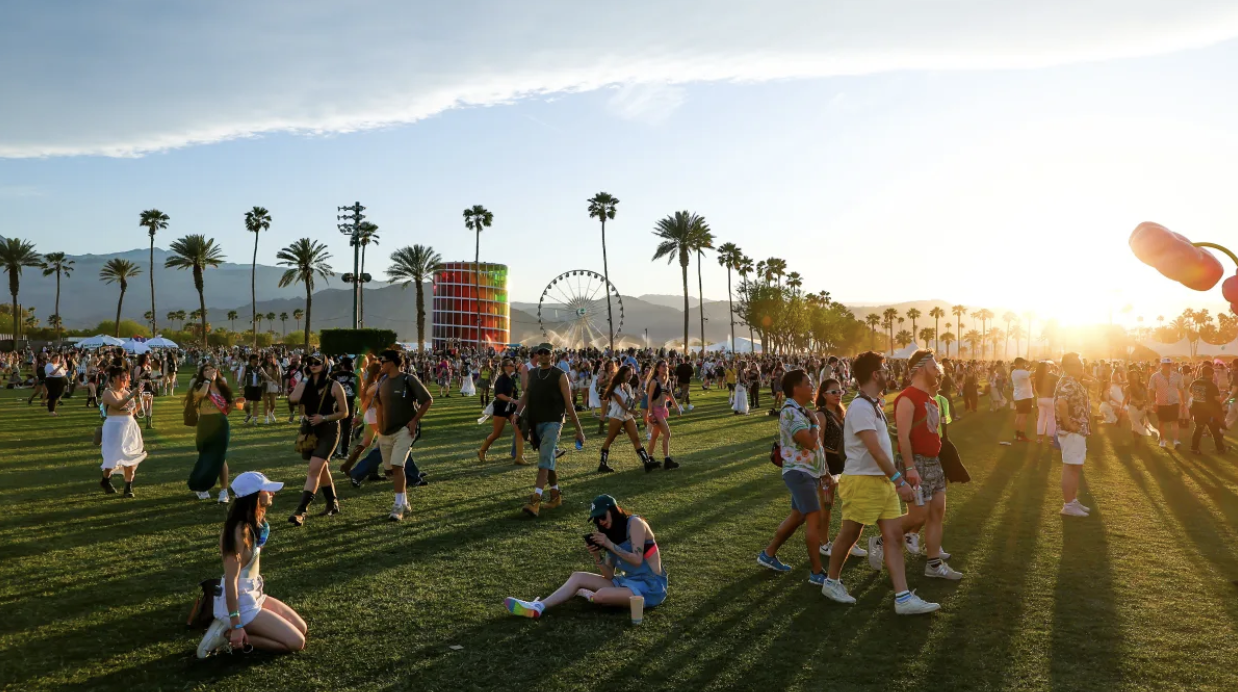
Photo via NBC Los Angeles
***
For the past week, coverage of the Coachella Valley Music and Arts Festival has dominated social media feeds across the country, detailing everything from “Bieberchella” to the long-anticipated influencer outfit reveals. With the festival celebrating its 25th year of performances, the history of its controversies, rising prestige, and cultural contributions deserves a moment of reflection. The festival has grown from a niche event into a global phenomenon, shaping trends in music, fashion, and pop culture. Despite criticisms of exclusivity and commercialization, Coachella remains a platform for artists to reach massive audiences and redefine their careers.
The two-weekend desert phenomenon didn’t start with the inaugural performances of Rage Against the Machine and Tool in 1999, but instead with a rebellion effort by Pearl Jam in 1993. In order to avoid service charges on ticket sales, the band boycotted Ticketmaster venues, causing them to seek out lesser-known arenas. They booked Empire Polo Club with the help of concert promotion company Goldenvoice, inspiring the company’s owner, Paul Tollett, to use the space for a larger festival in the future to combat the decline of interest in their shows. Launched in 1999, the first year of Coachella as a two-day festival was a critical success but a financial disaster, where Tollett and Goldenvoice lost almost a million dollars, despite critics raving about the multi-genre and underground performers.
The festival had a rocky start, where uninterest forced a hiatus in 2000, and organizers had to use the allure of free parking with a free bottle of water to attract audiences, but it became a sellout festival by 2004, with the help of headliners Radiohead and The Cure. Coachella only continued to grow throughout the 2000s, expanding to three days in 2007 and presenting performances from big-name artists, such as Prince and later Jay-Z. To meet increasing demand, the festival was extended to two consecutive weekends in 2012, the same year that a featured hologram of Tupac sparked a new wave of interest, and ticket sales broke global records. Since then, Goldenvoice, the festival’s organizers, have had to repeatedly purchase more land to match attendance, and have solidified their festival as a cultural sensation, despite two years of cancelled shows due to COVID, representing artists across the globe and continuing to set records with the 2026 concert series.
Aside from the unparalleled contributions to the music industry and development of artists, Coachella has also become notable for the fashion trends it has inspired over the years. Given its origins as an alternative music celebration, most early attendees were sporting indie or grunge looks, which is a notable departure from the style of the festival today. Throughout the 2010s, the Coachella fashion became synonymous with boho-chic, as celebrities such as Vanessa Hudgens and the Kardashians led the trend towards flower crowns and artsy layered outfits. As the event continued to gain notoriety, the curation of more cohesive looks became more common among festival goers. With the introduction of influencer culture, high-glam and designer looks became popularized by public figures like James Charles. While social media coverage for the 2026 performance series shows a reversion towards more bohemian energy, with cowboy hats and desert neutrals, the fashion aspect of Coachella’s influence has come a long way since its early days.
The festival’s ascent to global fame has been consistently shadowed by controversy, often centered on the behavior of celebrity attendees and the pervasive influence of social media. Early concerns revolved around the behavior of “it-girl” attendees, with instances such as Vanessa Hudgens’ alleged cocaine use facing scrutiny in 2011, momentarily clouding the event’s image. More persistent, however, is the recurring critique of cultural appropriation, particularly during the peak of the boho-chic era when traditional indigenous and religious attire, such as feathered headdresses and bindis, were worn as mere fashion accessories. In recent years, the attention has shifted to the stage and the audience: Frank Ocean’s highly anticipated 2023 performance was criticized for logistical issues and an abrupt ending, while the 2026 series saw unexpected backlash due to Sabrina Carpenter’s disrespect towards an audience member’s culture, which dominated online discourse for the rest of the festival. Furthermore, the relentless pursuit of social media engagement has fostered a culture of desperate influencer performance, where authenticity is often sacrificed for meticulously curated, sponsored content, reinforcing criticisms that the festival has become more about marketing and exclusivity than music.
Despite the occasional controversy of both previous and ongoing performances, the importance of Coachella ultimately lies in its unmatched contributions to the music industry and festival culture as it’s known today. Not only does the festival offer the “Coachella Effect” to already-popular performers, with artists experiencing sudden waves of revenue and interest after their performances, but Goldenvoice also hosts a “Coachella Showcase” earlier in the year to highlight emerging talent for the opportunity to perform. Networking opportunities have been instrumental in launching the careers of artists like Chappell Roan and Dominic Fike to their current level of fame. Beyond helping artists, Coachella has also contributed to festival culture worldwide, setting standards for creative fashion, venue standards, and attendee experience, as well as offering multigenre performances to appeal to a wide range of audiences. Upon reflecting on Coachella’s rocky beginnings in the context of how Coachella has transformed its little Californian valley, it’s amazing to see how influential the festival has become today.
***
This article was edited by Emma Saliasi and Emma Cate Martin.
 Esme Carson
  Anne Eslick-Persyn
  Stan Refermat