
Photo via Franck Fife/AFP via Getty Images
***
4 years ago, the world watched in real time as Russian tanks rolled across the Ukrainian border, starting Europe’s largest and bloodiest conflict since World War II. For weeks, the war dominated headlines and flooded social media feeds as the world watched in horror at the atrocities unfolding in Ukraine, but attention is finite. A quick glance at Google Trends reveals a sharp spike in interest in “Russia Ukraine,” but that mountain has long since flattened, except for a few brief surges when a politician said something incendiary or a particularly shocking piece of information broke through to the news. What was once the defining geopolitical moment of our generation has become background noise and not worth a second glance.
This erosion of attention is neither accidental nor harmless. Authoritarian regimes understand that time is their ally and distraction is their shield. The war in Ukraine has not slowed down to match headlines; civilian casualties continue, critical infrastructure is destroyed, and war crimes are committed daily. Yet in the United States, attention surrounding Ukraine seemingly only surfaces when U.S. President Donald Trump offers an outlandish comment aimed at reframing the war as a partisan talking point or sets an unrealistic ultimatum designed to exploit the country for its precious resources.
The consequences of this attention deficit extend beyond the newsroom. When the public eye is looking elsewhere, corporations, sports federations, and international organizations can test ethical boundaries and quietly normalize engagement with a regime accused of crimes against humanity. In a time where visibility leads to accountability, the fading spotlight on Ukraine might be Russia’s most powerful strategic advantage.
The Iranian government recognizes the importance of this phenomenon in its brutal crackdown against protesters over the past month. While the internet ban undoubtedly is crucial in preventing information from entering the country, its most lasting effect is its suppression of information leaving Iran’s borders. With death count figures taking weeks to verify, news coming out of Tehran has been few and far between, and the lack of consistent news has made it difficult for the protests to get the attention they deserve. The U.S. has tried its best to open up channels of communication, smuggling in thousands of Starlink devices so activists can report to journalists outside of the country.
It’s clear that U.S. tech companies understand the importance of communication when the public eye is even somewhat on the issue, but they also clearly understand when they can push the limits of what is ethical when the public is looking elsewhere. Ubiquiti, a NYC-based company specializing in wireless data communication products, was discovered to have been permitting the selling and distribution of its products to Russian military units, despite heavy U.S. sanctions. The devices have supported and enabled Russian drone strikes on Ukrainian civilians, actions that the United Nations has condemned and labeled as crimes against humanity.
Despite video proof that the Russian military is using Ubiquiti products, there have been no repercussions. CEO Robert Pera, owner of the Memphis Grizzlies, was already fined 12 years ago for circumventing U.S. sanctions on Iran in a manner very similar to this. Yet this story has gained little traction and failed to break through to the mainstream news cycle. With all eyes on the Epstein files and the ensuing fallout, news about the Russian invasion of Ukraine has fallen to the wayside.
Unfortunately, Russian President Vladimir Putin has recognized the lack of attention being paid to Russia’s horrific acts in Ukraine. He knows he can begin working his influential contacts to swing public opinion in his favor. His first call appears to have been to FIFA President Gianni Infantino, who has always had a suspiciously close and intimate relationship with Putin. FIFA, and Infantino in particular, have frequently been willing to overlook Russia’s human rights abuses, yet ultimately had no choice but to ban Russia from all competitions after Russia launched its campaign in Ukraine in early 2022. However, do not mistake this absolute condemnation for moral clarity; the most powerful bodies in international soccer only chose to act after days of growing unrest.
The reluctance to denounce Russia and its invasion of Ukraine highlights a worrisome trend in which the world’s elite are all too willing to pay no heed to Moscow. Infantino recently ruled in favor of lifting FIFA’s ban on Russia, arguing that the ban has “achieved nothing… and only created more frustration and hatred.” Not only is this statement grossly inaccurate in assessing the desired outcome of such prohibitions, but it also normalizes pro-Russian dialogue on a global scale. Russia recognizes how influential a country’s athletic success is in shaping public perception; if Moscow believed success to be trivial, it would not have devoted countless resources to orchestrating extensive doping schemes across multiple competitions. Studies have found that achieving Olympic medals can lead to more positive perceptions of authoritarian and nationalistic attitudes, especially among less educated individuals. Russia understands this, but it appears FIFA and other international organizations have chosen willful ignorance.
The potential silver lining is that the only thing more influential than medal success is sticking to sporting values and the rules of fair play. These values are not limited to the field of play; they extend to a country’s actions away from sports as well. When FIFA decides to excuse Russia’s actions off the field, it enables Russia to keep committing heinous acts in Eastern Ukraine, all without fear of significantly harming public opinion.
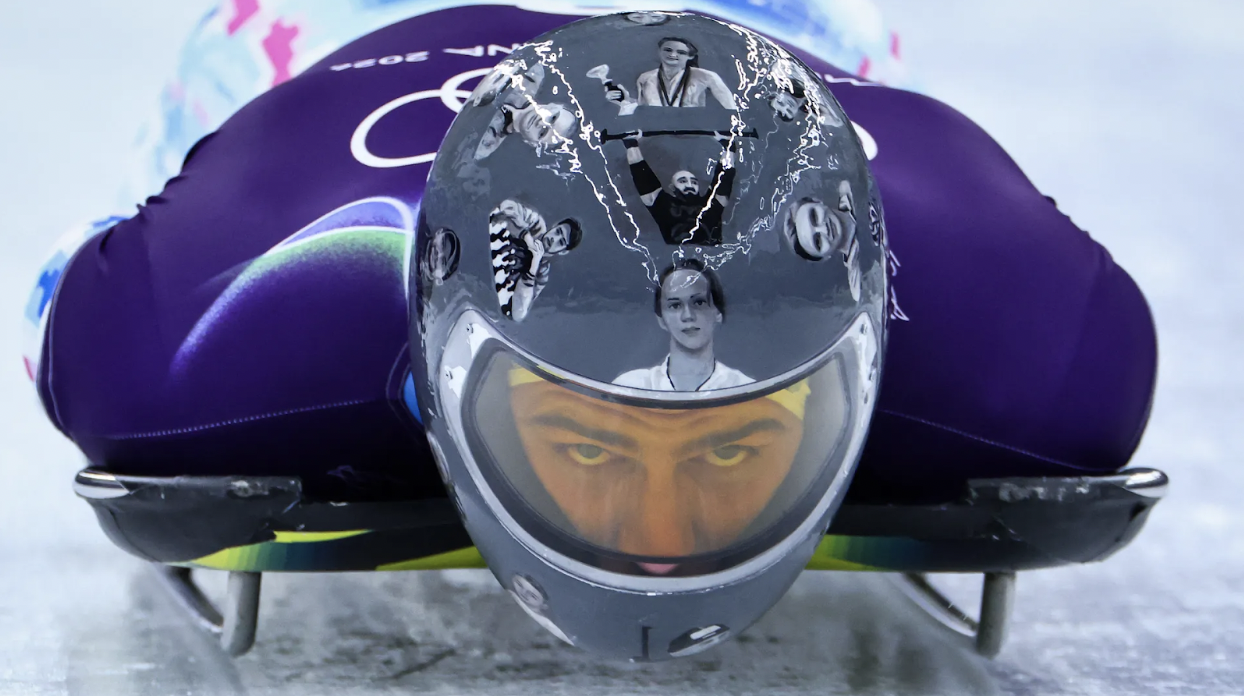
Infantino’s disturbing comments come before another incident during the 2026 Winter Olympics in which Ukrainian athlete Vladyslav Heraskevych was disqualified from competition after he planned to wear a helmet featuring images of his fellow athletes who were killed in the war with Russia. Despite repeated warnings to change to an approved helmet, Heraskevych made the decision to continue wearing the remembrance helmet, saying there “are things more important than medals.” He understands the impact of messaging, as does the International Olympic Committee, which is why there is a ban on political messaging during events. The IOC argued that the helmet constitutes propaganda, despite merely showing images of Ukrainians killed during the war. While the term propaganda undoubtedly has a grey area in which this incident falls, the IOC has chosen a strange time and place to draw the line.
With the war entering its fifth year and an outcome favorable to the Ukrainians increasingly unlikely, the IOC has silently excused the atrocities committed by the Russians under the guise of neutrality, all while selling T-shirts commemorating the 1936 Olympic Games held in Nazi Germany. The IOC and other institutions have the chance and will continue to have the opportunity to be a positive force in this world, and time and time again, they choose to succumb to power and greed. They’ve been able to get away with it for decades with no public accountability, and with authoritarianism on the rise across the globe, there’s no sign of them changing their ways.
Thankfully for Heraskevych and the Ukrainian fight against Russia, the IOC’s refusal to stand up for what is right has made this story about a skeleton rider’s helmet bigger than it ever would have been. It’s all quiet on the Eastern Front and around the world, but it doesn’t have to be that way.
***
This article was edited by Andrea Velez.
 Glenmarie Rios Rodriguez
  Sarah Olivia Sullivan
  Luke Helmholz