
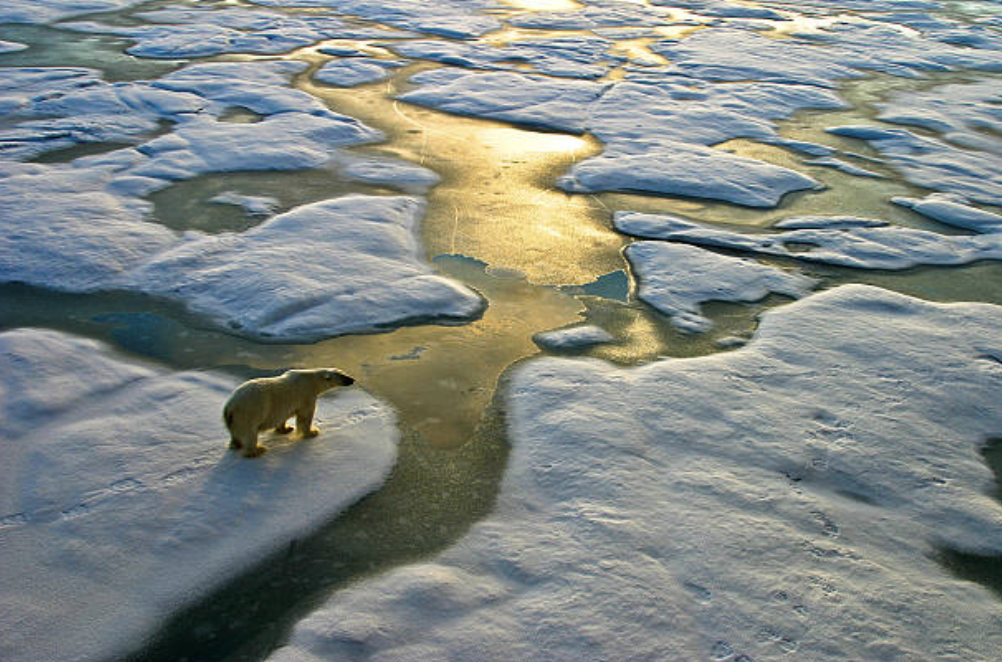
Photo via Getty Images
***
After the winter storm and record-breaking subfreezing spell that New York and the East Coast experienced this past month, the pot of climate change denialism in America has been stirred up yet again, with President Donald Trump holding the spoon. Although it would be reassuring if this brief cold patch was proof that global warming is an issue of the past, this mentality is one we cannot afford to let permeate our nation.
Anytime that cold spells like the one that the Northeast just experienced occur, it’s to be expected that people will raise an eyebrow at previous claims of climate change. However, science still supports the reality of climate change, and regardless of our temporary frostbite, it is essential not to let the cold numb you to the facts and statistics.
Unfortunately, the Commander-in-Chief seems to be struggling with a case of brain freeze, posting on Truth Social after the storm: “WHATEVER HAPPENED TO GLOBAL WARMING???”
By publicly spreading and supporting discourse that undermines scientific evidence about a global phenomenon that affects everyone, the president is perpetuating a state of resistance and denial of an issue that America should frankly be past bickering about. There is more at stake than just environmental consequences when it comes to climate change. So let’s take this recent weather anomaly as an opportunity to remind ourselves of the facts and learn the intricacies that any person planning on living on this planet for the foreseeable future should be acquainted with.
To further understand the implications of such a lack of consideration or action regarding climate change, this article will first address the below-freezing elephant in the room and explain how we can reconcile this storm with global warming.
When people hear the term climate change, the first issue that comes to mind is higher global temperatures. While this is indeed a consequence of climate change, there is more to it than just warmer temperatures.
“Research suggests that the polar vortex is more likely to bring cold air to lower latitudes as temperatures in the Arctic become more similar to those at lower latitudes,” explained Fordham University Professor of Economics Marc Conte in an interview with FPR. “The Arctic has seen some of the most extreme warming as a result of climate change.”
Beyond increasing global temperatures, climate change also increases the likelihood of extreme weather events and natural disasters, including winter storms. Therefore, using heavy snowfalls as a scapegoat for arguing against climate change simply doesn’t stand; in fact, it is more of a self-incriminating defense.
A key distinction people need to understand when questioning climate change is the difference between weather and climate. Although there is an abundance of articles and research that explain these distinctions, the main takeaway is that weather is short-term, and climate is long-term, based on historical patterns and trends of atmospheric events. This concept seems to be lost on Trump.
“Trump has not demonstrated an understanding of the complexity of climate change in a number of his public comments on the matter,” said Professor Conte.
Even if the general public does not take the president’s ramblings to heart, Conte suggests that there is still some resonance among his more ardent supporters.
If the majority of people believe in climate change, why is it that there seems to be so much backlash from our government concerning climate policies?
Politicians of today are seemingly more interested in benefiting their constituents, financial backers, and maintaining power than in considering what is best for the general public.
As a result, Professor Conte described how “vocal opposition to proposed legislation, particularly when the opposition comes from stakeholders with deep pockets (like the fossil-fuel industry), can certainly prevent regulatory action.”
While politicians can be financially corrupted when advocating for climate policies, in the long run, it would be in the economy’s best interest to confront Mother Nature.
“Part of the increase in inflation is due to increases in property and auto insurance, which have been driven by an increasing number of billion-dollar storms in the US in recent years,” said Professor Conte. “Once climate deniers come to understand that there is nothing partisan about increases in the prices that they face, we might expect them to soften or reverse their stance.”
Looking beyond purely atmospheric problems, one can see just how far the climate change ripple effect spreads. If not everyone can get on board with scientific studies to rally for proactive climate action, goodness knows that nothing unites Americans quite like high egg prices.
As much as I wish we could all frolic in the snow and take comfort in knowing that we scared global warming away with a week of frigid walks across campus and mountainous snowbanks, the very last reaction we should have is one of ignorance.
“Given that today’s college students will likely be alive for another 50 years, I would think that understanding climate science and the economics of climate change and policy would be a first-order concern,” posited Professor Conte.
For anyone wishing to continue their learning about climate change and its multitude of impacts, there are numerous classes offered at Fordham on related topics, including Professor Conte’s Environmental Economics class.
If you are sick of having to climb Everest just to get on the Ram Van at Lincoln Center, it’s never too late to start taking action when it comes to climate change. As cold as it may be, time doesn’t freeze, so we can’t let our efforts towards progress cool down.
***
This article was edited by Nicholas Meetze.
 Caroline Smith
  Kennedy Walker
  Christian Dziura