
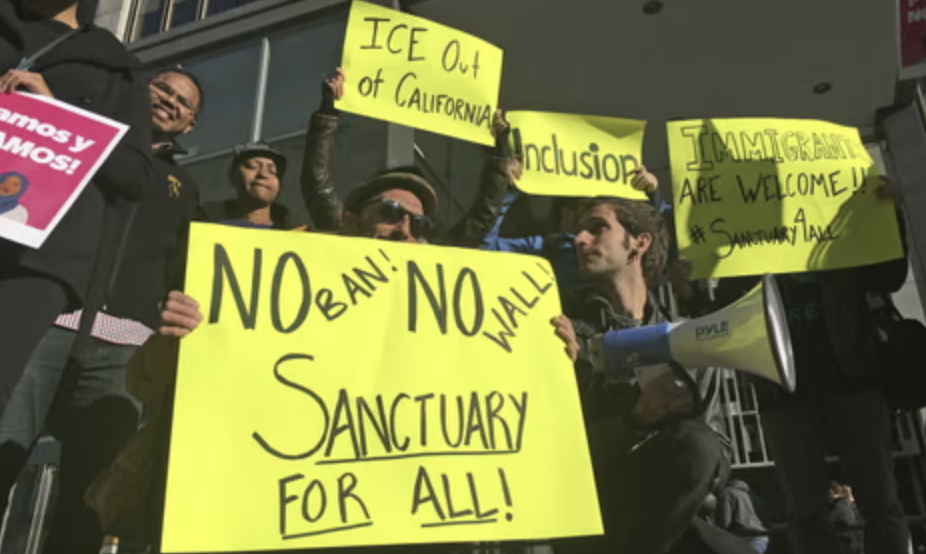
Photo via The Guardian
***
The beginning of 2026 has marked a period of widespread distrust in the United States government, from increased Immigration and Customs Enforcement (ICE) presence across the country to halting visas for people in 75 countries. Additionally, those within the United States have expressed deep concerns for their communities. Especially after President Donald Trump stated in a Truth Social post on January 14, 2026, announcing that his administration would cease federal payments to sanctuary cities. Beginning on February 1, Americans must recognize the implications of this statement and what it could mean for everyday life.
So, what exactly is a sanctuary jurisdiction, and who gets to be a part of one?
While there is no official definition of a “sanctuary jurisdiction,” on August 5, 2025, the U.S. Department of Justice named 13 states, four counties, and 18 cities as sanctuary jurisdictions, claiming that these areas hinder federal law enforcement from carrying out their duties, particularly in immigration matters. The current presidential administration has portrayed sanctuary jurisdictions as threats to national security and has detailed consequences for them if they do not abide by its wishes. Section 3 of Executive Order No. 14287 directs federal agencies to pinpoint federal funds flowing to sanctuary jurisdictions. President Donald Trump later said that if these jurisdictions defy his orders, the Attorney General and the Secretary of Homeland Security can suspend or terminate funding to “protect American communities from criminal aliens,” a tactic intended to force these locations to comply.
Still, these sentiments did not come as a surprise. In fact, in a House of Representatives subcommittee on Immigration and Border Security hearing in 2015, former Representative Trey Gowdy (R-SC), who served from 2011 until 2019 stated that sanctuary cities “…are cities more interested in providing a sanctuary for those criminals than they are providing a sanctuary for their own law-abiding citizens.” However, after decades of actions by ICE under the Department of Homeland Security and the federal government, some advocates argue that it has never been about said “criminals.” Take, for example, Renee Good, a U.S. citizen from Minnesota. She lived in a sanctuary state and did not have a criminal record, but was still brutally murdered by an ICE official. The Trump administration later described her as a domestic terrorist. The rhetoric surrounding the fact that ICE is prosecuting criminals is proven false time and time again. Places across the United States are home to unjust practices, and what were once places of refuge are now being scrutinized and targeted extensively.
In July 2025, the Trump administration threatened New York City over its sanctuary policies, claiming that local laws were bringing about danger and crime throughout the area and blocking immigration enforcement from executing its tasks. Despite many believing that the former Mayor Eric Adams would comply, the New York City Council blocked any such cooperation with the federal government. This striking decision indicated that local governments can exercise their rights to challenge abuses of power to truly reflect the wants and needs of their constituents. This raised bigger questions about interference with federal authority and the supremacy it continues to hold over the states.
Yet, these power imbalances have not always existed. After the development of sanctuary cities in 1971, undocumented immigrants had sounder relationships with law enforcement, were protected from unjust federal immigration laws, and murder rates steadily declined. Additionally, sanctuary zones upheld constitutional ideals, such as the 10th Amendment, which reserves powers to the states. In areas of high immigration, these havens became essential to the community and bolstered feelings of safety and security.
It is clear that sanctuary jurisdictions have become a physical representation of federalism, what the federal government claims and demands, and what is delegated to local governments. In times like these, it is imperative to recognize what is truly at stake. Not only unfair immigration policies and enforcement, but also the actions cities, counties, and states take to protect their constituents from harm. President Trump’s threats have grown far beyond budget cuts. His threats draw a clear and present line: will local governments comply, or will they fight for their citizens’ rights, because residents should not have to live in fear every day of their lives.
***
This article was edited by Isabel Adkins and Georgie Javier.
 Sarah Olivia Sullivan
  Luke Helmholz
  Gavin O'Sullivan