
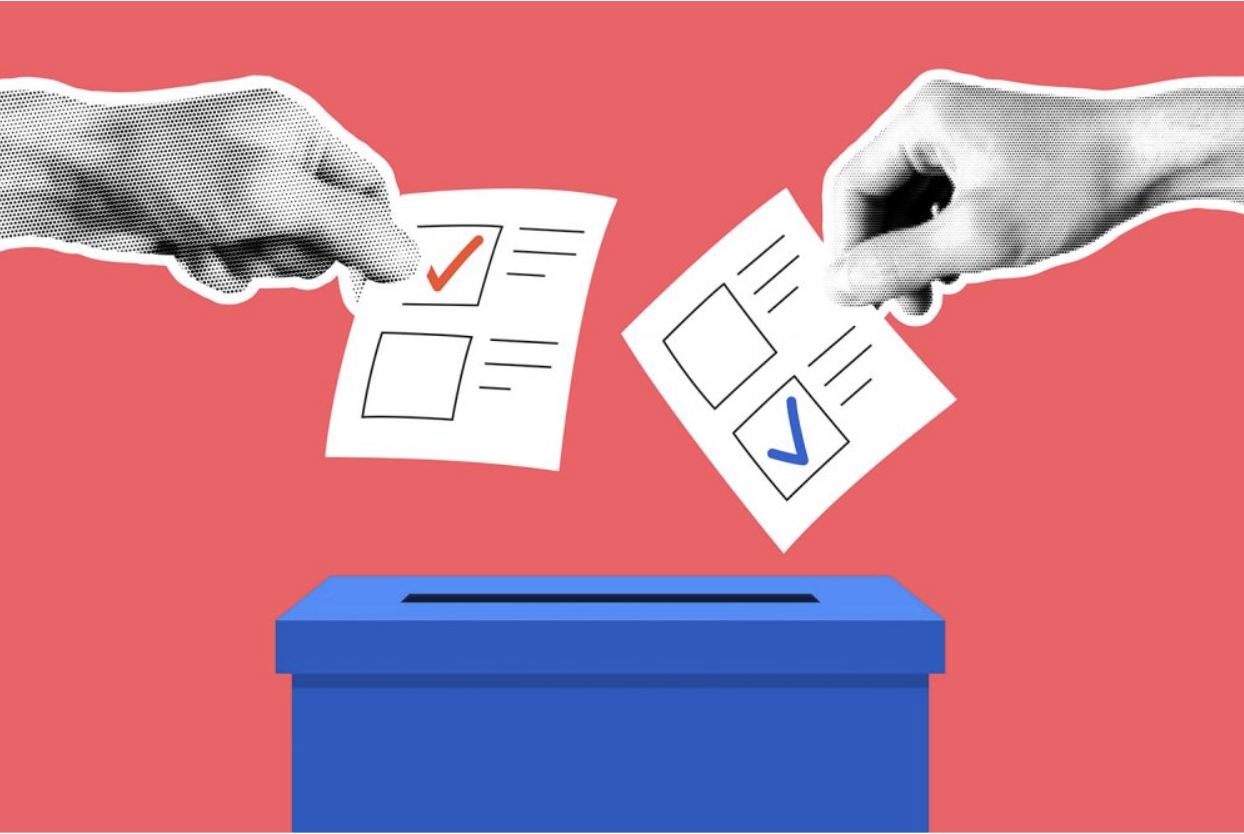
Image via UCONN Today
***
In the United States, election security and voting rights have become central issues in recent years. One of the most significant legislative proposals surrounding these issues is the Safeguard American Voter Eligibility (SAVE) Act, which seeks to impose stricter voter registration requirements. The U.S. House of Representatives passed this bill in April of 2025, but it failed to advance in the Senate because of widespread national opposition. However, the Republican Party now controls the presidency, the House, and the Senate, and is making efforts to fast-track the bill into law. This renewed push for the bill has sparked political discourse nationwide over its necessity and potential consequences. Supporters of the SAVE Act argue that it is a necessary defense in preventing voter fraud, especially from the alleged participation of noncitizens in elections. President Donald Trump actively feeds this misconception that noncitizens vote in large numbers after the 2016 presidential election, claiming that millions of illegal votes had been cast, without sufficient evidence. Despite these unrealistic claims, this narrative continues to shape public opinion and has left the threat of voter fraud as a widespread concern. The reality is that there are already federal and state laws prohibiting noncitizens from voting, which impose severe penalties if violated. Under the National Voter Registration Act, individuals are required to affirm their U.S. citizenship status when they register to vote, even in states that are exempt from this Act. The distinction between the SAVE Act and the preventive legislation the nation already has in place is that citizens are now required to repeatedly prove their status with official documents like passports and birth certificates whenever they register or update their voter registration.
These new guidelines will cause significant problems for U.S. voting rights because of the burdens these documentation barriers will bring. More than 21 million eligible Americans do not have access to sufficient proof of citizenship because obtaining these documents is costly, time-consuming, and logistically challenging. Additionally, only half of legal-age Americans hold a valid passport, which is one of the primary forms of documentation that could be required under this law. This legislation reform would also disproportionately affect the marginalized, as low-income Americans would struggle to afford the fees associated with obtaining or replacing these necessary documents. People born in rural areas could face trouble finding proper birth records. Racial minorities are more likely to lack documentation because of historical disparities in resources and government services. Individuals who are married, transgender, or have legally changed their name for any reason would face extreme challenges in the registration process because their birth certificate or citizenship records would not match their current legal name. Another hindrance for citizens would be that any change in address or political affiliation would require reregistration and the provision of legal documentation again. Instead of creating a straightforward and inclusive environment, the repetitiveness of this process adds unnecessary burdens to voting that would severely harm civic participation.
In 2022 alone, 7 million Americans registered to vote through mail, and 11 million used online registration systems. The SAVE Act, requiring physical documentation, would undermine these systems, forcing citizens to rely on in-person registration. This hinders people with limited mobility, transportation challenges, or inflexible responsibilities from voting. This law would not only affect voting citizens but also election administrators. The SAVE Act states that election officials could face civil or criminal penalties for assisting in registering people who cannot provide adequate documentation, even if it was a mistake or a misunderstanding. This threat could incentivize officials to refuse to help registration requests, resulting in eligible citizens being denied registration.
This is not the first time proof-of-citizenship requirements have been used in the United States. Kansas and Arizona implemented similar laws, leading to tens of thousands of eligible voters being blocked from registering. This included people on tribal lands, college students, and unhoused populations. Federal courts ultimately invalidated the law in Kansas after nearly 31,000 qualified citizens were prevented from voting. This historical example proves that restrictive registration requirements fail in practice. The SAVE Act is a very real threat to democratic participation and the freedom to vote in the United States.
Although many think this legislation will protect the integrity of elections, it addresses a problem that is already effectively regulated by existing laws. Imposing unrealistic documentation requirements only limits registration access, intimidates election officials, and disproportionately affects vulnerable populations, which risks the rights of millions of eligible citizens. The right to vote is a fundamental part of our democracy, and it is our job to stop any policies that restrict access without a clear justification.
***
This article was edited by Hayley Dunn.
 Sarah Olivia Sullivan
  Luke Helmholz
  Gavin O'Sullivan