
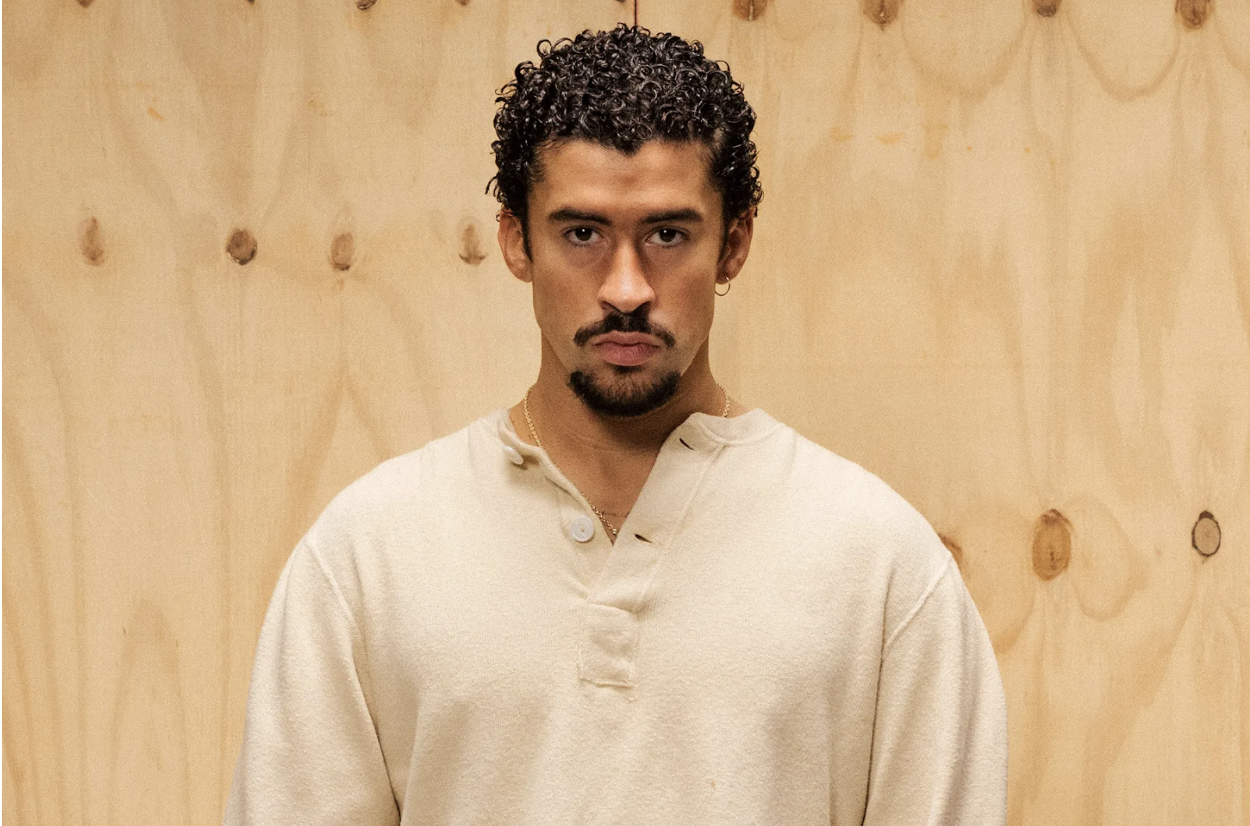
Photo via Billboard
***
Since 2016, Puerto Rican singer Bad Bunny has produced music and is considered the “King of Trap,” with more than a dozen music awards and recognition as the most-streamed artist on Spotify for three consecutive years. He recently won Album of the Year for his album “DeBÍ TiRAR MáS FOToS” at the 2026 Grammy Awards, making history as the first Spanish-language album to ever win in this category. Beyond his accolades, Bad Bunny’s music represents a celebration of Puerto Rican and Latino culture, blending traditional music styles, such as salsa and merengue, with modern beats that resonate globally with diverse audiences. Despite recognition as one of the most prolific and influential artists in the music industry, his upcoming performance at the National Football League’s (NFL) Super Bowl Halftime Show has sparked much controversy in the American media.
Although there has been backlash regarding the language barrier reinforced by Bad Bunny’s lack of English-language songs, it is clear that the hostile response is largely due to the artist’s outspoken political activism. Known for using his platform to uplift Latino and marginalized communities, Bad Bunny has been very vocal in his opposition to the Trump administration and their recent deportation efforts. Alongside publicly denouncing and spreading awareness of recent U.S. Immigration and Customs Enforcement (ICE) campaigns happening throughout the country, Bad Bunny explained that he would not perform any tour shows in the United States to protect his community from potential racial profiling that could happen at his shows. His endorsement of presidential candidate Kamala Harris in the 2024 presidential election, coupled with his support of LGBTQ+ rights, represents a stark contrast to the ideologies of mainstream conservative groups that make up a large portion of the NFL’s fanbase.
The announcement of Bad Bunny’s headlining was made on Instagram in September 2025, filmed in Puerto Rico, and captioned “February 8 the world will dance.” Within hours, the post was met with a flood of negative responses, mainly from prominent conservative figures and news outlets. Benny Johnson, a right-wing news commentator for The Daily Wire, attacked the musician for not performing in the United States during his latest tour, calling him a “massive Trump hater” and “anti-ICE activist.” Sports commentator Tomi Lahren has made similar comments, describing Bad Bunny as “not even an American artist.” TV host Greg Kelly even insisted that Bad Bunny “hates America, hates President Trump, hates ICE, hates the English language … [and is] just a terrible person.” Alongside the circulation of negative responses, the conservative media group Turning Point USA has announced that it will be sponsoring an alternative show, “The All-American Halftime Show,” to celebrate “faith, family, and freedom,” featuring country stars such as Lee Brice and Gabby Barrett.
Despite the backlash, the NFL has remained supportive of its selection, with commissioner Robert Goodell pointing to Bad Bunny’s worldwide popularity as indicative of a choice well-made. With Latin music as the United States’ fastest-growing genre, and considering the wide age demographic it appeals to, the NFL is using Bad Bunny’s performance to connect and unify with the American-Latino community. Marissa Solis, an executive for the NFL’s global brand marketing, shared how the Latino population of almost 70 million in the United States represents a “critical growth area” that the league needs to expand into. A performance by an icon like Bad Bunny at The Halftime Show would show recognition for this community. Alongside continued support from the NFL, other public figures have spoken out in support of the artist: California Governor Gavin Newsom posted that “California is excited to have [him],” as well as musicians who have performed at the Super Bowl before, such as Jennifer Lopez and Bruno Mars. As for the football world, Dallas Cowboys’ brand executive Charlotte Jones called the decision “amazing.” Even amid speculation of a canceled show and a boycott of the league because of the artist, the underlying narrative is how the support shared online and public excitement over the performance outweigh any controversy, according to the NFL.
As the NFL’s Robert Goodell explained in support of Bad Bunny, “I’m not sure we’ve ever selected an artist where we didn’t have some blowback or criticism.” The Super Bowl has had controversial performances before, the most notable being Kendrick Lamar’s in 2025 because of its blatant political messaging, but Lamar’s show was also the most-watched halftime performance ever, proving that the controversy only amplified public interest and visibility to the importance of his message. Knowing Bad Bunny’s history of using his influence to help his community, there is no doubt that his halftime show will also include powerful themes and commentary about our country. Not only did his 2026 Grammy acceptance speech include a dedication to the Latino community, but he also shared when hosting Saturday Night Live that he is “very excited … [and] happy” to perform the halftime show, recognizing “all of the Latinos and Latinas … in the United States who have worked to open doors” and how “no one will ever be able to take [their contribution to the country] away or erase it.” For many in the Latinx community, his performance signifies an embrace of cultural identity, resilience, and a challenge to the status quo. On the global scale, Bad Bunny’s influence on the future of music is undeniable, as he continues to push boundaries and inspire a new generation of artists to embrace their roots and address social issues through their art.
[editors note: upon publication of this article the Superbowl halftime show has already occurred]
***
This article was edited by Emma Saliasi and Emma Cate Martin.
 Glenmarie Rios Rodriguez
  Ayden Suber
  Isabella Villalobos