
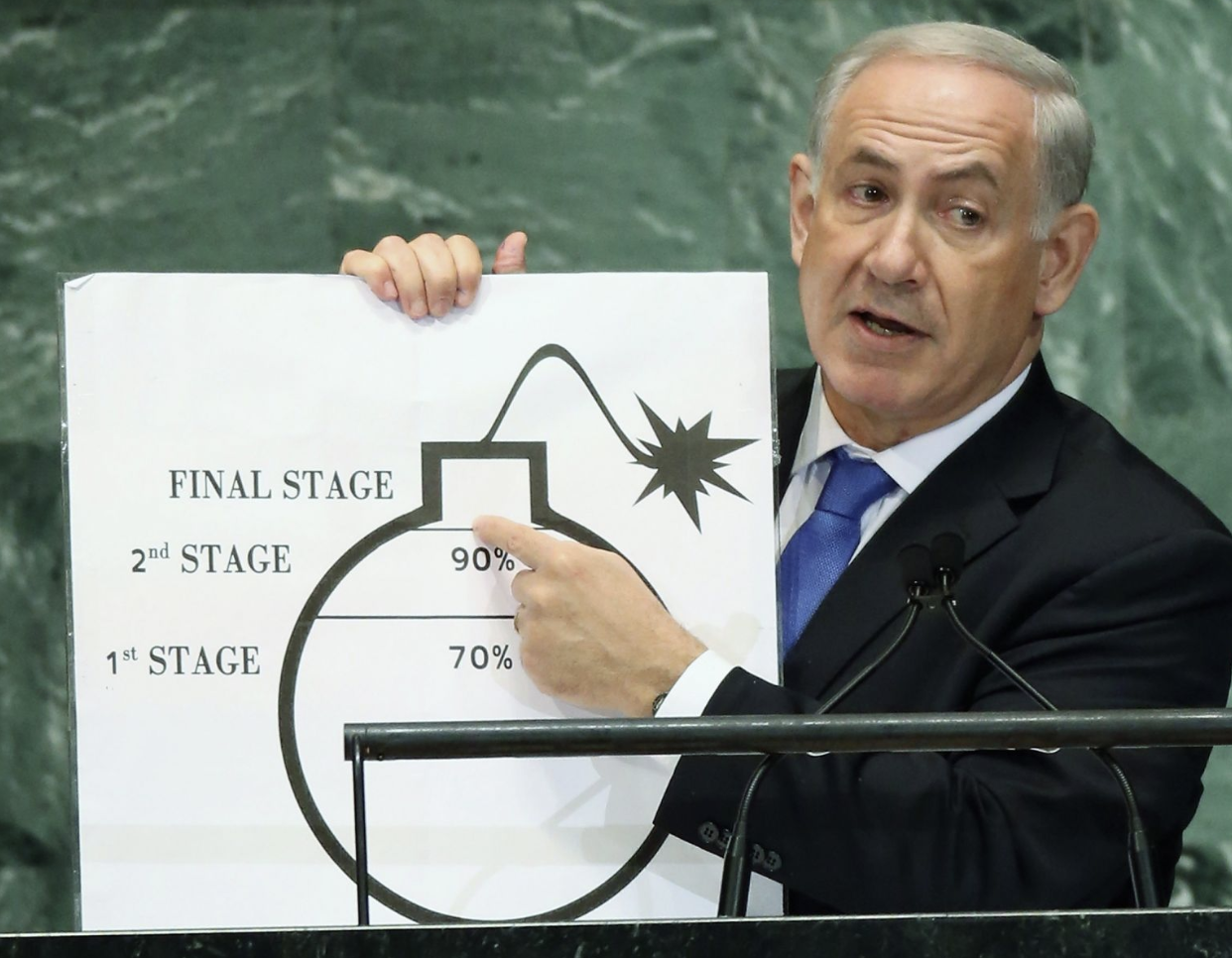
Photo via The New Statesman
***
“Iran is about to develop a nuclear weapon” is perhaps the most powerful line in the Middle East foreign policy gospel. It is impossible to have any informed discussion of the region without addressing the existential threat. Just listen to Israeli Prime Minister Benjamin Netanyahu in an address to the American people: Iranian nuclear weapons would “presage catastrophic consequences for all mankind.” Even worse, “the deadline for attaining this goal is getting extremely close.”
It is no wonder, then, that the United States just launched a massive attack on Iran. The deadline was “extremely close.” The world was running out of time to avert these catastrophic consequences. This is exactly the story the American and Israeli governments would like you to believe. Unfortunately for those with faith in their government’s ability to tell the truth, it is also completely made up.
The quotes from Netanyahu are real; they were delivered to the American people during a high-profile address to a joint session of Congress. The only problem with the narrative? This joint session of Congress convened in July 1996.
Benjamin Netanyahu first made public claims about the Iranian nuclear program all the way back in 1992. Then a rising star in Israel’s parliament, he declared in an address to the Knesset that Iran was a mere three to five years away from developing a nuclear weapon. The only solution? U.S. intervention, of course. The next year, Netanyahu published a column in an Israeli newspaper, claiming Iran would develop a nuclear weapon by 1999. In only a year, the timeline had shifted by several years–truly incredible insight by the world’s foremost Iranian nuclear weapons watchdog.
By 1995, Netanyahu was the leader of the Likud party and months away from being elected Prime Minister. He capitalized on his new position of authority to publish Fighting Terrorism, his manifesto on Islamic terrorism. The “three to five years” to a nuclear weapon claim was repeated essentially verbatim. To ensure his claim would reach a wider international audience, he appeared on CBS News to scare an American audience into believing Iranian nuclear weapons were imminent.
As the turn of the century came and went and no evidence of Iranian nuclear weapons surfaced, Netanyahu merely doubled down, asserting repeatedly–in 1999, 2002, and 2006–that Iran was only a few years away from a nuclear weapon. In 2002, he testified before Congress that Iran’s nuclear weapons program was closely linked to Baghdad’s. Of course, the United States never recovered evidence of weapons of mass destruction in Iraq. This did nothing to deter the champion of Iranian nuclear weapons warnings. WikiLeaks revealed that Netanyahu told a congressional delegation in 2009 that Iran was now only one to two years away from a nuclear weapon.
On September 27, 2012, a full two decades after warning the world that Iran was three to five years from a nuclear weapon, Benjamin Netanyahu arrived at the United Nations General Assembly with a cartoon drawing of a bomb. He famously declared that by spring or summer of 2013, Iran would be “only a few months, possibly a few weeks” from its first nuclear weapon. This warning came with a flashy visual—it simply had to be true. Pattern recognition experts could probably see this one coming: Iran did not develop a nuclear weapon a few months after the summer of 2013.
The United Nations bomb saga was a critical turning point because documents later leaked to Al Jazeera revealed shocking new information. At the same time, Netanyahu was telling the world that Iran was months away from a nuclear weapon, an internal Mossad report concluded that Iran was “not performing the activity necessary to produce weapons.” The outgoing chief of the intelligence agency even warned that military action could actually spur nuclear weapons development, not prevent it. For the first time, Benjamin Netanyahu was caught explicitly lying to the world about Iran’s nuclear program.
Rest assured, a true expert on Iranian nuclear weapons like Netanyahu wouldn’t let something minor like being exposed for blatantly lying to everyone at the United Nations slow down his critical work. In his 2015 address to Congress, he asserted that the pending Iranian nuclear deal would actually “pave” Iran’s path to nuclear weapons. Iran did not develop a nuclear weapon while the deal was in place, although Netanyahu did appear on U.S. media multiple times to repeat his claims that Iran was only months or years from a nuclear weapon. Trump withdrew from the deal in 2018, and Iran once again failed to develop a nuclear weapon.
In the aftermath of the October 7 attacks, Netanyahu found a way to link the war in Gaza to Iran’s nuclear ambitions, calling for broader action against Iran and its proxies. In June 2025, 33 years after the world was warned that Iran was a few years away from a nuclear weapon, Israel attacked Iran because, in Netanyahu’s words, Iran was “a year or a few months” away from a nuclear weapon. The most recent report of the U.S. Director of National Intelligence unambiguously concluded that “Iran is not building a nuclear weapon.” However, high-level experts on Iran like Netanyahu don’t let the noise of allied intelligence distract them. The United States later joined in the Israeli attacks and claimed that Iran’s nuclear sites were “obliterated.”
In February 2026, the United States and Iran reentered nuclear negotiations. The Omani Foreign Minister, who had been mediating the talks, declared that a deal was “within our reach” and that Iran had agreed to several major concessions. The next day, the United States and Israel launched a massive attack on Iran, with Netanyahu claiming that the goal was to remove the “existential threat” posed by Iran. At long last, Netanyahu was leading the war he mongered for decades.
In retrospect, the 34-year saga of nuclear weapons warnings by Benjamin Netanyahu is nothing short of incredible. Of course, Iran did stockpile uranium, violate international agreements, and generally posture itself as moving toward nuclear weapons. However, there was no clear intelligence behind Netanyahu’s repeated declarations of imminent threats. In fact, the intelligence often directly contradicted his claims. Nevertheless, he has managed to make a decades-long political career out of repeating nearly identical warnings of nuclear disaster that simply never come true.
When the deadline for his warning passed the first or second time and new timelines were issued, it was somewhat understandable. After all, it is impossible to predict the actions of a regime like Iran’s with perfect accuracy. However, after dozens of copy-paste warnings and recycled timelines that simply never come true, it is completely fair to ask how he could possibly keep getting away with this. Iran’s alleged nuclear weapons imminence has proved incredibly useful–whenever a domestic scandal threatened to take down Israel’s longest-serving Prime Minister, a new warning about Israel’s biggest adversary was waiting in his back pocket as an eternal get-out-of-jail-free card.
The United States, as it tends to do, has largely operated in lockstep with Israel on the issue of Iran. This partnership has elevated the repeated warnings from a domestic political goldmine to an invincible, worldwide trump card. It is easy to lie to the United Nations when the leader of the free world is tacitly or openly endorsing your manufactured narrative.
The elephant in the room in these discussions is Iran itself. Iran is far from a friend to Israel or the United States, and this is essential to the narrative. In the United States, especially, there is an overwhelming tendency to turn our adversaries into caricatures–be it the Soviet Union, North Korea, China, or, in this case, Iran. The tendency to view these countries as vague notions of evil rather than geopolitical actors, just like the United States, can help explain the lack of opposition to these objectively nonsensical warnings about Iran’s nuclear program.
Less than 30% of Americans can even identify Iran on a world map, yet nearly 75% believe that Iran poses a real national security threat to the United States. Iran is understood not as a country but as an abstract threat to Americans, and in this environment, it is easy to see how repeated warnings of nuclear weapons by Netanyahu are accepted unquestioningly by his most important ally. Simply because Iran and the United States are so ideologically opposed does not justify the acceptance of unfounded warnings and politically convenient lies.
As American and Israeli bombs rain down on Iran, it is essential to understand the decades of nuclear weapons nonsense that led up to this moment. As the New York Times summarized in 2025: “If Iran is truly pursuing a nuclear weapon—which it officially denies—it is taking more time than any nuclear-armed nation in history.” In as close to sarcasm as will ever be found in the pages of the Times, they masterfully captured the absurdity of this saga.
A Medium article on the parade of Israeli nuclear warnings put it perfectly: “The best way to predict a war is to start one.” After 34 years of crying wolf, Netanyahu finally got his war against Iran, and the blood of any U.S. and allied casualties will be on his hands.
***
This article was edited by Sophie Reilly.
 Glenmarie Rios Rodriguez
  Sarah Olivia Sullivan
  Luke Helmholz