

Image via Getty Images
***
Imagine you are having a conversation with one of your friends, trying to discuss your most recent crashout or crisis. Now, the entire time you are talking, someone else periodically walks into the room, taps your friend’s shoulder to divert their attention, and announces their own unrelated updates or questions. Worse yet, you discover that your friend is openly inviting all of these distractions—frustrating, right? Welcome to the modern-day standard of conversation.
Almost every interaction these days includes a “third wheel”: a smartphone. More often than not, our own words are ignored in favor of the musings and allure of the messages behind the buzz of our phones. People are no longer eager to actively participate in one-on-one conversations. We are each acting as a sort of operator, receiving signals from different sources and feeling compelled to address them all as soon as possible, with convenience right at our fingertips.
This distraction epidemic harbors concerning and real risks for the future of relationships. Even when physically being with someone whom you have not seen and are eager to converse with, you are still competing with their smartphone for their attention. With each vibration you feel from their phone, you may have to worry that their care for what you have to say is dwindling.
It’s not only interpersonal interactions that are diminishing. Even alone, we prefer the entertainment of a six-by-three rectangle to that of our own minds and surroundings. When was the last time you took public transportation without making sure you had your headphones beforehand? When was the last time you left your house without double-checking that your phone was in your possession? Rather than confronting the desire to avoid feeling bored or having to simply listen to the sounds of our surroundings, we subject our ears to the constant beratings of media through our headphones.
We now rarely hear direct, authentic opinions; instead, we often hear the curated and targeted thoughts and views from the algorithmic videos we receive or the podcasts we subscribe to. Instead of practicing the ever-fading art form of keeping our ears open and listening to the authentic dialogue of the people around us, we tune in to what some distant experts or internet personalities deem is right or wrong in the world we are growing increasingly disconnected from.
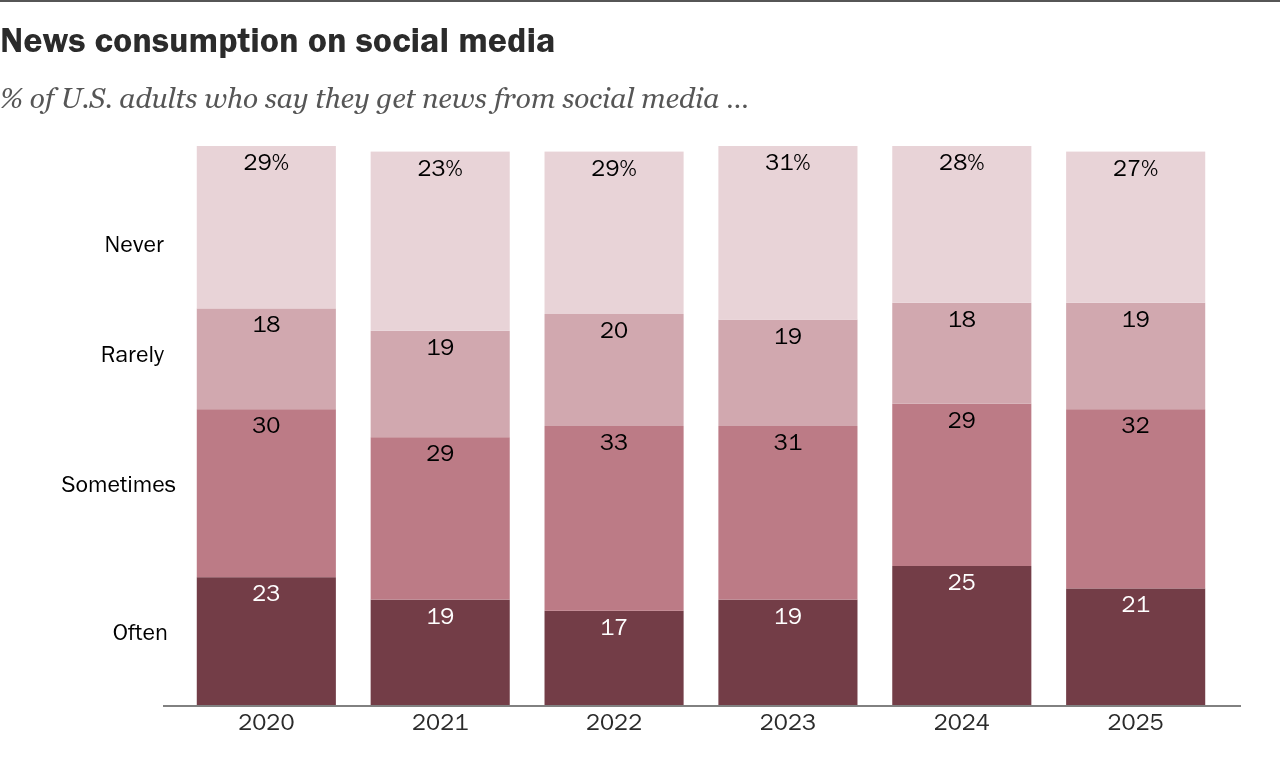
Image via Pew Research Center
While being able to learn the views of people from around the world has its merits, opting to drown out the voices of those directly around us disconnects a society from experiencing community. 70% of Americans admit to some level of news consumption from social media. The format of online news is intended to cut out any substance and deliver only the attention-grabbing bullet points. When someone gets bored of an online video or article, they can easily swipe on with their lives.
This formula is becoming prevalent in personal conversations. If someone isn’t succinct enough, or their story isn’t sensational or stimulating enough, the listener diverts their eyes to their screen to see if there are any more pressing matters. Humans are now so digitally accessible at any point and time that it is nearly impossible to be immersed in a singular, physical conversation.
The objective of our day-to-day interactions is shifting from spending quality time with a few people to ensuring we’re being heard by as many people as possible. People are less interested in the people they interact with and more interested in how many people they can interact with.
Conversations are entering a battle between quantity and quality. Because we have the ability to connect with so many people, we feel drawn to do so, even if that comes at the expense of making the person across the table feel ignored and overlooked. Phones have transformed each person into an individual communication center, seeking to gain more and more information. Productivity is put above consideration, results are put above relation.
We are curating a world where everyone, from politicians to our own loved ones, are paradoxically becoming less connected by engaging with more and more people. Representatives go through their regimens of broadcasting themselves and their messages across countries, yet rarely listen to the people they are advertising themselves to. Unsurprisingly, the public that these politicians serve can end up feeling pretty cheated and ignored.
The modern world is progressively moving towards a reality where everyone is expected to answer any notification at any time. Each day becomes occupied by an increasing series of messages, emails, and DMs to address. People are prioritizing responding while devaluing listening, and at a certain point, there will be no one left to actually hear us.
***
This article was edited by Corrina Gapp and Reva Maslekar
 Giovanni Esposito
  Emma Trauner-Coady
  Lauren Gracia