
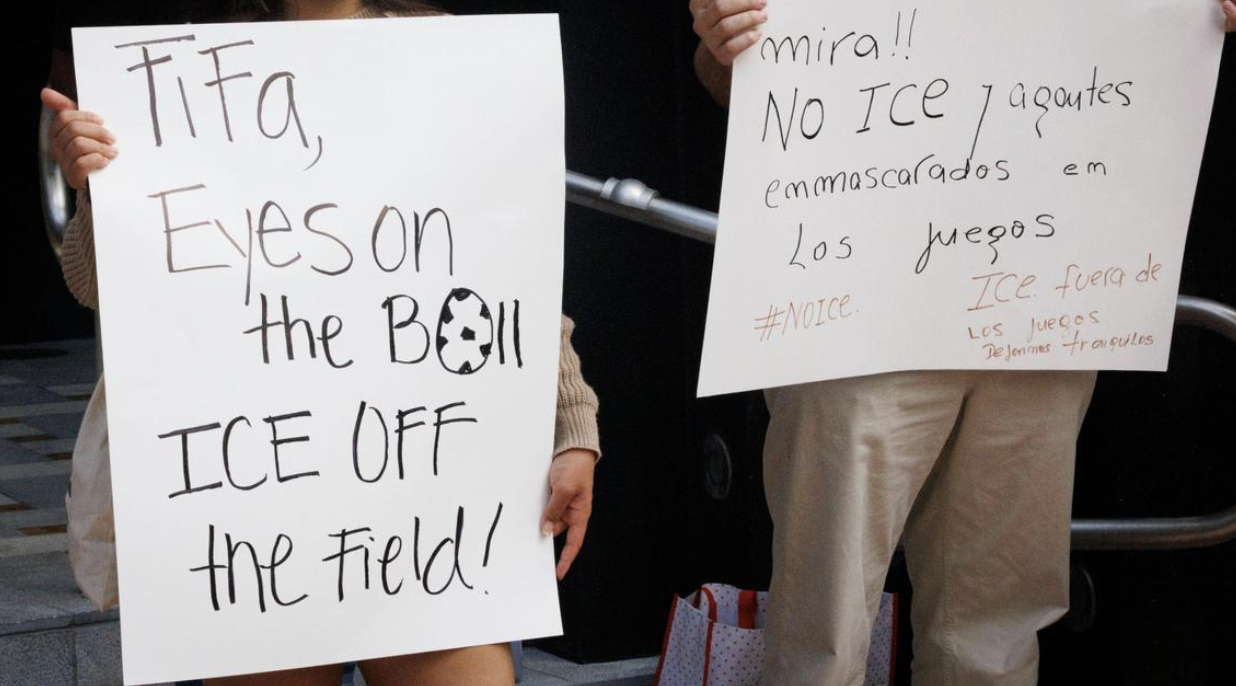
Photo via the Miami Herald
***
With official gameplay starting on June 11, the United States State Department expects a possible upward of 10 million visitors to the United States this summer. But will some fans hesitate? With a nation almost known for its gun violence, along with recent immigration crackdown and political hostility. The question is no longer how will the U.S. host the World Cup, it is whether the world feels safe enough to show up.
While hosting the World Cup is a prestigious honor, it is also extremely expensive, often costing billions for stadiums, transportation, and accommodations, with uncertain long-term economic benefits. To put that in perspective, Russia spent $14 billion, Brazil $15 billion, and Qatar an estimated $220 billion on infrastructure and preparation. Still, nothing brings people together like the World Cup. Regardless of race, gender, age, nationality, fans unite to support their country under one flag. To me, it is one of the most beautiful examples of human unity. Not only does it bring fans together, it also brings players together, who often seem to be enjoying the experience as much as the spectators. Beyond the excitement, there is also a deeper awareness of what these matches can represent. U.S. defender Jeff Agoos famously said after the U.S. vs. Iran match at the 1998 World Cup: “We did more in 90 minutes than the politicians did in 20 years.”
Even though, statistically, mass shootings are rare and involve complex personal factors, the perception of safety abroad is often shaped by media coverage and high-profile events rather than data. Research shows that most incidents involve legally obtained firearms and have increased in visibility over time, contributing to global awareness of gun violence. Because of this, international tourists may feel uneasy traveling to the U.S. for major events like the World Cup, where perception of risk can matter more than actual likelihood.
The most prominent issue, immigration enforcement, particularly involving the U.S. Immigration and Customs Enforcement, largely contributes to fans’ hesitation to travel. Travelers may worry about visa complications, being detained or questioned at the border, or facing profiling based on appearance or nationality, concerns that are especially relevant for fans coming from Latin America, Africa, and the Middle East. Since 2025, federal authorities have significantly expanded nationwide immigration raids, targeting workplaces, neighborhoods, and even public spaces. This has been described as one of the largest deportation efforts in United States history. In some cases, these operations have led to widespread protests and controversy, such as incidents where federal agents have fatally shot U.S. citizens during enforcement actions, raising concerns about the use of force.
The current political climate of the United States is marked by deep polarization, deep public pessimism about democracy, and low confidence in political institutions. Many Americans report strong partisan divides on issues like military action, immigration enforcement, and social policy, while overall trust in government and the direction of the country remains low. This level of division and unpredictability can shape how the U.S. is viewed abroad, potentially making international visitors see the country as politically tense and unstable during major global events.
Globally, the political climate in 2026 is widely characterized by growing instability, rising polarization, and weakening trust in democratic institutions. According to OECD, many democracies are facing increasing internal pressures including disinformation, political division, and declining public trust in government, which can deepen stability and reduce effective governance.
Over 120 civil society organizations and NWSL and MLS-affiliated fan groups have sent a travel advisory to visitors potentially headed to the United States this summer. Starting those from immigrant communities, racial and ethnic minority groups, and members of the LGBTQ+ community are “most vulnerable to serious harm” due to government policies. The advisory lists six specific risks to visitors:
- Risk of being denied entry, detained, or deported without clear reason
- Tighter restrictions on travel and entry into the United States
- Increased screening of social media accounts and searches of electronic devices
- Concerns about aggressive immigration enforcement, including racial profiling and discrimination
- Limits or pressure on free speech and public protest
- Risk of mistreatment in immigration detention facilities
German national, Steve Schwarzbach, who is half Korean and claims to appear more Asian than German says “You see the ICE people going around and just pulling people from the streets just because they look foreign and you don’t get the feeling that anybody would protect me, you know?” Similarly, Canadian citizen Omar Hassen states “It’s scary hearing what’s happening at the border,” Hassan said. “I’ve had friends who were forced to give up their passwords and who got their phone taken away.” As someone who is critical of President Trump’s policies in WhatsApp group chats, Hassan worries he is at risk of being turned away at the border and having his phone taken away. Along with that he shares Schwarzbach’s fear of being racially profiled by federal agents. To clarify, according to Todd Lyons, director of ICE, the use of ICE is as follows, “ICE, specifically Homeland Security Investigations, is a key part of the overall security apparatus for the World Cup. We’re dedicated to securing that operation and we’re dedicated to the security of all of our participants as well as visitors.”
Despite these fears, massive interest persists for the 2026 FIFA World Cup, with millions of fans expected to attend. The tournament has generated unprecedented demand, including 150 million ticket requests in the first two weeks of availability, highlighting that global appeal remains high. In addition, senior FIFA officials discussed the possibility of Gianni Infantino, the president of FIFA, making a direct request to President Trump for a full suspension on ICE raids across the US this summer during the World Cup. However there is no record of a response.
In the end, this summer’s World Cup will show more than whether the United States can handle hosting such a widescale event, it will show how people around the world actually feel about coming to the U.S. right now. Soccer fans are some of the most devoted in the world, and if even they hesitate to come, it raises the questions of who would feel confident to show up at all. Even with huge excitement and record demand, concerns about safety, immigration, and political tension are still part of the discussion. So beyond the games, the 2026 World Cup will be a test between the U.S. and the rest of the world.
***
This article was edited by Abigail D’Angelo.
 Luke Helmholz
  Gavin O'Sullivan
  Madelyn Marcisz