
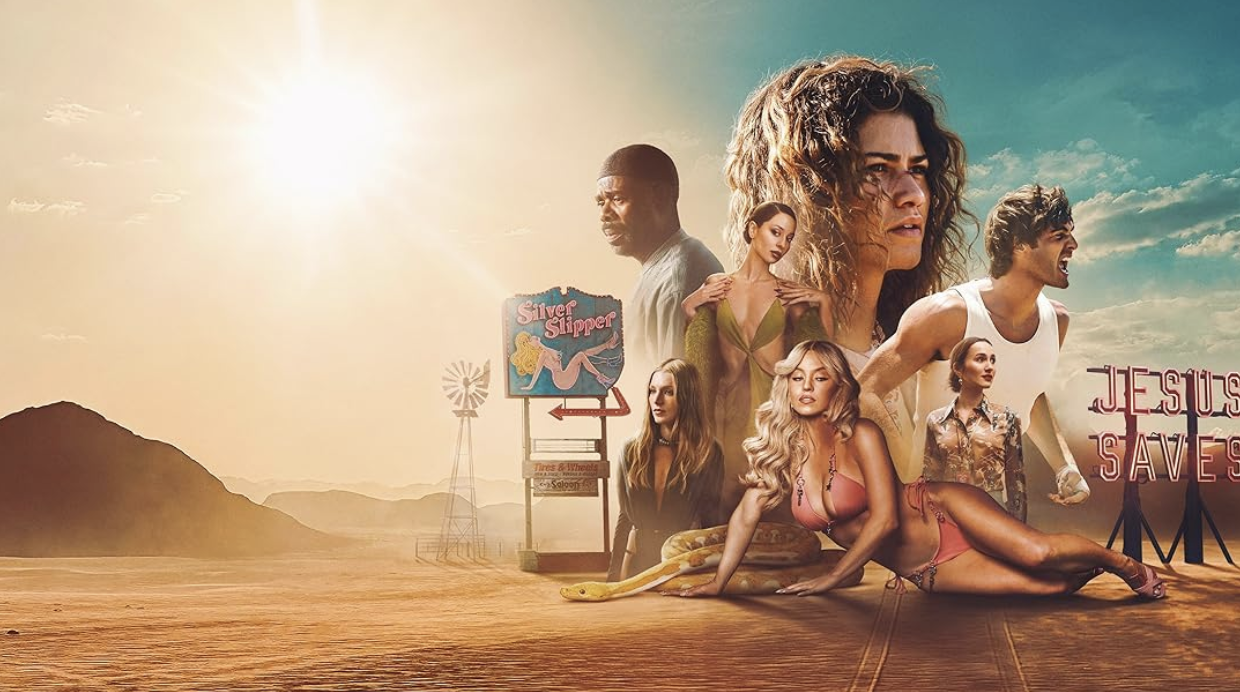
Image via Prime Video
***
When Euphoria returned this April for its 3rd season, it didn’t just resume the story where it left off—it arrived riskier and more provocative than ever, and reignited a cultural argument that has followed the show since its debut in 2019. From the very first episode, the tone is unmistakable: more heightened, more performative, more exposed. The high school world that once felt internal feels almost theatrically externalized into the volatile “real world.”
And at the center of that shift, so far, is Cassie.
From the first episode, her storyline wastes no time becoming the season’s most polarizing thread. Frustrated by her fiance Nate’s refusal to spend $50,000 dollars on her dream wedding floral arrangements, Cassie proposes a solution that feels both absurd and disturbingly plausible within the logic of the show/considering the trajectory of her character so far: she wants to start an OnlyFans account.
“You want to sell your body for floral arrangements?” Nate asks.
“I will if I have to,” Cassie replies. “I didn’t wait my entire life to have a ghetto wedding.”
What follows is a sequence of clips showing Cassie posing for different curated photoshoots—all topless—with different sexual themes and outfits. The most provocative iteration—her “sexy baby” persona, which had already upset viewers through its brief appearance in one of the show’s pre-season trailers—pushes the season into deliberately uncomfortable territory.
Within days of release, criticism flooded social media, forums, and think pieces—all centered around the escalation into fetishized (or moreso, pedophilic) imagery, including the “sexy” baby aesthetic.
Although controversial, the moment was not particularly shocking. Cassie’s trajectory has always been defined by a lack of control over how she is perceived and desired—and the ways she tries to gain back control. From the first season, she is positioned as someone who “submits herself to all kinds of sexual exploitation.”
Watching this theme further unfold, my initial reaction was a mix of discomfort and satisfaction. In fact, I found myself almost elated watching the trailers for season 3, seeing that Cassie got what she “deserved”—degradation through her turn to porn. In my understanding of her character, she’s been a bad person, a bad friend, and a “bad” woman—one who consistently prioritizes male validation over self-respect and, in doing so, makes other women “look bad.” Her move to an OnlyFan performer felt like a narrative endpoint, a symbol of punishment that aligned with her early choices and has ended in chaos and misery, which she allowed herself to fall into.
But, my reaction raises its own set of questions: Why does Cassie’s humiliation feel justified? Should I really be happy watching this? Is it anti-feminist to take pleasure in a woman’s entrapment, even when that entrapment appears self-imposed?
This discomfort points to a deeper tension in how audiences interpret female characters who participate in their own commodification.
This ambiguity is amplified by Euphoria’s own cultural positioning. The series has long been as known for its stylized depictions of addiction and teenage excess as it has been for behind-the-scenes controversy. Questions about exploitation, indulgence, and the blurred line between critique and spectacle have followed it throughout its run. Critics describe its “sleazy charm” as something designed simultaneously to “infuriate and horrify and turn on.”
Before this, Sam Levinson—Euphoria’s writer—faced similar scrutiny with The Idol, a project widely criticized for its chaotic production and for what many described as exploitative, “torture porn” depictions of female sexuality, which is what first sparked concerns about his personal approach to female representation.
Levinson’s single authorship on Euphoria further intensifies this perception. Operating largely without a traditional writers room, Euphoria reflects a highly centralized and sensationalized creative vision, risking the limitation of narrative complexity and reinforcing a singular male gaze that can veer into misogyny.
In an online reddit forum asking whether or not Sam Levinson is a misogynist, many answered bluntly:
“Yes, next question.”
Others essentially accused him of projecting his personal fantasies onto the show:
“He is a porn addict for sure”
“He is definitely a creep, to put it lightly. I don’t necessarily dislike the stories he is trying to tell, but I do think their execution comes off as obsessive and abusive. At the end of the day, there are many ways of telling a tale, and it seems he is choosing a very convoluted way to do so.”
“Well every woman is a sex worker or drug addict or sex worker drug addict to him so who knows”
Many critics of Levinson argue that his shows increasingly funnels its female characters into narratives of sexual degradation and exploitation. Some have questioned whether Euphoria, in particular, offers any vision of women beyond sex work, sexualization, or victimhood.
However, some defended Levinson:
“He’s creating fiction for us to consume..a lot of it is for shock value. It’s HBO after all. That’s kind of their trademark.”
“Does Sam Levinson’s work showcase a contempt towards women? I’d argue no. His work doesn’t suggest to me he thinks of women as lesser than. In fact, his work actually goes to some length to explore the complexity of women (through a very, very clearly straight, male gaze) With that said… he’s clearly a bit of a creep… it’s clear he’s a little sexually perverse and that shows in his work”
“I don’t think writing a show with lots of sex is misogynist…A few feminist points come up in the show. The repercussions of porn obsession on women and girls…the various ways young women and girls are sexual for the wrong reasons (for example, cassie using it to feel loved and appreciated).”
There is certainly a compelling argument that Levinson is only creating a mirror of society today, where problematic sexual content is increasingly normalized and the female body is portrayed as sexually available for male desire—a shift made possible by the rise and ubiquity of the internet. Some even argue that Levinson’s depiction of excess even serves as an implicit cautionary storytelling of the consequences of commodified intimacy.
Levinson continues to defend his work using this argument, pointing to the hypersexualized nature of contemporary culture, arguing that pornography and digital media deeply shape how young people understand intimacy. But critics counter that Euphoria does not adequately critique these dynamics, instead “reflect[ing] it, and revel[ing] in it.”
This ambiguity can be seen in the show’s visual framing: rather than critically interrogating Cassie’s content creation, the camera lingers on the aesthetics and appeal of her nakedness.
Ultimately, the “sexy baby” scene sits within the unresolved tension of realism versus overexposure and exploitation.
That tension only becomes more complicated when placed in the broader context of contemporary sex work. Public attitudes toward strippers, escorts, and survival sex workers differ significantly from attitudes toward OnlyFans creators, particularly those who appear economically and socially privileged.
Reactions to Cassie’s new storyline seem to echo the increasingly polarized discourse around women who engage in digital sex work—an increasingly normalized and condemned occupation—framed as empowered in some contexts and self-degradating in others.
Platforms like OnlyFans can be especially predatory because they promote liberation and downplay the risks associated with it. Research highlights significant structural inequalities for the women performing on the platforms: investigations have uncovered cases of abuse, coercion, and even child sexual exploitation material slipping through moderation systems. Additionally, only a tiny percentage of creators earn substantial incomes, while the average user makes relatively little, often pushing them toward more extreme content to remain competitive.
The illusion of autonomy exists within a system shaped by demand, algorithmic visibility, and escalating expectations of explicitness.
At the cultural level, this normalization of sexual commodification has begun to shape expectations far beyond the platform itself. Social media ecosystems increasingly blur the line between mainstream content and adult material, with young audiences exposed to highly sexualized imagery that is often framed as aspirational. Reports show an increase in teenage girls viewing sexualized content-creation on platforms such as OnlyFans as a viable career path. Girls as young as elementary and middle school report feeling, due to popular OnlyFans creators, the boys in their grade have similar unrealistic expectations of them, their bodies, and behavior.
The result is a generation navigating what one source describes as a “pornified” landscape.
In this way, Cassie’s decision to start an OnlyFans account—although fueled by the desire for rather unrealistic wedding decoration – does not emerge in a vacuum.
In this sense, the discomfort viewers feel may stem not from the act itself, but from the recognition of its familiarity.
At the same time, though, in-person sex work, particularly outside the U.S., is shaped by intersecting pressures of class, race, and economic contstraint. Not all women enter sex work under the same conditions, and not all are judged the same way for doing so. Research on women in India, for example, shows that many enter sex work as a “constrained choice,” shaped by poverty, lack of education, domestic abuse, and limited employment options. For these women, sex work is often a last resort; a means of survival rather than self-expression. On the other hand, it appears that digital sex workers most often cite reasons like flexibility, autonomy, and the appeal of quick and easy financial gain as their motivation.
As I hinted at before (with the reference to Cassie’s reason for starting her OnlyFans; her desire for extravagant $50,000 wedding floral arrangements), Cassie exists in a symbolic position shaped by privilege, visibility, and aestheticized consumption. If she “doesn’t need” to commodify herself, then her choices are deemed less defensible. She embodies a version of “choice feminism” that equates empowerment with any individual decision, even when those “rebellious” decisions reinforce existing very old norms, where women commodify their bodies, men remain the consumers, and the market rewards hyperfeminine compliance. That distinction partly explains the intensity of the audience’s reaction.
But, it also exposes a contradiction: society is more comfortable accepting female sex workers when it is framed as a choice made out of necessity, not personal elective.
Additionally, the most revealing aspect of Cassie’s storyline may not be what she does, but the way audiences respond to it. There is a visible pleasure in her unraveling, an almost collective satisfaction in watching a hypersexual woman fail.
Part of this comes from what Cassie represents, a woman whose choices remain deeply shaped by male desire and validation.
The audience response doesn’t just stop at this critique, however. Hatred for Cassie becomes personal, almost punitive, mocking her for being “stupid” and for lacking self-respect—which could partially be due to the fact that hatred for Cassie’s choices is often recognized unseparate from the public image and “intellectualization” of Sydney Sweeney, the actress who plays her, who has recently been turned into a vessel for broader ideological debates following her American Eagle Jeans Ad. Meanwhile, her fiance Nate—who is canonically manipulative, violent, and abusive – is treated as complex, and especially in the newest season, pitiable. As some viewers themselves admit, they find Cassie more “annoying” than Nate is evil, even while acknowledging that he is objectively worse. Cassie violates a social rule: if women are going to be objectified, they are expected to do it “well.”
Evidently, people are more disturbed by a woman who is visibly undignified than by a man who is quietly dangerous, and they take great pleasure in condemning her for it.
But, if the enjoyment comes from watching a woman self-destruct within a system that already exploits her, is that really critique–or is it participation? Much like the dilemma of Sam Levinson’s writing, the audience’s own line between analyzing misogyny and reproducing it becomes very thin.
***
This article was edited by Abigail D’Angelo.
 Ayden Suber
  Isabella Villalobos
  Madelyn Marcisz