
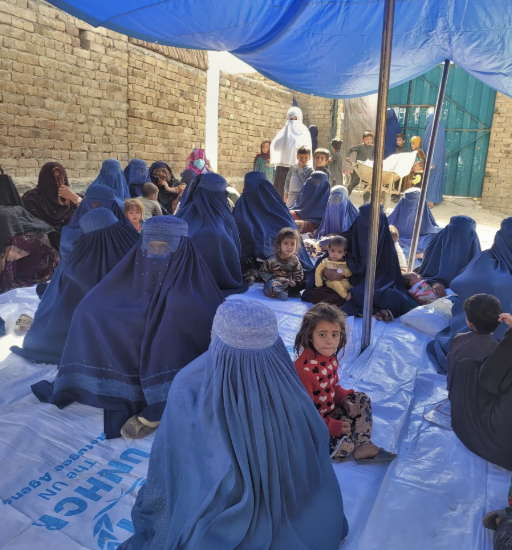
Photo via: Sarah Easter/CARE
***
If you were to time-travel back to Afghanistan in the 1960s, you would most likely see women in knee-length skirts and dresses, boys and girls studying in classrooms together, and groups of friends eating and listening to music in public. If you’re lucky enough, maybe you’ll pass by a beautiful river where Afghan children are free to play in the water with the ducks. This perception of the Afghan community was captured by Dr. Bill Podlich, an Arizona State University professor who went to Afghanistan to teach at the Higher Teachers College in Kabul. From the accounts of Podlich, his wife, and two daughters, the community in Afghanistan was rich in history and culture, filled with people who were proud of where they came from and peaceful towards one another. However, that is surely not the impression you would get of Afghanistan if you were to visit today.
Since the Taliban took over in 1995 and again in 2021, the country has been in a much worse condition. The Taliban is a terrorist organization that gained its rise in the 1990s from the formation of the Afghan mujahideen, a group of Islamic fighters that fought against the Soviet takeover in Afghanistan. The group sought to end corruption and crime. However, their regime has only proved to increase poverty levels, enforce severe punishments, and strip Afghan women of any autonomy they once had. The Taliban’s strict interpretation of the Islamic religion is the driving force of their policies.
Hope of a better future and opportunities for children has essentially disappeared for Afghan families after the Taliban takeover. Women stay at home praying their husbands return home safely. Worry takes hold of citizens whenever there is a strange knock on the door, fearing the Taliban has come to exploit them. Mothers and fathers work excruciating and painstakingly long hours in hopes of providing for their children’s education. Girls who were once in school with plans of pursuing higher education now sit at home with their dreams crushed, watching the cycle repeat for their daughters. Children are sent away to marry due to severe poverty and familial pressure. In a quick turnaround, the hope that Afghanistan would be a progressive and opportunistic country has been lost.
Previously, the United States had a strong force in helping the citizens of Afghanistan. However, many reversals of efforts to fund humanitarian aid in Afghanistan have occurred under the Trump Administration. $3.8 billion in funding has been stripped for foreign development, hitting Afghanistan particularly hard, and relocation efforts to place Afghan citizens who are allies to the United States have stopped. Furthermore, entry for Afghan citizens into the United States has been suspended under the requirement that “immigrants must be financially self-sufficient and not be a financial burden to Americans.” Presumably, these decisions have sparked intense debate about America’s role in helping Afghanistan. The Trump Administration defends its actions, stating that Americans are the priority and funding should reflect that. The White House also pushes that the United States Agency for International Development (USAID), the fund that works to end global poverty and discrimination, did not effectively help other countries and instead encourages “radical, leftist priorities, including climate change, diversity, equity, and inclusion (DEI), LGBTQ activities, and other projects.”
Many Americans disagree, pointing out that USAID has contributed greatly to combatting many international issues such as treatment for illness and recovery from natural disasters. In regard to Afghanistan, funding from USAID primarily supports food assistance, access to clean water, healthcare, and education initiatives. Now more than ever, these citizens could greatly benefit from the support funded towards their needs and futures.
As the needs of Afghan citizens increase and the support from the United States decreases, other countries have stepped in, but they can’t come close to the level of funding the United States once gave. Some argue it is not the United States’ responsibility to save other countries, while others believe that if the government has the means to do so, a moral responsibility kicks in to give to those in need. As a world leader, the United States has a duty to help countries in need on the basis of humanitarian rights, given that it has the resources to do so. Although rightful devastation has resulted from the condition Afghanistan is left in, the continuous revolt against terrorism gives hope that the country can return and progress from the way it was in the 1960s.
***
This article was edited by Madison Boyd and Ruben Ortiz.
 Christian Dziura
  Javeer Khan
  Amelia Felice