
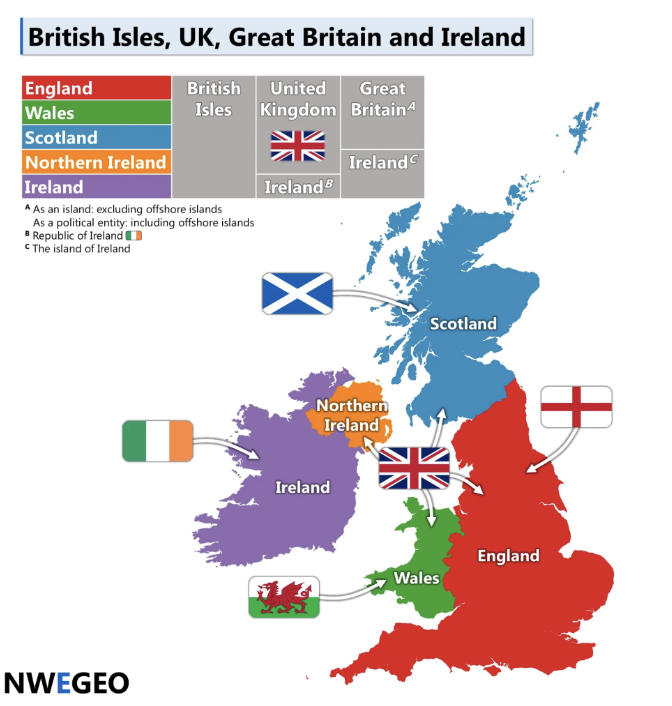
Image via NWEGEO
***
On September 15th, party leaders from the Scottish Nationalist Party (SNP), Plaid Cymru from Wales, and Northern Ireland’s Sinn Féin all met in Cardiff to sign a historic agreement. The agreement marks a unified push by the three nationalist parties to reclaim their right to self-determination and decide their constitutional futures on their own terms, stating in a joint statement reported by BBC, “That no Westminster government has the right to block democracy.”
Whether these goals are feasible or not remains in dispute, as Wales faces steep economic and political hurdles. If we look at the official statistics from the 2022 Welsh Government’s Trade Survey, trade with the rest of the UK is extremely vital to the Welsh economy, with sales to England, Scotland, and Northern Ireland growing by £14.8 billion in just 2022 alone. Apart from economic concerns, the Welsh political consensus presents another barrier. Looking at the results of YouGov’s Welsh Independence Polls, support for complete independence in Wales has significantly less support than in Scotland, making the political climate just as difficult as the economic one in the case of Welsh independence.
While Scotland has the most established independence movement of the group, its biggest hurdle is still getting enough voters on board. In the 2014 Scottish Independence Referendum, 55% of Scots voted to stay in the UK, but nationalists argue that the 2016 Brexit Referendum completely changed the game two years later, as 62% voted to remain in the EU. Still, the real roadblock is in London—unless Prime Minister Andy Burnham backs down on a second referendum or a future Labour-SNP coalition forces the issue, another vote just isn’t in the cards anytime soon.
Unlike Scotland and Wales, where independence requires a new legal framework, Northern Ireland already has the constitutional framework to leave the United Kingdom and reunite with the Republic of Ireland.
To understand why, we have to look at how Northern Ireland came into existence. In 1921, Britain seized the northern counties of Antrim, Armagh, Down, Fermanagh, Derry, and Tyrone from the rest of the island, creating Northern Ireland. The division created a lasting political and religious divide between the primarily Protestant Unionists, who wanted the North to remain a part of the UK, while the mostly Catholic Republicans wanted to reunite Ireland.
Eventually, all of these tensions became the Troubles, a three-decade period of violence between political and religious groups beginning in the 1960s. Republican groups, mainly the Provisional IRA, sought to end British rule in Northern Ireland and achieve Irish reunification, while loyalist paramilitary groups and British Security forces sought to maintain Northern Ireland’s position within the United Kingdom.
The Good Friday Agreement, signed in 1998, brought an end to the conflict by establishing that Northern Ireland’s status would be determined by the consent of the Northern Irish voters. According to the terms set forth by the Good Friday Agreement, Northern Ireland will remain under British sovereignty unless its people vote to rejoin the Republic. Through the laws of the House of Commons, the UK Secretary of State for Northern Ireland can call a border poll if a majority vote for unification appears likely. Unification would also require a majority vote from the Republic of Ireland.
There have been some significant political changes in Northern Ireland over the last decade, which could play into unification. In the 2022 elections, Sinn Féin became the first Irish Republican Party to win a plurality of seats in an assembly election after winning 27 of the 90 seats, while the Democratic Union Party (DUP) won 25 seats.
The religious makeup of the North has also changed. The 2021 census found that 42% of the population identified as Catholic, while only 37% identified as Protestant or another Christian denomination.
Although whether someone is Catholic or Protestant does not necessarily decide which side of the reunification debate they fall on, a Catholic majority would most likely favor the unification of Ireland. Some political analysts, including those from the Northern Ireland Life and Times Survey, caution that religious background will not determine a vote for unification, as other issues, mainly economic stability, remain the decisive factors for voters.
For more than a century, the idea of a united Ireland has been the most divisive issue on the island. The question today is no longer whether reunification can legally happen, as the Good Friday Agreement established that it can. The real question is whether enough people in Northern Ireland will eventually decide that it should happen. The Cardiff Agreement may not answer that question, but it could be another sign that the debate over Ireland’s future is entering a new chapter.
***
This article was edited by Hayden Schreck and Gwynneth Palo Mack.
 Thomas Tisdale
  Samuel Speiser
  Domenick Fedele