
Image via Investigative Post
***
Across New York State, public schools are getting bled dry.
Parents notice the warning signs first. Advanced Placement elective classes vanish from the course catalog. Music programs get chopped to part-time electives. Class sizes creep upward, and school boards issue grim warnings about impending budget shortfalls.
The citizens of these towns? They brace for yet another education-budget hike that amounts to seemingly nothing.
Naturally, taxpayers look to city halls or Albany for answers. Yet, the entity siphoning their public education budgets isn’t a corrupt mayor or negligent governor. It is an obscure, unelected board operating out of a local conference room down the street: The Industrial Development Agency.
The $2 billion corporate giveaway machine
To understand how your local school district lost its funding, you have to look back to 1969.
The New York State Legislature created Industrial Development Agencies (IDAs) with the goal of curbing the catastrophic loss of manufacturing jobs by offering targeted tax relief to heavy industry. Decades later, an organization once designed to bring jobs to New York has mutated into a lawless corporate giveaway engine.
Today, over 100 hyper-local IDAs operate across New York’s cities, towns, and counties. Unelected and appointed board members hand out an estimated $2 billion in annual property, sales, and mortgage recording exemptions.
Rarely do these tax breaks save manufacturing town centers. Instead, IDAs routinely funnel public wealth into the pockets of commercial developers, Amazon fulfillment centers, and luxury apartment builders.
The system is simple. IDAs “grant tax breaks through a mechanism called a payment-in-lieu-of-taxes agreement, commonly referred to as a PILOT.” The system works incrementally: after entering into an agreement with the state, companies begin with a steep tax discount and pay incrementally until they start to pay in full. The goal is to incentivize businesses to move their factories to New York, generating jobs and revenue.
Taxation without representation in the classroom
The collateral damage of this corporate welfare falls directly on local schoolchildren.
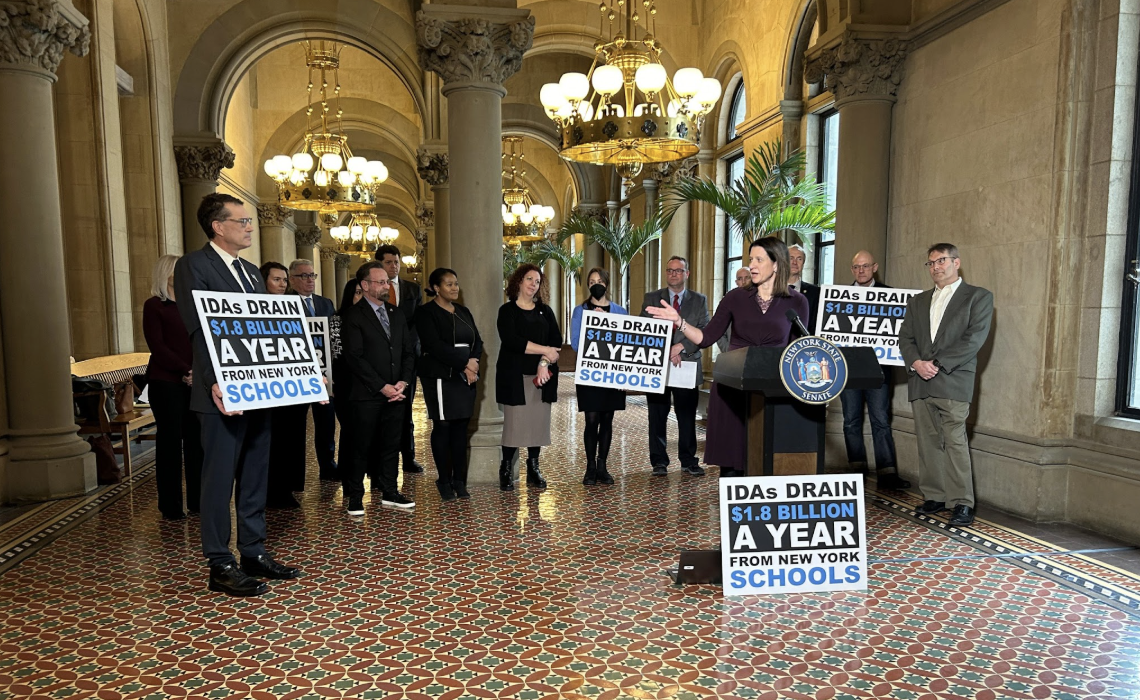
In New York, public school districts depend on local property taxes for roughly 50% of their operating budgets. When an IDA waives property taxes for a mega-development through a decades-long PILOT deal, it strips those revenues directly from municipal tax bases. Statewide, IDA tax abatements siphon off more than $1.8 billion every single year from public school funding.
“A Zero-Sum Race to the Bottom”
To add insult to injury, New York’s tax laws actually punish the communities where these projects land.
Under a disastrous flaw in the state property tax cap formula, properties receiving IDA subsidies are excluded from local tax-base growth calculations entirely. School districts are blocked from adjusting their tax levies to keep pace with new residential developments brought in by subsidized housing complexes built on PILOT deals.
Because IDAs overlap at both the county and municipal levels, developers routinely shop around for the best deal, creating a “Zero-Sum Race to the Bottom.” A warehouse developer could threaten to build 3 miles down the road in the next town over unless they get a 100% sales tax waiver.
Consequently, suburbs and towns compete in a desperate race to the bottom. These local governments grant massive tax breaks simply to shift existing, low-wage jobs across town borders while starving their own public infrastructure.
The path forward for Albany
State Comptroller audits consistently show that IDAs rarely enforce “clawback” provisions when developers fail to meet promised job-creation targets. New York is trading long-term public infrastructure for “ghost” jobs that never materialize. Albany cannot continue to look the other way.
Legislative reform is urgently needed, starting with a statutory ban on IDAs abating school district property taxes, alongside elections on all local development agencies. Until New York stops allowing hyper-local boards to trade away public school budgets for private commercial interests, our communities will continue to pay the price.
***
This article was edited by Zahra Akhtar and Ananda Ramdass.
 Thomas Tisdale
  Caroline Smith
  Giovanni Esposito