
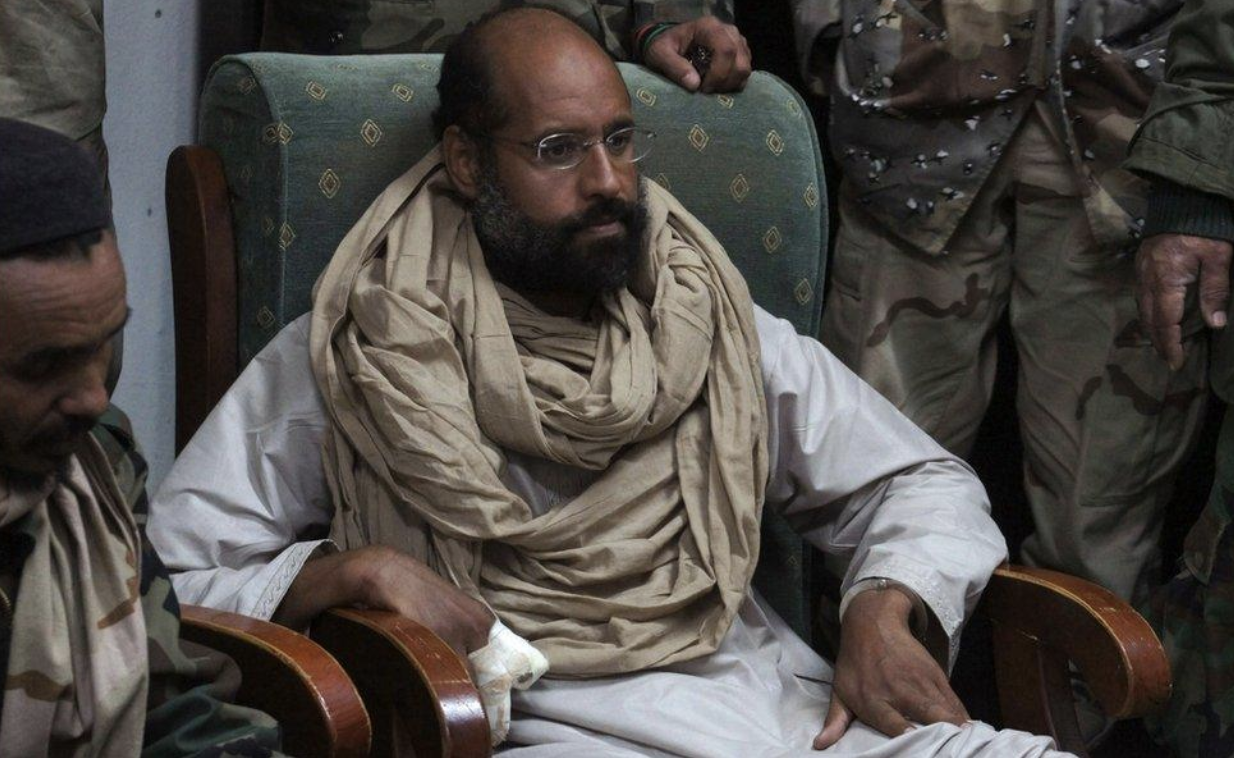
Photo via the BBC
***
On February 3, 2026, Saif al-Islam Gaddafi, the son of Libyan revolutionary and leader Muammar Gaddafi, was slain in his home in the western city of Zintan. He was 53 years old. The assailants are unknown.
Once considered the public face of the Jamahiriya government, he was viewed by the international community as a moderate counterpart to his more radical father. However, following the 2011 Arab Spring revolts, Gaddafi firmly refuted liberalization and Western-stewarded democratization, threatening “rivers of blood” against those who would rebel against the Libyan regime. With UN Security Council approval and NATO military assistance, the anti-Gaddafi National Transitional Council (NTC) successfully took power on September 16, 2011, approximately one month before Muammar Gaddafi’s killing in Sirte, That same year, Saif al-Islam was captured and held prisoner, eventually sentenced to death in a highly controversial trial held in absentia, from which he was later pardoned. He remained wanted by the International Criminal Court for crimes against humanity until his death.
Revolution without Reconstruction
Al-Islam’s death closes the final political chapter of a family whose power defined the modern Libyan state. Regardless of the brutalities of the Jamahiriya system, its collapse in 2011 did not simply depose a ruling elite—it dismantled an architecture that had guided the nation since 1969. Muammar Gaddafi repressed political dissidents, consolidated power, and provoked the ire of the international community by supporting resistance organizations such as the Palestine Liberation Organization, the Irish Republican Army, Ansar Allah, and the Polisario Front. Oil production was nationalized, tribal conflict was mediated through patronage networks, and sectarianism was subdued. Although the state was undemocratic, Libya was sovereign and stable.
Despite the NTC’s military success, the rebellion failed to generate a unitary government following the end of the war, leaving the Libyan state fractured between two rival authorities—the UN-recognized Government of National Unity and the Libyan House of Representatives-backed Government of National Stability— claiming to rule the entire country, alongside Islamist, tribal, and paramilitary organizations controlling territory throughout the vast nation. The Second Libyan Civil War quickly followed the first, which, although officially concluding in 2020, has yet to result in national elections, leading to the dual power system in the country.
The Last Heir to Jamahiriya
Saif al-Islam’s relevance did not end with his government’s collapse. Following his release, al-Islam emerged as a symbol of regime restoration and legitimacy. In 2021, he announced his presidential candidacy, leveraging nostalgia and disillusionment with post-revolution authority. His campaign ultimately went unrealized, as the Libyan electoral process collapsed before a leader could be chosen. To his supporters, al-Islam represented stability, not dictatorship. His rhetoric promised a return to state sovereignty, institutional restoration, and national unity. However, to many powerful groups in post-2011 Libya, his ascendency constituted an existential threat.
Death
With al-Islam’s death, the last remnant of a pre-revolutionary state has faded. His death failed to resolve the structural contradictions of 2011; it cemented them. Jamihiraya’s dismantling did not institutionalize a successor state. Now, fractured sovereignty persists. Violence determines legitimacy. The fate of the Libyan regime proves one thing: it is easier to destroy a system than to rebuild it.
***
This article was edited by Mila Cabanlit.
 Thomas Tisdale
  Samuel Speiser
  Domenick Fedele