
Photo via 800 × 450 Medium
***
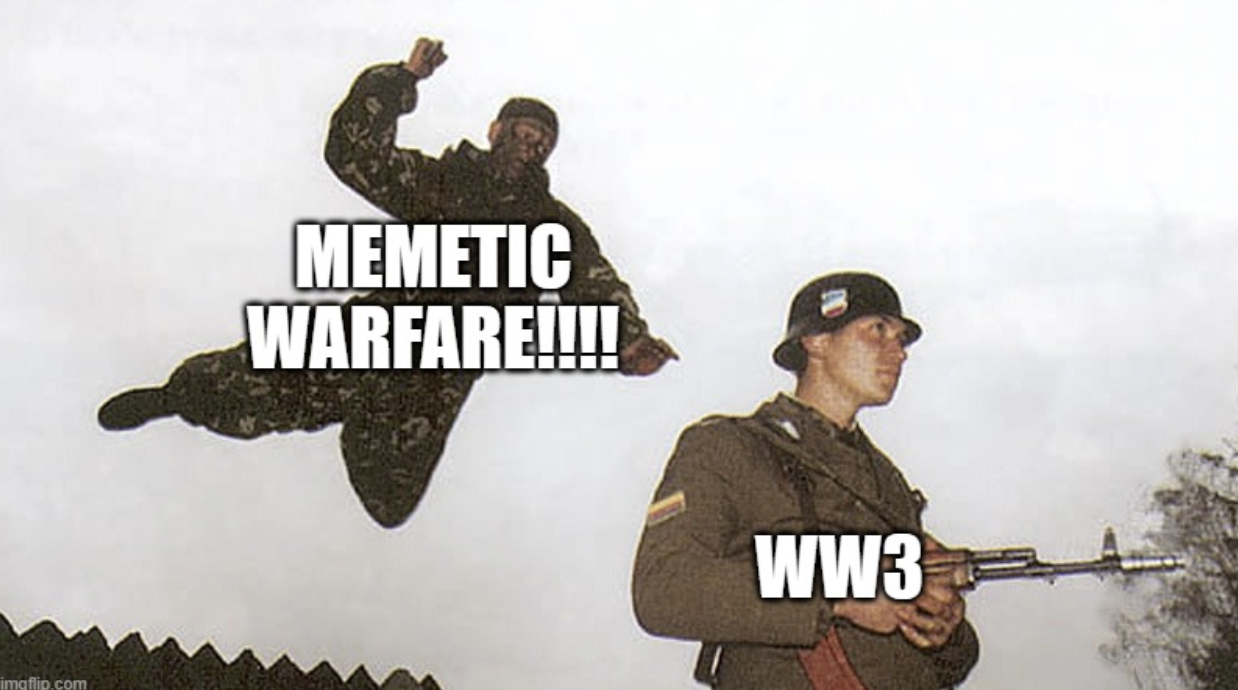
The internet loves a good conspiracy theory, and if you’re a deep diver, you’ve most likely heard of “memetic warfare” or the CIA’s “meme department.” With the release of the Epstein files, this “theory” has gained a lot of attention. While the public often jokes about it, memetic warfare is a serious tactic that affects many people, often without them realizing it. So, what’s real and what’s not, and how does this type of digital influence actually operate?
There are countless explanations of memetic warfare online, and it’s easy to get lost, so it helps to define it clearly: “Memetic warfare is a modern form of information and psychological warfare that involves the propagation of Internet memes on social media.” Whether through propaganda or misinformation tactics, all are aimed at influencing public opinion. The concept of memetics comes from Richard Dawkins’ The Selfish Gene (1976), where it is defined as a non-genetic way of transferring information between individuals. Over time, memes have become images, text, or videos, and researchers like Michael Prosser and Keith Henson explored their use in military operations and as replicating patterns of culture, ideas, and behavior. For example, internet communities are skeptically noting the sudden prominence of Jeffrey Epstein jokes, from AI videos of him dancing to clips joking about or romanticizing his island. The absurdity of these videos is almost painfully shocking. At first, your instinct might be to laugh because of the song or the sheer “what am I even watching” factor, but that is exactly the point. They are desensitizing you to something horrific.
Let’s begin with what we can say with certainty. U.S. military and intelligence agencies have long explored psychological operations (PsyOps) and social media influence. PsyOps soldiers are elite communicators who use a range of skills, especially advanced media techniques such as social media, digital marketing, and traditional outreach, to influence the beliefs, emotions, and actions of foreign audiences in support of U.S. Army objectives. Through strategic messaging, deception, and relationship-building, they turn information into action, shaping decisions, behaviors, and perceptions worldwide. DARPA, the Defense Advanced Research Projects Agency, is a research and development agency within the U.S. Department of Defense. It launched the SMISC program in 2011, Social Media in Strategic Communication, to study how information spreads online, track memes and narratives, and develop tools to detect and counter misinformation at scale. SMISC shows that memetic warfare is not theoretical but actively studied. The research in this study builds on the earlier concepts of “military memetics,” which examined how ideas spread and influence behavior. Dr. Robert Finkelstein suggested the creation of the “Meme Control Center” as a “framework for meme-war.” This system would analyze enemy memes for information and produce “friendly” memes for offensive purposes. The following image displays Dr. Finkelstein’s design.
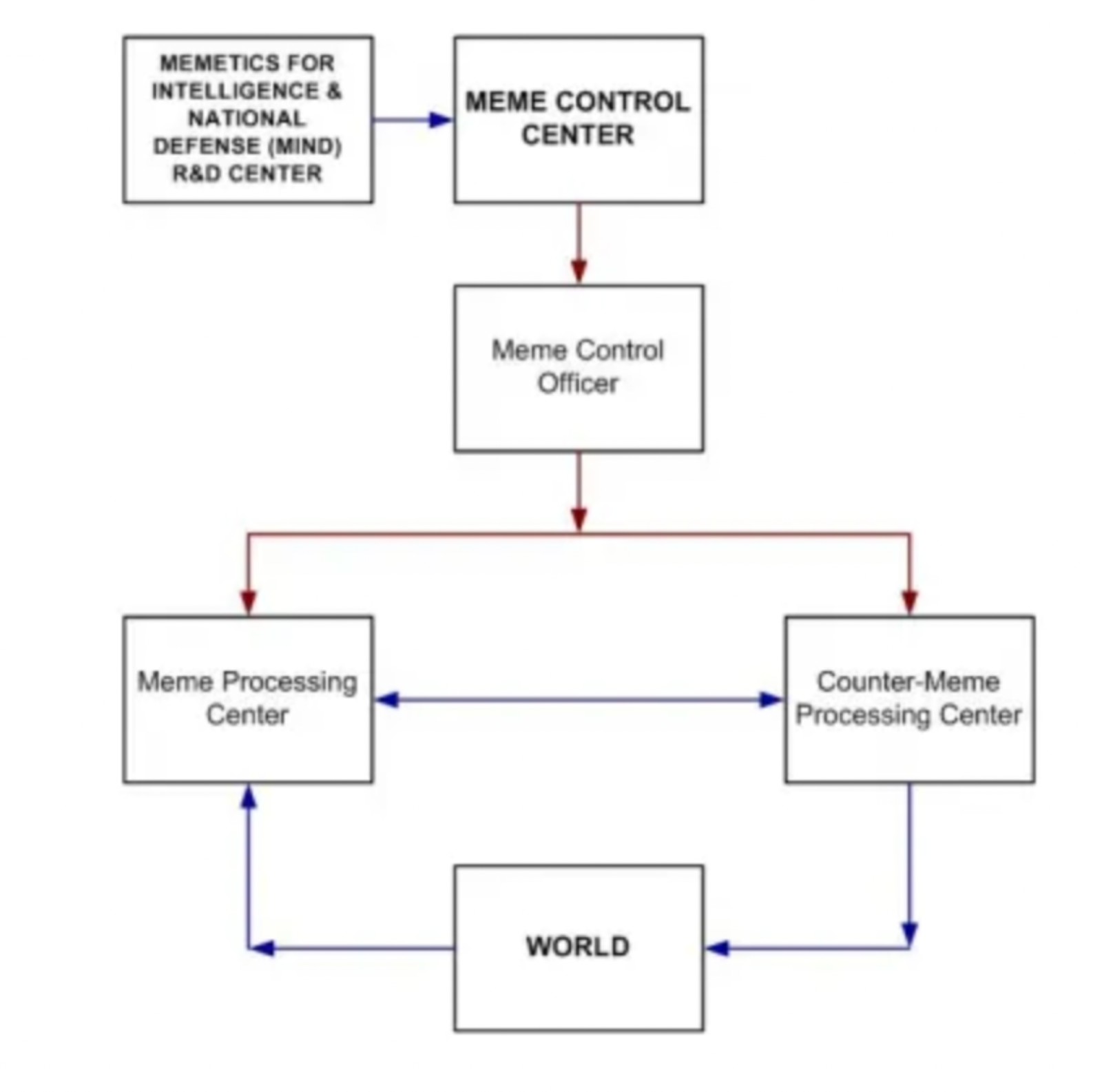
Image via Medium
***
Whether this system was ever actually used or not is classified information. However, past disclosures such as WikiLeaks’ Vault 7 show that highly sensitive intelligence capabilities can and do become public, revealing just how extensive and advanced these operations can be behind the scenes. So in this context, memes are not just jokes, but tools that can “exploit psychological vulnerabilities” to create confusion, fear, and influence behavior.
This is not limited to the United States. Russia’s Internet Research Agency became widely known for its role in the 2016 United States Presidential Election, using memes and social media campaigns to influence public opinion. China has also carried out large-scale digital influence efforts through state media and online networks, as documented in reporting by The New York Times and Freedom House’s Freedom on the Net.
What makes memetic warfare effective is how invisible it feels. Memes are fast, emotional, and very easy to consume, which lowers people’s guard, like previously mentioned with the Epstein videos, consumers don’t even realize they are becoming desensitized to a very serious topic, and shifting the focus from heinous crimes to some online insane meme legend. These memes don’t read like news or propaganda, so they are rarely questioned in the same way, and often stick in people’s memories more than a lengthy article would. Instead of directly convincing someone, they repeat, exaggerate, or reframe ideas until they start to feel normal. Over time, this can shift what people pay attention to, what they take seriously, and what they dismiss. It is less about forcing belief and more about shaping the environment in which belief forms.
The point is not that every meme you see online is part of some coordinated operation, but that the landscape itself has changed. Humor, irony, and absurdity now play a role in how information spreads and how people process serious issues. In the end, while memes are clearly taken seriously as tools for influence and psychological operations, whether there is, or ever was, a formal CIA “meme department” remains unknown. When something disturbing is repeated often enough in a detached or joking way, it becomes easier to ignore. Memetic warfare does not need to be obvious to be effective. It works best when it blends in, when it feels organic, and when people never stop to question why they are seeing what they are seeing. Memetic warfare is real, but the conspiracies about secret meme labs are still just that: speculation.
***
This article was edited by Hayley Dunn.
 Cooper Toland
  Lara Ejzak
  Jonathan Kho