
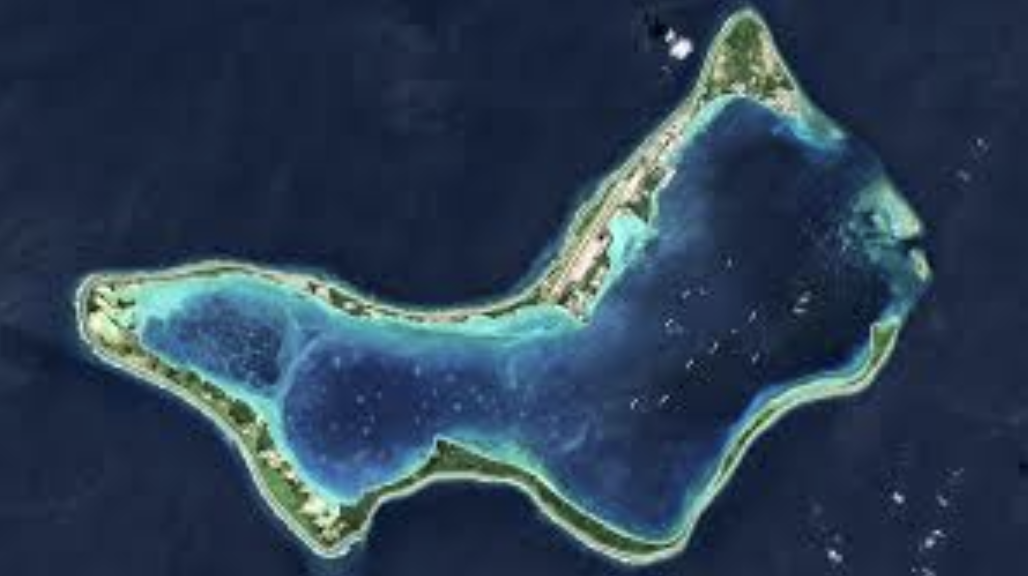
Photo via the BBC
***
Nothing embodies the evolving geopolitical order more than the fight over the island of Diego Garcia, a small, remote island in the middle of the Indian Ocean, no bigger than Lower Manhattan.
Part of the Chagos-Laccadive Ridge, an underwater mountain range, Diego Garcia is roughly 12 square miles, with only its coastal rim of sand and coral rising above the ocean. Its horseshoe shape encloses a sheltered lagoon. This natural harbor makes the island’s value immeasurable, enabling the security of naval fleets, the prepositioning of supplies, and the rapid deployment of air and sea power from the Middle East to South Asia.
Thus, amid rising tensions during the Cold War, the United Kingdom, recognizing the island’s potential, purchased the Chagos Archipelago, including Diego Garcia, from Mauritius in November 1965. Upon this purchase, Britain forcibly removed the islands’ native inhabitants, the Chagossians, between 1968 and 1973, expelling roughly 1,500 to 2,000 people to Mauritius and Seychelles, with many tailspinning to desolate poverty as a result.
The United Kingdom showed zero concern for the Chagossians. Instead, the UK worried about turning the newly purchased island into a military stronghold in the Indo-Pacific, as Cold War-era advisories did.
The island hosts an extensive airfield with runways long enough to accommodate large military aircraft like B-52 bombers, reconnaissance aircraft, and transport planes. It also has major fuel storage facilities, radar installations, and control towers that can support regional military operations.
Diego Garcia has remained a key military base, becoming one of the few places in the world where the U.S. military can refuel submarines, pre-position vast stockpiles of equipment, and launch long-range bombers without relying on its allies.
In recent years, China’s expanding commercial and dual-use footprint in the Indian Ocean has heightened security concerns among regional powers, and Western powers warn that it could open the door to Chinese influence in Mauritius.
Yet Britain is attempting to sell the island back to Mauritius. Why would the UK do that? For one reason, guilt.
In 2019, the International Court of Justice concluded that Britain’s separation of the Chagos Archipelago from Mauritius was unlawful and urged the islands to be returned. This belief was then overwhelmingly supported by the United Nations General Assembly. Since then, Mauritius has pressed its claim, raising the prospect that Britain could face mounting isolation as adversaries exploit the dispute to question the credibility of Western international law and advance their own interests.
Under mounting pressure from the political left in the United Kingdom, Britain’s right to ownership is under attack. This is partly due to the political left wanting to shed Britain’s colonial past. Given that the United Kingdom relied heavily on colonialist policies for a long time, those calling for its abandonment are valid.
Yet, Diego Garcia is more than an island representing the UK’s colonialist past; at least, it is to Xi Jinping and the Communist Party of China.
China is rapidly expanding its military and economic footprint across the Indian Ocean, seeking to build a network capable of challenging Western military dominance in the Indo-Pacific. Diego Garcia would be the perfect island to further this plan.
Xi Jinping even commented that “China is willing to always be a good friend and a good partner of Mauritius.” Diego Garcia is yet another attempt to expand their influence worldwide at the expense of their adversaries.
China’s and Mauritius’ blossoming relationship is what makes the United Kingdom’s Kier Stamer’s stance shortsighted.
Once Mauritius owns Diego Garcia, China would have the opportunity to pressure Mauritius into allowing Chinese officials to inspect military equipment on all of the islands, greatly compromising American and British interests and gravely endangering national security.
British lawmakers’ attempts to shred their colonial past are admirable, yet when they endanger safety, their aspirations are no longer admirable; it’s toxic empathy.
Giving a strategic military base vital to national security does not undo the British colonial past; it only neuters Britain’s post-colonial future and global security.
For that reason, common sense must prevail; Prime Minister Keir Stahmer and the toxic empathy must not.
***
This article was edited by Catherine Hart Sheehy.
 Abby Coxe
  Campbell Brown
  Holmes Wormald