
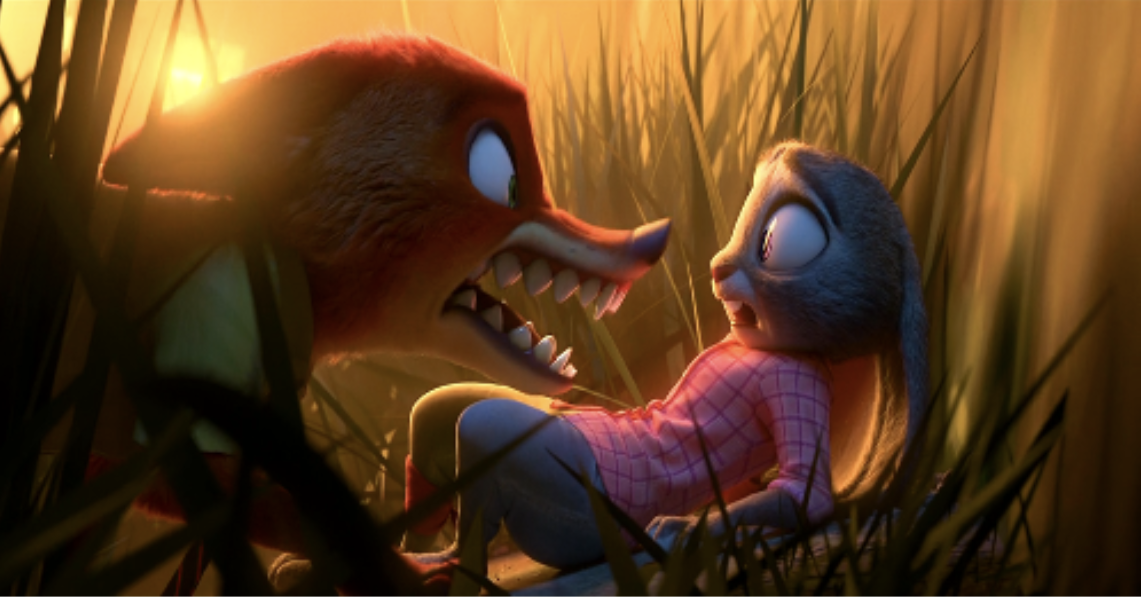
Photo via Zootopia
***
For those who have not seen it, the first Zootopia movie follows the life of Judy Hopps, who achieves her dream of becoming the first rabbit police officer in Zootropolis—a city where predators and prey live harmoniously. After being relegated to parking duty, she takes on what appears to be a low-profile missing persons case in an attempt to prove her worth beyond the margins of tedious parking citations. Enlisting the help of a con artist fox, Nick Wilde, Judy soon realizes that the case is a part of a huge, prey-supremacist conspiracy that works to criminalize predators altogether. As it turns out, Assistant Mayor Bellwether had been poisoning predators, inducing a regression into ‘savage’ behavior, and sowing fear across Zootropolis to justify their containment.
In a pivotal sequence (pictured above), Nick Wilde pretends to go ‘savage’ on Judy Hopps to procure an admission of guilt from Assistant Mayor Bellwether. Bellwether is arrested, and the afflicted predators are cured and released back into Zootropolis.
In revisiting the first Zootopia with closer inspection, here are my thoughts.
Firstly, the film is an obvious critique of our own prejudices and the hunch that someone different than us is out to get us. In ICE raids across the country and the use of excessive force (emphasis on ‘excessive’) justified through the lens of a ‘reasonable fear’ of the ‘predatory’ others, we see similar politics at play.
April 10, 2026 marks 93 days since Renee Good died and 76 days since Alex Peretti died at the hands of federal immigration officers during protests against unlawful immigration crackdowns in Minneapolis. The difference between Minneapolis and Zootropolis is that Nick Wilde weaponized the stereotype that has oppressed him for justice, whereas Good and Peretti were not weaponizing anything at all. Even with a sense of the firearm Alex Peretti was carrying, no weapon was spotted by the agents until after he had been pepper-sprayed point-blank in the eyes and tackled—his free hand above his head—when the gun became visible. That is to say, Alex Peretti never drew his weapon, and Renee Good was unarmed. In that respect, Zootopia remains a children’s film, inviting the hope that someone like Nick Wilde can, against all odds, weaponize the very stereotype used against him. Unfortunately, in our reality, harm is inflicted regardless of whether or not that stereotype is ever performed.
Secondly, in Zootopia and in the U.S. alike, ‘predatory animals’ and those associated are subject to a belligerent campaign of racial profiling. For the themes outlined above, it reminds me of a core concept of political theory: raison d’état, or “reason of state.”
Raison d’état suggests that the preservation of the political system and the security of the State take precedence over civil liberties. Historical examples include suspending habeas corpus during the Civil War, post-9/11 Guantanamo Bay detention, etc. Although this term is used mostly in IR theory, for all intents and purposes, taking care of your family could be your raison d’etat, and so could your career. But in the context of Zootopia, once the ‘savage’ and ‘feral’ narrative is activated, Zootropolis’ raison d’état motivated total isolation of predators. When fear is institutionalized and once the State adopts the premise that “all predators are dangerous,” it legitimizes extraordinary measures against them (ex. 1942 Japanese American Incarceration). Minneapolis and Zootropolis show that once fear is institutionalized, it doesn’t need truth to sustain its momentum. It really only requires narratives, and narratives, as we all know, are dangerously easy to construct when a government has already decided what “danger” looks like. Under the pressure of perceived collective threat, the State can expand its coercive power outside traditional standards to regain control. Naturally, categories of “safe” and “dangerous” are quickly produced, and the boundaries of constitutionality become increasingly malleable.
Lastly, stereotyping makes us human; it’s a natural, heuristic cognitive process to simplify complex ideas. But, how hard we cling to them and our willingness to revise them is the deciding factor in entrenching harmful/peaceful ideologies. Cycles of whataboutery and profiling is represented in the names of those lost exercising their First Amendment rights, and stands as a reminder of the human cost when the State acts on illogical raison d’état. On a personal level, as someone who grew up in a truculent, Trump-supporting household, and who has at times shared my immigrant parents’ frustrations over their paths to citizenship— Zootopia does a great job at reading against the grain, addressing the biopolitics that destabilize the binary of victim and perpetrator, all while showing the speed with which institutionalized fear can lower the threshold for excessive violence.
***
This article was edited by Abigail D’Angelo.
 Glenmarie Rios Rodriguez
  Ayden Suber
  Isabella Villalobos