
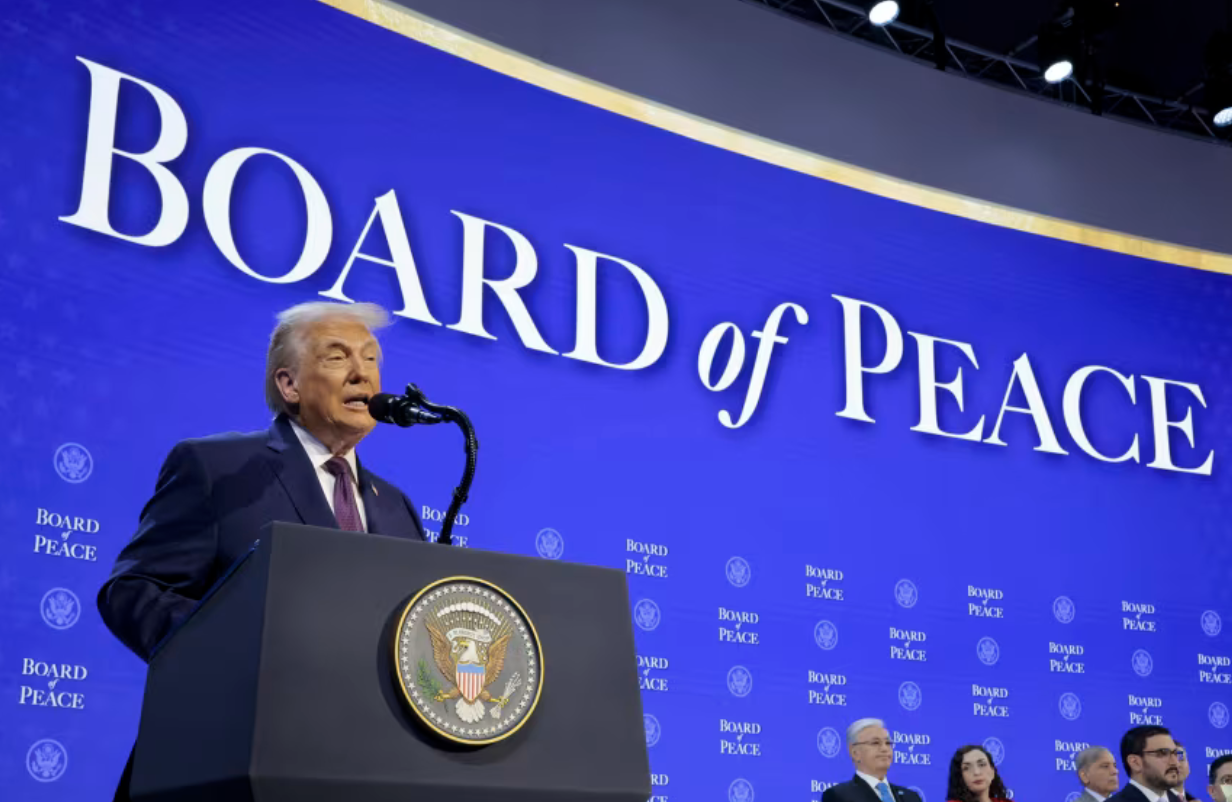
US President Donald Trump speaks as he presents the “Board of Peace” onstage at the World Economic Forum (WEF) on January 22, 2026 in Davos, Switzerland. Photo via Chip Somodevilla/Getty Images
***
In 2025 alone, Donald Trump had signed 221 executive orders, more than any president throughout their entire term since President Carter. So far this year, 2026, Trump has signed 16, which have already had large impacts. Evidently, these executive orders have been a major tool for the White House to accomplish its agenda. It’s not unprecedented to use executive power; however, it becomes a little unsettling when it’s used to push the boundaries of presidential limits.
By executive order signed on January 16th, Trump designated his Board of Peace as a Public International Organization through the International Organizations Immunities Act (22 U.S.C. 288). Meaning that the Board of Peace is entitled to certain privileges, exemptions, and immunities. It’s very similar to current international organizations such as the UN and NATO. The current plan for the Board of Peace is to map the reconstruction and rehabilitation of Gaza, with future plans to “take care of a lot of things“ in “other spots” around the world, according to the president during the Board of Peace Inaugural Event.
While peace is a benevolent goal, the organization raises some diplomatic red flags. Foremost, Trump has appointed himself as the chairman of the Board of Peace, according to his own Truth Social account. This is the first time in U.S. history that a president has chaired the public international organization they created. A precedent has been set for presidents to establish these organizations, but they have always appointed someone else to head them. Also, per the New York Times, the board “invests significant personal power in Mr. Trump, even after he leaves the White House.” Essentially, Trump now chairs an international organization that can make decisions beyond the U.S. government, for life. Keep in mind, an organization with ‘special privileges.’
Granted, the other members and countries must agree on these decisions, but the New York Times also writes that “Mr. Trump would wield considerable veto power” within the board. The POTUS wrote the rules for his own international organization; he can shoot down any ideas he disagrees with. Following the same theme of central power, Trump controlled who the Board appointed. Notable figures leading the executive committee are Jared Kushner, Trump’s son-in-law, and Tony Blair, the former British prime minister. Trump also controls which countries are invited. He received particular backlash for not including representation for Palestine, yet involving the Prime Minister of Israel, Benjamin Netanyahu. When the Board’s first objective is to rehabilitate the Gaza Strip, why aren’t both sides represented?
The answer is simple: to push his agenda. Reuters suggests that the rehabilitation of Gaza is actually just an imperialistic strategy of gaining control. In February of 2025, Trump said that the U.S. would take over Gaza, and this may be his move to do so. It’s not far off to compare this decision to Trump’s actions involving Venezuela this year. The Gaza Strip contains significant untapped oil reserves, a resource that underpins the global political system. Gaining control of the Strip means more wealth and bargaining chips against other countries. If you don’t believe it yet, according to NPR, “A crucial part of the next phase of Trump’s ceasefire plan will be the deployment of thousands of international troops to Gaza.” The deployment is said to be “20,000 soldiers and 12,000 police officers.” Military presence can be necessary for maintaining peace, but historically, having troops on the ground has often seemed more like a move for control.
Is the Board of Peace legal? Yes. Nothing illegal has been done; it’s all technically within the president’s power. Unprecedented is the president chairing his board, but there are no laws against it. The legal gray area is Trump’s biggest ally, and this is a clear example of him capitalizing on it.
At the end of the day, the formation of the Board of Peace falls in line with Trump’s political strategy—take every inch he can get. So far this term, he has been issuing executive orders one after another, pushing the limits of his power. With every order passed, it’s one more straw of power. When an order is declared unconstitutional, Trump amends it and sends it right back, flooding the DOJ. He is constantly testing how far his executive power can get him and how much more control he can grab.
Trump claims “there’s nothing more important than peace,” but for his board, I’m not sure their intentions are truly just peaceful.
***
This article was edited by Abigail D’Angelo.
 Luke Helmholz
  Gavin O'Sullivan
  Madelyn Marcisz