
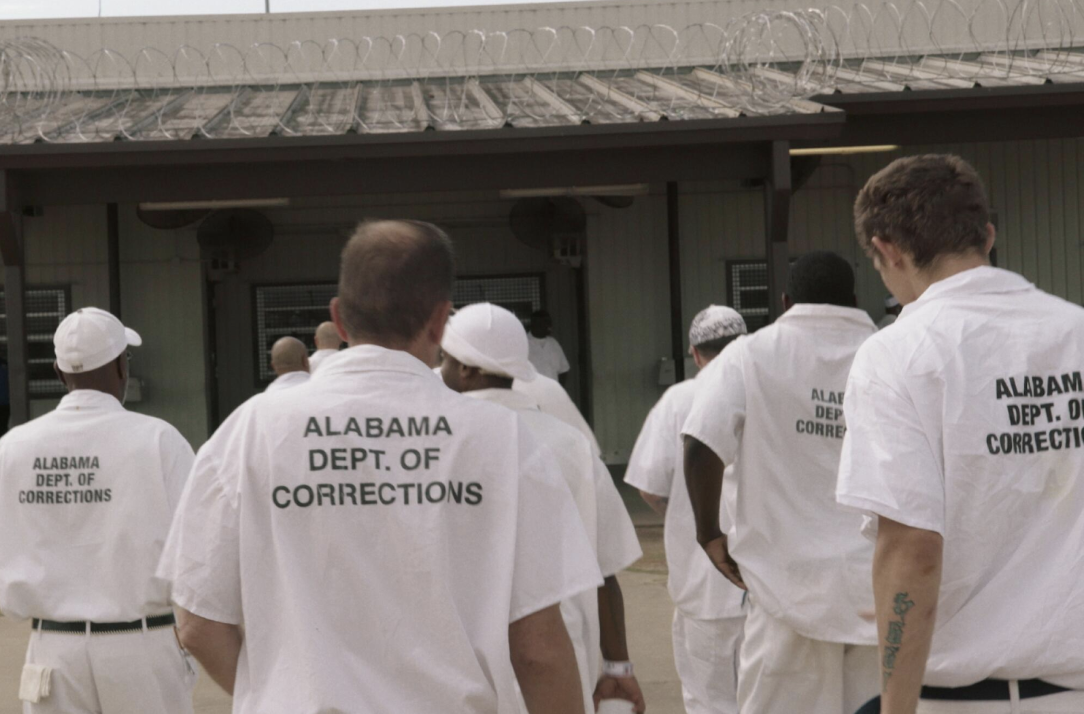
Easterling Correctional Facility in Clio, Ala., as seen in the HBO documentary “The Alabama Solution.” Image via HBO
***
In 2019, filmmakers Andrew Jarecki and Charlotte Kaufman took on the challenge of documenting Alabama’s prison system. While the state of Alabama broadly prohibits outside media personnel from accessing prisons, Easterling Correctional Facility allowed the duo to film their annual volunteer-run barbecue. While cameras were rolling, prisoners smiled and listened attentively to the county’s visiting pastors. Off-screen, men told stories of institutional violence and inhumane living conditions. Jarecki recalls hearing cries for help from inside the prison dormitories, after which guards shut down filming for the day.
That interaction served as the foundation for the 2026 Oscar-nominated documentary The Alabama Solution. Made over the course of six years, the film brings awareness to the rampant abuse perpetuated in Alabama prisons, bypassing press restrictions by relying on videos shot directly by the prisoners on contraband cellphones. The result is typically grainy footage, providing first-hand accounts of filthy dorms, health violations, and inmate assaults. The first thirteen minutes detail the assault of Steven David, an inmate who was beaten so aggressively by correctional officers that he was transferred to an ICU and later pronounced dead. His assaulter, Roderick Gatson, still works in the Alabama prison system.
David’s case is just one of many that The Alabama Solution sought to unfold, stemming from decades of institutional failures. In 2017, the system was once again up against the Department of Justice for a lawsuit regarding overcrowding and insufficient mental health resources. Between 1999 and 2009, the prisons were continuously under fire for increasing costs but depleting quality. In 1976, the landmark case Pugh v. Locke exposed several violations of the 8th and 14th amendments, which protect citizens from cruel and unusual punishment and the right to due process.
These civil rights violations span even further back than the 20th and 21st centuries, starting with the very conception of the U.S. prison system. After the Civil War, specifically between 1875 and 1928, Alabama partook in the convict-lease system. This allowed business owners and private enterprises to pay fees to the U.S. government in exchange for prisoner labor, stimulating the post-slavery economy of the South. Surprisingly, this system was completely legal, as the 13th Amendment, which outlaws slavery, makes an exception for enslaving convicted criminals. To maintain the sheer number of prisoners sustaining Alabama’s post-slavery workload, Black men were specifically targeted and arrested at disproportionate rates. In one instance, Alabama leased all state prisoners to a coal-mining company, of which 90% were Black. The convict-lease system was abolished in 1928, but forced labor persisted through unethical living conditions, systematic exploitation, and high incarceration rates for Black men.
Today, Alabama relies on forced prison labor and perpetual abuse to continue leasing out imprisoned individuals to giant corporations, such as Burger King, Best Western, and Bama Budweiser. An estimated $450 million in revenue is generated by forced prison labor in Alabama, yet The Alabama Solution documents the grim conditions that accompany this economic incentive. Jarecki and Kaufman use the documentary to shed light on how exploitation and forced labor work hand in hand, creating profitability for corporations and unbearable conditions for thousands of individuals.
“Forced labor is coerced because of these violent conditions,” said Jarecki after the film’s debut, “[officers] have a huge amount of leverage over these men.” When individuals are stripped of their identity and subjected to such an inhumane quality of life, their perceptions of their own right to justice are diminished, aiding in the continuation of forced prison labor.
Though state officials and supporters will argue that leased labor facilitates rehabilitation and increases employability amongst prisoners, these intense conditions and lack of financial compensation for labor mirror that of past convict-leasing systems.
Even inmates who spoke against the system through Jarecki and Kaufman’s documentary have been silenced. Since the film’s release, three inmates have reportedly been moved to solitary confinement with relatively no explanation beyond their involvement with The Alabama Project. Jarecki and Kaufman continue to bring attention to these cases and have since directly called upon Alabama legislators to take action against this unjust system.
While activists and protesters remain persistent in their fight for institutional reform, the Department of Justice has pushed their trial on, against the state of Alabama to April 2026. Meanwhile, construction has begun on Alabama Governor Kay Ivy’s Correctional Complex in Elmore County, a multi-billion-dollar prison project that allegedly includes improved mental health, vocational, and recreational resources. There is no information from the state of Alabama regarding how prison labor will be utilized within the new complex.
While state-sanctioned efforts can undergo as much positive promotion as possible, the undeniable truth is that countless prisoners are still experiencing inexcusable living conditions amidst being utilized to increase corporate profitability. Effective change will not come solely from a new facility, and certainly not from a prolonged DOJ ruling, but from a comprehensive evaluation of how prisons operate and the retribution that countless individuals are owed.
***
This article was edited by Sofia Downes,
 Luke Helmholz
  Gavin O'Sullivan
  Madelyn Marcisz