

Image via Getty Images
***
After my Spanish oral exam, my professor and I discussed studying abroad in Spain. She voiced her own language insecurity from when she visited the country, but when I expressed a similar concern for myself, she eased my doubts by saying, “Don’t worry, they love Americans.”
At that moment, I was still on a post-exam high and I didn’t register what that sentence implied, but now that I’m on the comedown, I’ve realized the double standard that statement holds. While I’m sure it wasn’t a dig by my professor, the sentiment is a mix of admiration and pity.
While it is convenient that Americans have a pass for being proficient in other languages, what does this incompetence say about our country and foreign opinions on Americans? Is this transcendence above the rules and expectations of linguistic knowledge a testament of the power of the United States or a standard to be ashamed of?
Culture and media clearly represent the American-centric world view. Over 80% of contemporary movies are filmed in English, and even movies filmed outside of English speaking countries primarily use English.
This English language domination of the entertainment industry could be interpreted as a show of power and control. The Hollywood industry is the largest proponent of this monopoly and is undeniably an impressive institution, with respect to success and distribution.
As patriotism-inducing as these cultural statistics are,, I can’t help but feel embarrassed that I would have no chance of understanding a foreign film without subtitles. A Polish child would have a better chance of understanding Inception than I would have at understanding an episode of “Peppa Pig” in Polish.
The root of this issue stems from the delayed start most American public school students have in the linguistics education field.
Looking at Europe alone, studies report that “students typically begin studying their first foreign language as a required school subject between the ages of 6 and 9.” These students were speaking in foreign tongues before I could even wear shoes with laces.
Pretty impressive, right? Well, I’ll do you one better. In 20 European countries, students are required to learn a second foreign language. Talk about a continent of overachievers.
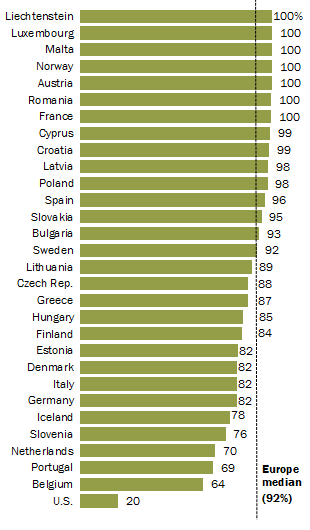
Europe drastically outpaces US in foreign language learning. Image via Pew Research Center
***
The expectations of linguistic education in the states pales in comparison with the rest of the world. In my hometown secondary school district, only two years of language classes were required. And speaking from personal experience, those years were by no means rigorous or impactful, seeing as I can speak Spanish–a language I’ve only taken for a little over a year—more proficiently than I ever spoke German in the four years I took courses for it.
Unfortunately for all my peers and I, we’ve likely peaked as far as our potential for becoming fluent in another language goes. MIT scientists suggest that after age ten, it is nearly impossible to reach a level of mastery in a second language. Still, there are many cultural and cognitive benefits that come with learning a new language, even if you can never manage to roll your R’s.
If the majority of the world natively spoke English, though the disparity of American foreign language proficiency would still be troubling, it would be more excusable. The great irony is that English is neither the first nor the second most spoken native language. Instead, it’s bringing home bronze behind both Mandarin/Chinese and Spanish.
Granted, there are a significant number of English speaking countries, but just because there are a lot of people who speak English doesn’t offer an excuse to neglect making an effort to learn another language. The fact that Americans expect anyone who lives here to speak English whilst simultaneously relying on other countries to speak English for our convenience shouldn’t be seen as a sign of language superiority, but rather a wake up call to diversify our own lexicons.
I have been dreading that oral exam for the entire past month, and it lasted a total of eight minutes. It’s inconclusive whether that says more about the American education system or my own concerning levels of stress, but it can’t be a good sign either way.
If the American education system implemented earlier language programs, a whole other world of media and communication would be at our disposal. We could watch “Narcos” without subtitles or confidently order from ethnic restaurants.
There is no catering service more efficient than that of other countries pampering Americans in conversation. The only downside is that this service had to eliminate the h’orderves section. No one could pronounce it.
***
This article was edited by Mariella Richards and Whitney Woodrow.
 Glenmarie Rios Rodriguez
  Ayden Suber
  Isabella Villalobos