
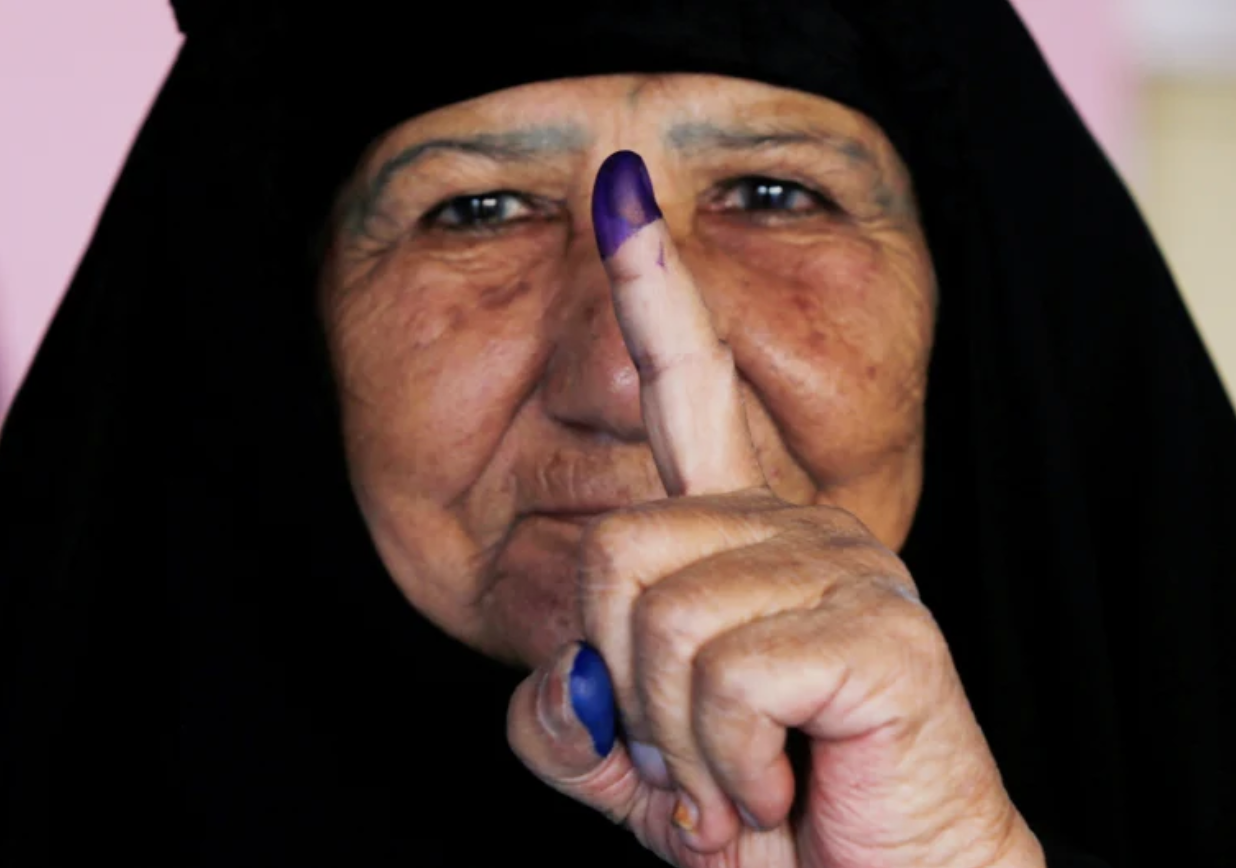
Photo via NBC
***
“Many of my friends and relatives, even people with higher degrees, have just lost faith in voting,” said Kawthar Jaber, a Baghdad native. This is the unfortunate reality of Iraq, a nation where democratic fatigue has taken over. Iraq’s elections have become a national ritual of disillusion, a civic act performed out of habit rather than hope. After two decades of war, corruption, and foreign interference, the Iraqi democracy continues in theory, but falters in faith. Together, these realities reveal a deeper truth: Iraq still holds elections, but its people no longer believe in what those elections promise.
Democratic backsliding is rising globally, and scholars warn of its dangers. It occurs when political systems erode elections, institutions, and basic checks on power. The 2021 parliamentary elections of Iraq saw a national turnout of 43%, a sharp drop from the high turnout of over 79% after the 2003 U.S. invasion, showing a long-term decline in public engagement. Although the 2025 election recorded about 55% turnout among registered voters, many eligible Iraqis never updated their registration and stayed away from the polls. AP News Coverage links this to public disillusionment with corruption, militia power, and the sense that real decisions are made after voting.
Since the 2003 U.S. invasion, the government has been dominated by Shiite parties. Iraqi politics crystallized around muhasasa ta’ifiyya, an ethno-sectarian quota system that allocates top posts by identity rather than program: in practice, the presidency is reserved for a Kurd, the prime ministership for a Shia Arab, and the parliamentary speakership for a Sunni Arab, with ministries and senior posts divided among party blocs.
Scholars argue that this system was not organically developed by Iraqi society, but rather was formed through bargains struck by exiled opposition groups and solidified under U.S. occupation. The Carnegie Middle East Center demonstrates how these early post-invasion deals entrenched sect-based party power rather than fostering citizen-centered politics. Research further suggests that this imported power-sharing model prioritizes elite stability and foreign-supported balancing over accountability to Iraqi citizens. In practice, this system transformed elections into elite negotiations rather than public mandates, deepening the gap between citizens and the state.
Iraq consistently ranks among the most corrupt states in the world, receiving a 26/100 (0 being extremely corrupt and 100 being no corruption) score and a rank of 140/180 (1 being no corruption and 180 being most corrupt) on the 2024 Corruption Perceptions Index, as reported by Transparency International. Iraq is a classic rentier state, where vast oil revenues support large public payrolls, and political parties use state jobs and contracts to reward supporters. Ministries are often treated as negotiable assets in coalition talks; parties trade them to control hiring, procurement, and access to money. During the most recent election cycle, there were reportedly 46 arrests for suspected voter card trafficking, turning votes into commodities in a system shaped by poverty and political competition. This further discourages Iraqis from believing that voting matters. After all, with all this corruption, what’s the point of placing your vote?
But corruption alone is not what hollowed out Iraq’s democracy; fear and violence did, too. Iraq’s voter disillusionment is shaped by the 2019 Tishreen uprising, when security forces and armed groups killed and injured hundreds of protesters, with no prosecutions or credible investigations since. Human Rights Watch documents ongoing intimidation, threats, and harassment of activists seeking justice, reinforcing the belief that political participation is dangerous and futile. Voters interviewed by Reuters say elections mainly help politicians divide oil wealth and government jobs rather than deliver reform. The testimony of Salih Abdul Hassan, a 64-year-old lawyer from Basra, further illuminates this disillusionment. His refusal to vote, as he states, “I will not vote for corrupt politicians or militia leaders because I don’t want to be complicit in their crimes over the next four years,” exemplifies how perceptions of corruption and complicity undermine individuals’ sense of agency and trust in electoral processes. This sentiment, shared by both older and younger citizens, highlights how skepticism about the motives of public officials continues to suppress genuine engagement and reinforces patterns of political disengagement.
Human rights groups describe how the 2019 Tishreen protests, in which hundreds of mostly young demonstrators were killed, injured, or disappeared, left a legacy of impunity and fear that continues to shape young Iraqis’ mistrust of elections and political parties. Similarly, nations like Venezuela show comparable patterns of electoral authoritarianism, with low turnout reflecting public skepticism and disillusionment in the face of manipulated electoral processes. These parallels matter because they show that Iraq’s crisis is not an outlier; it’s a warning sign about the fragility of democratic faith everywhere.
What Iraq is experiencing is not unique. Political scientists argue that some governments maintain elections not to empower citizens, but to demonstrate legitimacy. In his Journal of Democracy article, Andreas Schedler describes these systems as “electoral authoritarian” regimes, where leaders allow voting while manipulating media, courts, and participation to maintain power. He argues that even as some forms of authoritarianism fade, many states have produced new ones. He states: “They have produced regimes that hold elections and tolerate some pluralism and interparty competition, but at the same time violate minimal democratic norms so severely and systematically that it makes no sense to classify them as democracies, however qualified.” Schedler goes on to say these electoral regimes do not represent warped ideas of democracy, they are examples of authoritarian rule. Schedler believes this nondemocratic nature has to be taken seriously. Freedom House’s 2024 report rates Iraq 31/100 (“Not Free”), citing militia influence, corruption, and restricted civil liberties despite regular elections.
Taken together, Iraq’s experience shows how a political system can keep performing the functions of democracy long after its citizens have stopped believing in it. Years of violence, corruption, and sectarian politics have drained elections of meaning. A government built on quotas instead of accountability, and sustained by patronage instead of public trust, cannot convince people that their votes matter. The legacy of the Tishreen killings, the retrenchment of muhasasa, and the recycling of the same elites all reinforce the feeling that outcomes are predetermined and participation is futile. Iraq does not lack elections; it lacks faith in what elections can do. What remains is a political ritual that persists out of habit and obligation, even as the hope that once animated it fades, and that is a far more dangerous collapse.
***
This article was edited by Fatimah Waqas and Angelina Bland.
 Abby Coxe
  Campbell Brown
  Holmes Wormald