
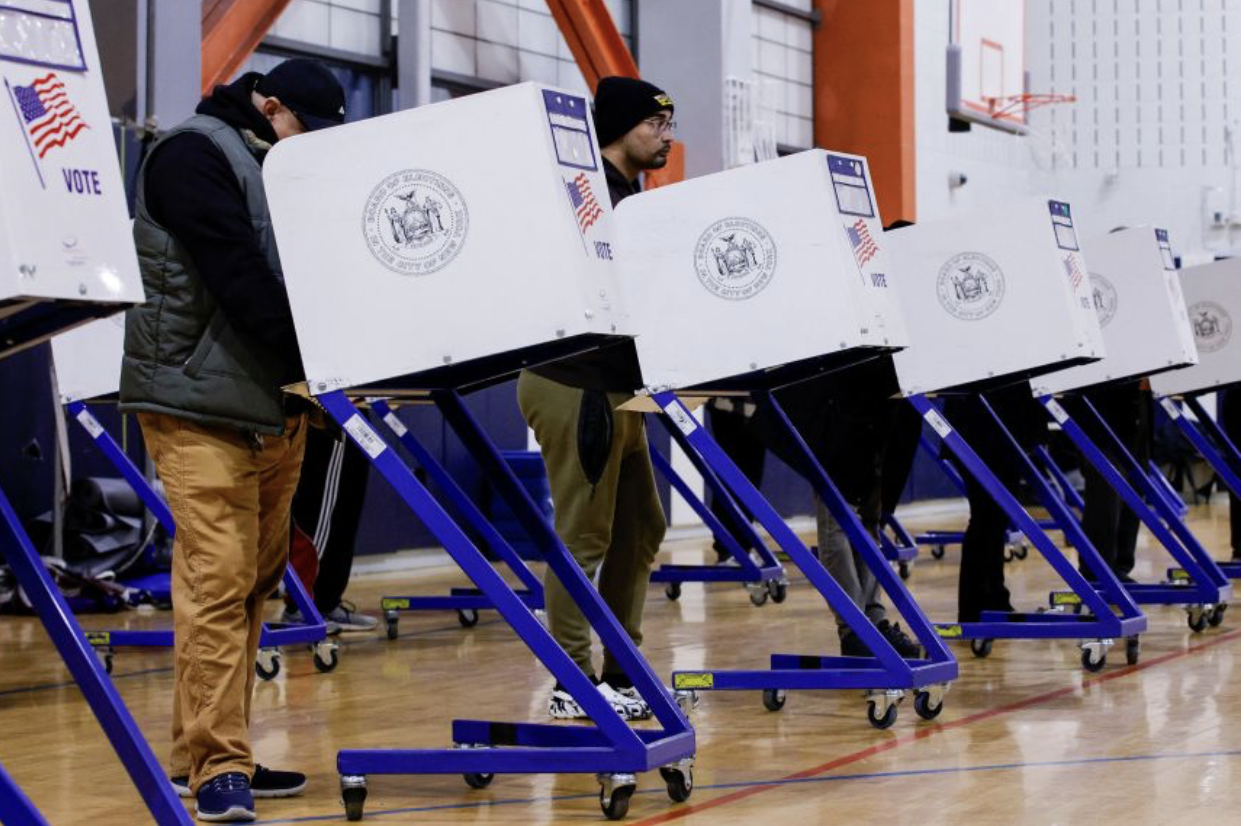
Polling location in Queens, NY on November 4th, 2025; Photo via Leonardo Munoz, Getty Images
***
Election Day 2025—a big day for Democrats, a warning sign to Republicans.
Democrats made large gains nationwide. The four largest elections were in New York City, New Jersey, Virginia, and California. Zohran Mamdani, a thirty-four year old self-proclaimed Democratic Socialist won the New York City mayoral election; Mikie Sherrill, a former naval officer and federal prosecutor, and Abigail Spanberger, a former Representative and intelligence officer, were elected as the new Democratic governors of New Jersey and Virginia, respectively; Proposition 50, a direct response to Texas redistricting to bolster Republican presence in the House, passed in California.
However, what is notably more intriguing are the outcomes of the exit polls in these most recent elections, and what they may mean for the Republican Party. These exit polls reveal the most pressing issues to voters, and not only helped to predict the outcomes of these elections, but will also predict the outcomes of the upcoming 2026 midterm elections.
These polls largely emphasized how the economy swayed voting outcomes. According to an Associated Press exit poll, 17,000 voters across New Jersey, California, New York City, and Virginia reported that the cost of living, property taxes, and federal cuts were the factors that influenced their vote the most. Many expressed concerns about holding steady financially, yet feeling unable to “get ahead.”
According to CBS News exit polls, seven out of ten New Yorkers expressed concern about the cost of housing, and renters made up over half of the New York City electorate. In New Jersey, while there were some voters concerned about electricity and taxes who voted for former New Jersey State Representative Jack Ciattarelli, CBS found that voters primarily concerned about the economy voted for Sherrill. In Virginia, Spanberger had a twenty-point lead over current Virginia Lieutenant Governor Winsome Earl-Sears from voters concerned about the economy.
Another interesting discovery in the exit polls is that those who voted for the economy overwhelmingly voted Democrat—this being despite current Republican President Donald J. Trump’s 2024 victory, which he secured by making promises to Americans regarding lowering the cost of living and building a stronger economy. Trump’s second presidency has so far been defined economically by high tariffs, rising inflation, and no budge in the high cost of living.
Combined with Trump’s low approval ratings, the 2025 elections prove to be a warning sign to Republicans. Many voters feel that the Trump administration has fallen out of touch with the economic reality of everyday Americans. There seems to be nothing done to combat high costs, and many voters feel that Trump’s emphasis on tackling immigration has gone to the extreme. AP Voter Polls found that crime and immigration were not top priorities for voters this election.
If the current administration’s attitudes about the economy persist, Republicans can expect a similar result in the midterms. While the aforementioned elections took place in blue states, Democrats also saw big wins in traditionally red states; for example, in Mississippi, Democrats broke the Republican supermajority in the state Senate after measures taken to end Black voter suppression in the state. There seems to be a shift nationwide from the 2024 presidential election.
Voters are becoming increasingly more dissatisfied with the direction of the country, and if the most recent elections and exit polls are any indicators, they may begin to side with Democrats against the current Republican-controlled legislature.
How will Republicans respond? Will they continue to try to sway voters by fixating on other “hot topics,” or will they listen to the majority of everyday Americans on the issue of affordability? Only time can tell—if Republicans want to secure 2026 victories, it is time to tackle the obvious problem of rising costs nationwide and work to provide affordability for all Americans.
***
This article was edited by Zeynep Helva and Andrea Velez.
 Sarah Olivia Sullivan
  Luke Helmholz
  Gavin O'Sullivan