
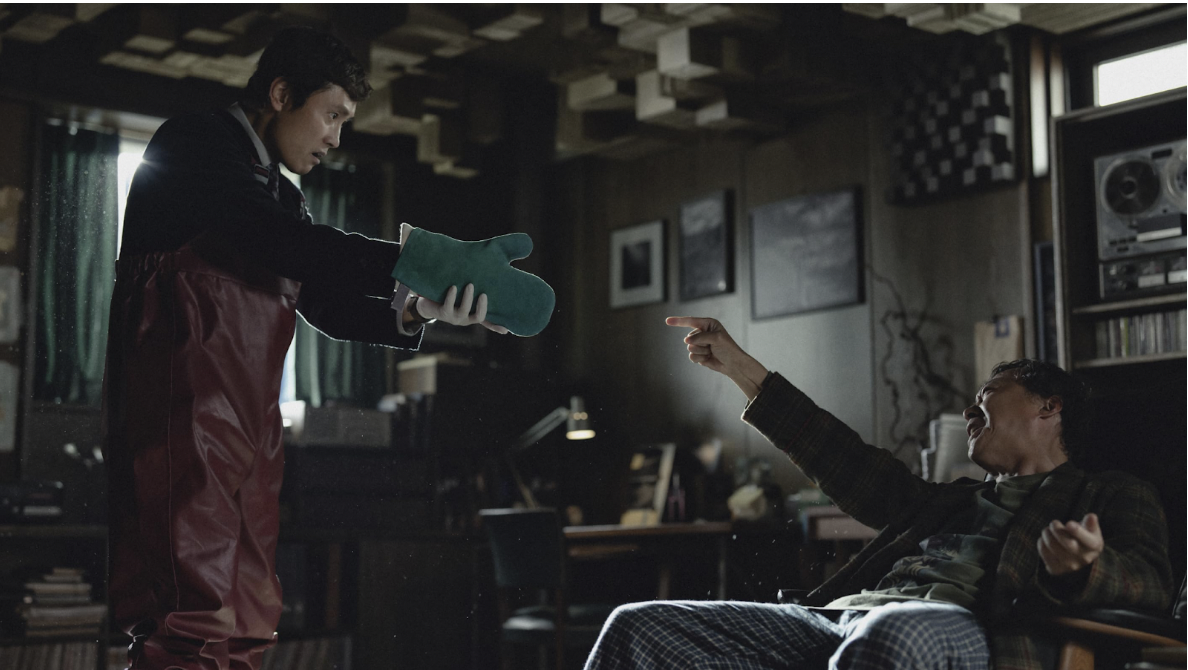
Photo still via IMDb
***
Few ideological fictions have proven as durable or comforting as meritocracy; the promise that skill, effort, and perseverance will carry one to the summit of their potential. Work hard, refine your craft, expand your resume, and the market will reward you accordingly. This narrative insists that employment is a neutral sorting mechanism, distributing opportunity in proportion to talent.
Yet reality is less procedural and more relational. Hiring frequently hinges on networks and nepotistic pipelines that completely undermine formal qualifications. Qualifications matter, certainly, but often less than proximity to power or fluency in the right professional vernacular. The meritocratic myth persists not because it is empirically reliable, but because it is ideologically useful.
This leaves one to ask the question: what becomes of those who lack the right connections, the curated networks, those who are told to compete in a system whose gates were never going to open to them?
Korean film director Park Chan-wook answers this with his 2025 film “No Other Choice.” The film follows paper factory worker Yoo Man-su, who, after getting fired due to budget cuts, turns to killing his competition for a new job, and succeeds at doing so with no repercussions. As the film progresses, Man-su transforms from a man who values human partnership and camaraderie in the workplace to a man isolated, surrounded by AI-powered machinery in a dull and lifeless paper factory, no longer yearning for the familial and communal setting he once valued in the workplace via his peers.
It’s easy to laugh at the absurdity that someone would literally interpret “there is no other choice” as an open invitation to murder, but that absurdity is precisely the point. Capitalism trains us to see systemic violence as a personal inevitability.
Philosopher Louis Althusser’s theory of ideological interpellation helps explain this ugly pedagogy of capitalism. In his essay, “Ideology and Ideological State Apparatuses,’ Althusser argues that ideology constitutes individuals as subjects who see their place in society as natural and unalterable, even if it means beating each other to death for a job.
Althusser’s point, that subjects are “hailed” by ideology into seeing their role in the social structure as inevitable, maps almost too neatly onto Man-su’s journey. Capitalism here doesn’t coerce with whips. It interpellates through the soothing and nurturing grammar of self-help mantras and market inevitability. Man-su repeats corporate therapy slogans, like “Losing my job is not my choice” and “I am a good person,” even as he literally stages meticulous murders to survive.
Ideology, in Althusser’s formulation, is not some abstract cloud of beliefs drifting above material life. It takes shape in habits, institutions, rituals, and the very language through which we make sense of ourselves. Ideology “interpellates individuals as subjects” precisely so that exploitation appears to be natural and necessary, and eventually unavoidable.
“No Other Choice” weaponizes this insight with biting effectiveness. Characters repeat the phrase “no other choice” like a rationalization chip embedded deep into their psyche. The bosses say they had “no other choice” but to cut wages; Man-su says he had “no other choice” but to kill.
The title thus becomes a damning indictment of capitalist ideology. The title repackages what could be just a grim economic landscape to a teaching that individuals must accept systemic exploitation as their own burden to bear. At key moments, the film lets its comic facade crack, exposing the harsher truth beneath. Capitalism does not need to actively sabotage your dreams if it can persuade you that their erosion is simply fate.
Park Chan-wook’s satire feels timely for a world obsessed with workplace insecurity. Layoffs once confined to headlines are now daily anecdotes, with automation and AI looming over labor markets as both a supposed efficiency solution and an existential threat. Reporters chronicle how fears around AI replacing jobs shape public discourse, often without analyzing why we structure labor markets in such precarious ways.
There’s an almost perverse irony at the heart of the 21st century labor crisis: even the journalists and commentators who meticulously document job insecurity struggle to envision a world beyond the system that generates it. Park Chan-wook isn’t shy about this ambivalence. In interviews, he declines to offer an anti-capitalist manifesto, noting that capitalism isn’t going away soon, and even expresses a reluctant acceptance of AI’s inevitability.
That becomes the real cruelty: the film’s critique of capitalism is sharp enough to slice but not sharp enough to fully amputate the belief that “there is no other choice.” Under capitalism, survival is framed as a scramble for leftovers and the real sleight of hand is that we are encouraged to view one another as a threat, while the structures that engineer scarcity remain safely out of sight. It’s no wonder that Man-su’s murderous strategy sometimes feels more logical than collective bargaining in the warped moral universe Park Chan-wook constructs.
If the film were more ‘serious,’ it might offer solutions—policy suggestions, union demands, universal basic income squibs. Instead, it holds a mirror up to our present, a society where economic precarity competes with technological unemployment, individual desperation crowds out collective strength, and ideology whispers that exploitation is ‘just life.’
In the final scene, Man-su is isolated within the hum of the machinery and a dull, lifeless atmosphere settles over the paper factory, completely devoid of human life that he once valued. It’s a reminder that survival under capitalism often amounts to preserving a shell of dignity while your roots are torn out. This image resonates with real-world anxieties: from factory closures in the Rust Belt to software engineers contemplating obsolete skill sets, millions are taught to believe that their best option is to simply outcompete, innovate, hustle, or die.
We might laugh at Man-su’s absurd literalism. His decision to interpret “no other choice” as a logistical problem solvable through homicide. But the satire lingers because it feels uncomfortably familiar. The real punchline isn’t his hyperbolic violence, it is our recognition.
Capitalism rarely, if ever, asks us to kill outright. It asks us to compete, to rationalize, to accept insecurity as natural law, to narrate structural precarity as personal failure. We are trained to internalize the logic of elimination so thoroughly that Man-su’s extremity appears less monstrous than exaggerated. The joke, in the end, is not that he believed there was no alternative. It is that we so often believe it too, and call it realism.
***
This article was edited by Peter Leyba and Madison Boyd.
 Glenmarie Rios Rodriguez
  Ayden Suber
  Isabella Villalobos