
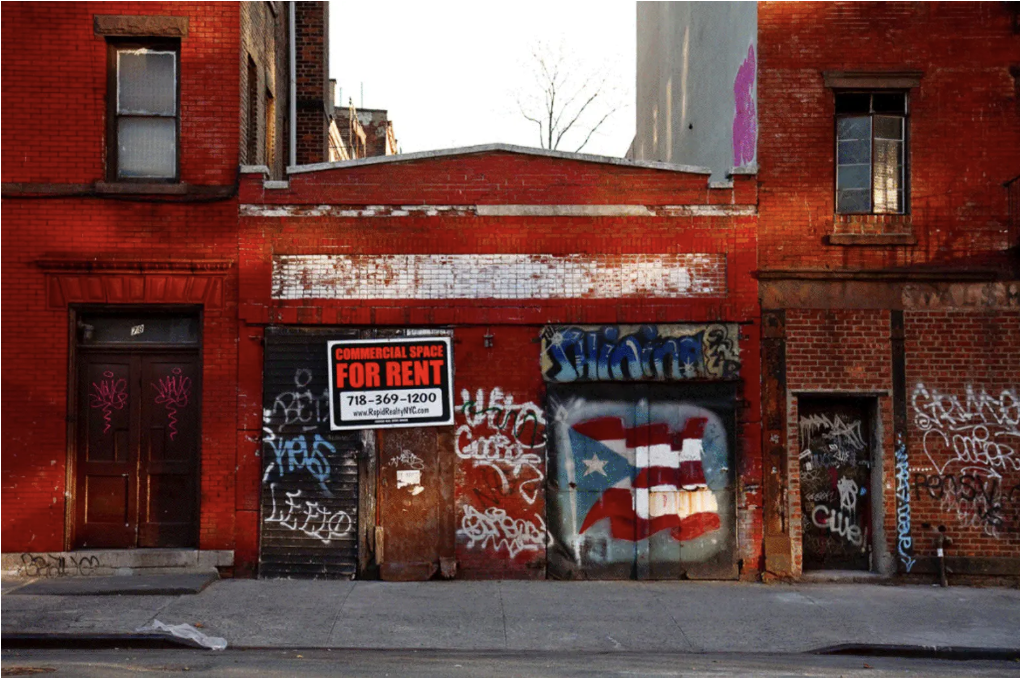
Photo via 6sqft
***
In the outer boroughs of New York City, one could once walk down the street and hear Spanish, Urdu, Haitian Creole, Italian, Polish, Bengali, Yiddish—languages embedded into the city as a byproduct of intergenerational immigrant settlement. Indeed, the city boasts over 700 languages spoken across its five boroughs, making it one of the most linguistically diverse metropolises in the world. But when the cost of rent soars and longtime residents are pushed out, something else vanishes: the mother tongues that made the city what it is. This is not a coincidental product of time; it is a political story of displacement, power, and erasure.
In neighborhoods experiencing the sharp edges of gentrification, rising rents and redevelopment are well documented. According to a typology by the Urban Displacement Project, over 12% of census tracts in the New York metro region were classified as “gentrifying” or in advanced gentrification as of 2016. As an NYC native myself who has witnessed firsthand the effects of gentrification on our city, there is an unmistakable correlation: where affordability declines, so does language retention.
Linguistic diversity once served as a living archive of immigrant resilience. The linguist Ross Perlin documented in his book, “Language City,” how speakers of the indigenous Mexican language Nahuatl, the Himalayan tongue Wakhi, and others make their homes in Brooklyn and Queens, proof that New York was a refuge for endangered ethnic communities. But Perlin warns that the spiral of gentrification and housing costs now threatens that role. As immigrant families are priced out, the soil in which languages grow is pulled out from under them.
Language is inseparable from place. A study of Brooklyn shop-signs found that the presence of heritage languages not only marked identity, but anchored community spaces. When stores shift from spoken Spanish and Bengali to boutique branding and bar facades aimed at wealthier arrivals, the linguistic ecology changes too.
Take, for example, the linguistic data from Brooklyn: around 45% of residents aged five and older spoke a mother tongue other than English at home. That’s nearly half the borough speaking something beyond the hegemonic language. Those figures reflect the city at its most vibrant. But with waves of displacement, language retention declines. Children switch to English or adopt the dominant tongue earlier, heritage media shutter, and enclaves fragment.
These linguistic shifts are not simply about nostalgia; they carry structural consequences. Households that are “linguistically isolated”—where no one in the household speaks English well—have lower income, higher rent burdens, and reduced access to services. A 2007 study by the CUNY Graduate Center showed that such households earned roughly half the income of others and paid a heavier share of rent. When gentrification uproots these communities, their language-based infrastructure vanishes: cafes, social clubs, media outlets, signage, even informal childcare networks.
Moreover, the loss of heritage languages results in intergenerational language erosion. Research in immigrant family contexts identifies a process called “shared language erosion,” in which children improve their English while losing the home language, a phenomenon compounded when the neighborhood language ecosystem disappears. The result: homes become dominated by monolingual English, breaking ties to a collective cultural voice.
To be clear, gentrification isn’t the sole factor in affecting language shift in either way. Immigration patterns, generational change, and national education policies also play major roles. But the local, spatial factors of rapidly changing neighborhoods, with long-term immigrant residents exiting and being replaced by higher-income newcomers who are often monolingual English speakers, are rarely discussed in linguistic studies of NYC. But it matters. Ethnic enclaves traditionally serve as protective zones for language and culture. When those are disrupted or dissolved, the languages affiliated with them become vulnerable. Ongoing research finds that the very structure of enclaves—co-ethnic employment, social networks, and language use—relies on spatial stability.
One may argue that language diversity remains high in New York: the Empire of tongue still stands. But to say “it’s fine” misses the nuance. Yes, hundreds of languages are spoken. But for many, the question isn’t how many, but how stable their existence will be when their speakers are pushed out. The linguistic richness may remain on paper, but the density of use, the intergenerational transfer, and the neighborhood-based institutions may slip away.
As a New York native who has experienced the displacing effects of rent and cost-of-living spikes and loved ones forced to relocate, it is evident that the mother tongues that previously reverberated through and defined the city vanish along with housing affordability. This process is further exacerbated by white-led influxes that alter the social matrix: bodegas are replaced by “chic” cafes, heritage fonts are replaced by new signage, and ambient languages revert to English-only soundscapes. To watch language recede is to watch communities lose their public voice.
So, what is to be done? Policies that treat housing, culture, and language as interconnected, rather than siloed, are essential. Preservation is not only about the continuation of teaching foreign languages in classes; it is about keeping the neighborhoods that speak those languages alive. It means supporting rent-regulated housing in immigrant neighborhoods, creating language-access infrastructure, and recognizing that linguistic justice is urban justice.
In the city that prides itself on its immigrant infrastructure and its countless mother tongues, a new silence may be emerging—the absence of the very languages that made this city loud. And in that quiet, the question remains: who gets to speak here, and who is rendered mute by displacement?
***
This article was edited by Chapin Fish.
 Glenmarie Rios Rodriguez
  Ayden Suber
  Saad Sandhu