
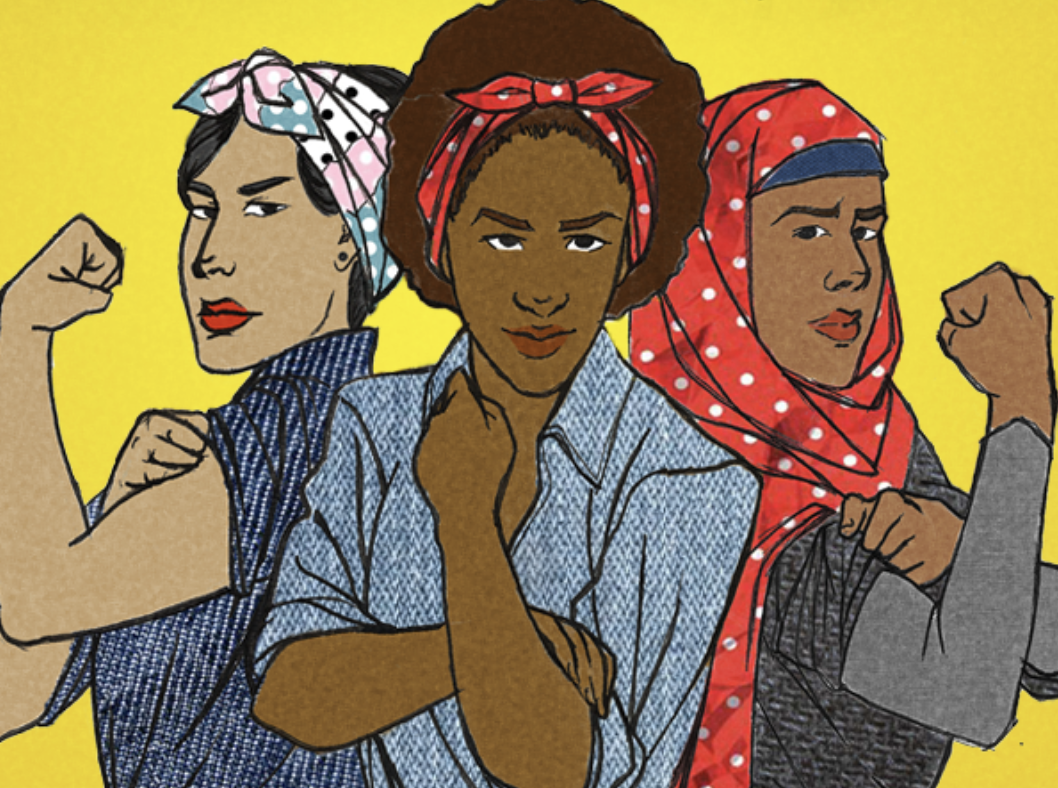
Revised “Rosie the Riveter.” Image via EverydayFeminism
***
In 1792, moral and political philosopher Mary Wollstonecraft published the ‘radical’ feminist essay, A Vindication of the Rights of Women. In this essay, Wollstonecraft argues that women deserve rational education and equal, indisputable rights with men. She argues against eighteenth-century theorists who, up to this point, had advocated only domestic education for women, challenging their view of women as property.
This revolutionary work set the groundwork for the feminist movement in America. Since Wollstonecraft’s A Vindication of the Rights of Women, the definition of feminism has undergone many different interpretations. For instance, Wollstonecraft’s literary work would be considered a product of first-wave feminism, and abolitionism focused only on white women.
This exclusion of women of color within first-wave feminism would do irreparable damage to the feminist movement for decades to come.
The ideals of the average modern, young American woman would likely fall under the category of a third-wave feminist. Going into the 1990s, women across the nation began to incorporate reclamation and self-expression into their feminist ideals. Themes of individual empowerment and reclaiming femininity flooded all forms of digital media, including e-zines, online forums, and music, particularly the Riot Grrrl underground punk movement. After the emergence of third-wave feminism, it underwent a sort of sanitization, with diluted versions making their way into pop music and other media. Overall, third-wave feminism was about expressing one’s sexuality through clothes, speech, and action in any way they wanted, free of judgment, and rejected the traditional ideals of femininity.
Many young American women are unaware that feminist ideology extends beyond the third wave into a transformative fourth wave, grounded in intersectionality and inclusivity. Fourth-wave feminism deals with the uncomfortable question of why most feminist ideology seems to cater only to white women. This pattern dates back to Wollstonecraft’s ideological essays. Fourth wave feminism calls for acknowledgment of the unique struggles of women of color as well as transgender women, who, up until this point, have been pushed to the back of the movement. As stated, fourth-wave feminism opens the door to challenging, nuanced conversations that many unaffected, youthful American women may not want to deal with.
Think of the most popular fictional “feminist” media among Gen-Z American women online. Acclaimed series following slightly eccentric, yet beautiful, slim, and beloved white women, such as Gilmore Girls or Sex and the City, may come to mind.
Perhaps directors such as Sophia Coppola or Greta Gerwig, who have been deemed staples of the “thought daughter” archetype popularized on TikTok, a term dedicated to young women who are introspective, devout overthinkers. Ironically, these “girl-boss” directors go to extreme lengths to omit women of color from their stories, such as Coppola did with her 2017 film The Beguiled, where she removed an entire character, Mattie, who was a black slave and featured in the original novel. Young American women on the internet seem to love these run-of-the-mill coming-of-age stories about young white girls because they are easily relatable.
The praise of white-feminist media is not the most damaging online trend to the feminist movement. Instead, I place the blame on the “I’m just a girl” trend circulating on apps such as TikTok and Instagram. This phrase, drawn from the 1995 song by No Doubt, is a popular saying on social media used by women to jokingly excuse destructive behavior, chaotic lifestyle, or frivolous spending. This phrase has been given several equally demeaning variations, such as “girl math” and “girl dinner,” titles given to justify poor spending and dietary habits. The phrases, while convenient for young women to use as an escape from judgment, are extremely infantilizing and reinforce stereotypical narratives regarding women lacking cognitive function, having poor math skills, and having disordered eating habits.
Overall, the popularization of white-feminist media, along with the online popularization of the “just a girl” mentality, has irrevocably hurt any chance of Gen-Z women being the women who popularize fourth-wave feminism, and in turn achieve true equality and rights for all kinds of women. It’s vital to the feminist movement that we, as young women, pay attention to our everyday media consumption and the vernacular we choose, and make sure we are not subconsciously helping the movement digress.
***
This article was edited by Abigail D’Angelo.
 Glenmarie Rios Rodriguez
  Ayden Suber
  Isabella Villalobos