
Photo via BBC
***
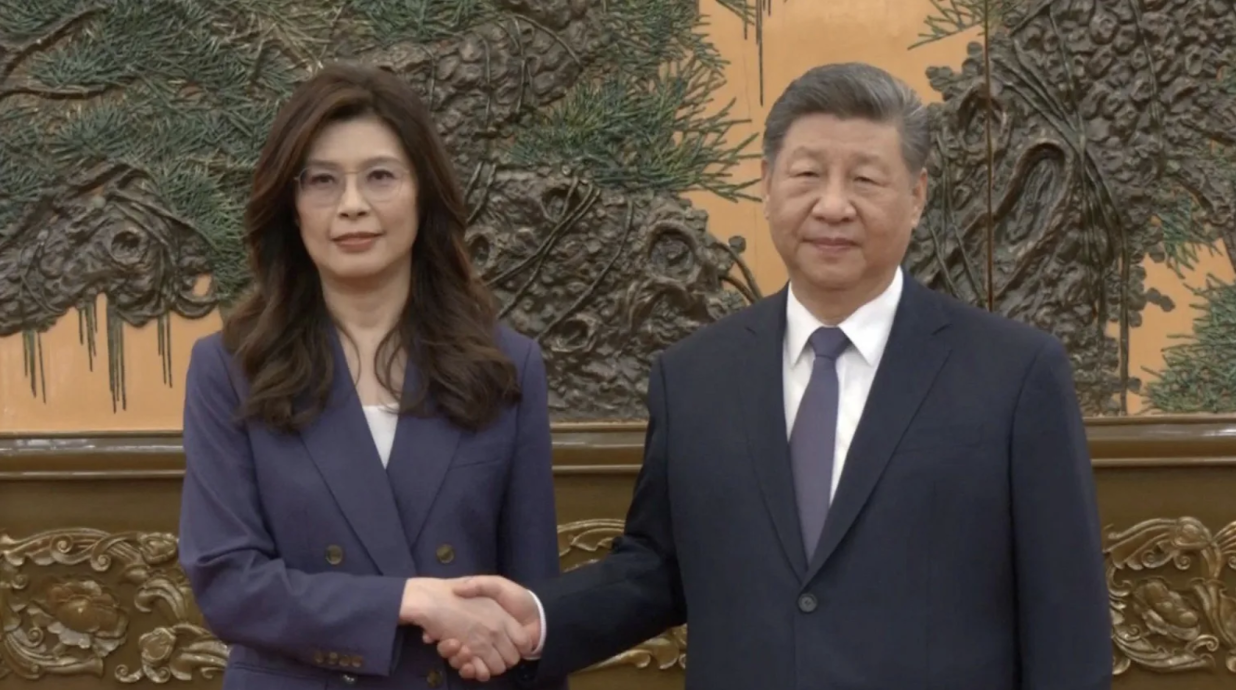
Amidst a world with much war and conflict currently occurring, on Friday, April 10th, 2026, Xi Jinping met Taiwan’s opposition leader of the Nationalist Party, Cheng Li-wun, for the first time in a decade, with the goal of finding common ground and working towards building peace. This follows China’s long-time refusal to hold communications with Taiwan’s president, labelling him a separatist, which is what led to the meeting between Xi Jinping and Cheng Li-wun. This long-awaited meeting between Taiwan and China took 10 years to take place due to Beijing cutting off high-level communications with Taiwan after the ruling Democratic Progressive Party’s (DPP) Tsai Ing-wen became president in 2016, citing her refusal to endorse the concept of a single Chinese nation. Today, the DDP is among those who have criticized Cheng’s trip to China and accused her of being “subservient” to Beijing. While China continues to call for reunification and states it would “absolutely not tolerate” independence for Taiwan and has not yet discarded the possibility of taking it by force if necessary, Taiwan has no such desires and instead simply seeks peace.
Following the meeting, officials from China signaled a limited willingness to restore certain channels of communication, particularly those tied to trade, travel, and cultural exchange, suggesting that Beijing may be attempting a more strategic, incremental approach to influence rather than immediate escalation. However, this outreach remains highly conditional and politically calculated, as it bypasses Taiwan’s current leadership under its President Tsai Ing-wen and instead engages opposition figures like Cheng Li-wun, raising concerns about external interference in Taiwan’s democratic processes. Analysts note that while such engagements may temporarily ease tensions, they also deepen internal divisions within Taiwan, as the ruling Democratic Progressive Party continues to reject Beijing’s “one China” framework. Ultimately, the meeting underscores a broader geopolitical reality: while both sides publicly emphasize peace, their fundamentally opposing visions for Taiwan’s future, sovereignty versus reunification, remain unresolved, leaving the potential for both diplomatic progress and renewed conflict.
To fully understand the significance of these renewed efforts, it is essential to recognize the long and complex history of underlying tensions between China and Taiwan. The roots of this conflict trace back to the end of the Chinese Civil War in 1949, when the defeated Nationalist government, known as the Kuomintang, retreated to Taiwan after losing to the Communist forces led by Mao Zedong. Ever since then, Beijing has maintained that Taiwan is a breakaway province that must eventually be reunited with the mainland, while Taiwan has developed its own political system and evolved into a democratic society with its own distinct identity. Over the decades, relations have fluctuated between periods of cautious engagement and heightened tension, often depending on which political party holds power in Taiwan. This recent meeting with opposition figures reflects this historical pattern, as Beijing has traditionally found more common ground with the Kuomintang, which is more open to the idea of closer ties under a shared Chinese identity. As a result, current diplomatic gestures are not occurring in isolation, but rather as part of a decades-long struggle over sovereignty, identity, and the future of cross-strait relations.
Overall, the recent meeting between Xi Jinping and Cheng Li-wun represents more than a simple diplomatic reunion but reflects the enduring complexity of cross-strait relations shaped by decades of tension, historical division, and competing visions for each of their respective futures. While renewed communication and limited cooperation may suggest a step toward stability, the underlying disagreements between China and Taiwan remain deeply rooted. As both sides continue to navigate this delicate relationship, the challenge will be finding a path that preserves peace without compromising political autonomy or democratic values. Ultimately, whether these efforts lead to meaningful progress or simply prolong the status quo will depend on the willingness of both parties to engage not only strategically, but also genuinely, in addressing the core issues that have defined their relationship for generations.
***
This article was edited by Abigail D’Angelo.
 Abby Coxe
  Campbell Brown
  Holmes Wormald